Bring Your Own LLM: Enterprise Guide to Models and Control
What bring your own LLM means for enterprise voice and chat agents: when it pays off, what it costs, how to govern it, and how to deploy it on-prem or in cloud.
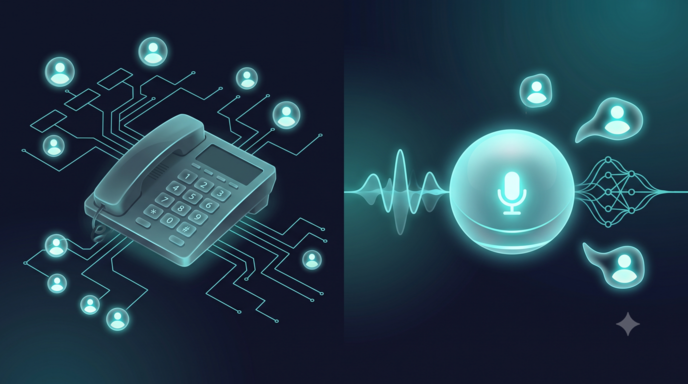
Bring your own LLM (BYO LLM, also called bring your own model) is an arrangement in which an organization connects a large language model it selects, licenses, or hosts to a vendor’s application layer, instead of using the model the vendor bundles by default. For enterprise voice and chat agents, the decision affects latency, data residency, cost at scale, and the audit trail, and it should be made against those four criteria rather than as a matter of preference.
This guide explains what the term covers, where self-hosting a model helps and where it does not, how to govern the result, and which questions to settle before a contact center commits.
TL;DR
- BYO LLM means the enterprise chooses the model endpoint, whether it is a hosted API under its own contract, a private deployment, or an on-premise model, while the platform handles channels, integrations, and workflow.
- In voice, the model’s time-to-first-token is the largest single latency contributor, and self-hosted models can deliver a more consistent response time than shared APIs.
- Self-hosting is rarely cost-effective at low volume; the economics depend on sustained peak concurrency, not on the hourly price of a GPU.
- Governance is the larger task: pair NIST’s risk-management structure with OWASP’s technical controls so that the program survives an audit.
- Regulated organizations should start from the deployment model (cloud, private cloud, or on-premise) and select the LLM inside that boundary.
What bring your own LLM means in practice
The phrase is used in several ways, and the differences matter when requirements are written.
Bring your own key (BYOK). The organization keeps its existing contract with a model provider and supplies its credentials to the application. GitHub documents this pattern for Copilot, where an existing provider can be used to save costs or consolidate billing, including models that the customer runs itself.
Bring your own endpoint. The organization points the application at a model endpoint it operates. Reltio’s documentation for AgentFlow describes this as using the customer’s own LLM endpoints in place of the vendor-managed default.
Bring your own model, fully self-hosted. The weights run on infrastructure the enterprise controls, in a private cloud or a data center. This is the pattern behind searches for on-prem LLM deployment and on-prem generative AI, and it offers the most control at the highest operating burden.

All three share one principle: the application layer and the model layer are separable. The application layer includes channel handling, telephony, CRM integration, conversation flow, and reporting. The model layer supplies language understanding and generation. Separating them lets an enterprise change the model without rebuilding the contact center around it.
Why enterprises ask for it
Four motivations recur in enterprise evaluations.
- Data control. Customer conversations in banking, insurance, healthcare, and collections contain regulated personal and payment data. Keeping inference inside a defined boundary simplifies data-residency and retention answers.
- Consistency of response time. Voice conversation tolerates very little delay, and shared APIs can vary from one request to the next.
- Cost predictability at volume. Per-token or per-minute pricing from a bundled provider is convenient at low volume and can become the largest line item at high volume.
- Model governance. A regulated organization may need to pin a model version, test it against its own evaluation set, and retire it on its own schedule instead of on the provider’s.
Each motivation can be tested with numbers, which the following sections do.
Latency: where the model choice shows up in a voice call
A voice agent built as a cascade runs speech-to-text, the language model, and text-to-speech in series. According to formal analysis of cascaded voice agents, this design is cheaper, more auditable, and easier to equip with tools than native speech models, but it produces a perceptible silence between the caller’s utterance and the agent’s reply.
The same paper’s guidance is that practitioners should treat roughly 800 ms mouth-to-ear as the design center, since conversational fluidity degrades significantly beyond 1,200 ms and breaks down past 1,300 ms. Streaming the stages in parallel can bring time-to-first-audio to about 755 ms, whereas a non-streaming pipeline can reach about 1,600 ms.
Within that budget, the language model is the largest variable. A production orchestration playbook identifies the model’s time-to-first-token (TTFT) as the most significant contributor to overall latency. It reports that a bundled API model varied from 700 ms to 1.5 s, while a self-hosted Llama-3-8b model offered a steadier TTFT of about 300 ms.
| Pipeline stage | Hosted API | Self-hosted on dedicated GPUs |
|---|---|---|
| Speech to text | ~250 ms time to first byte | ~110 ms time to first byte |
| Language model | 700 ms to 1.5 s TTFT | ~300 ms TTFT |
These figures come from a GPU deployment comparison published in August 2026, and they describe one vendor’s test setup. They should be read as an indication of order of magnitude, not as a guarantee. An enterprise should measure its own model, its own prompts, and its own network path before it commits.
The practical conclusion is that predictability matters as much as the average. A model that answers in 300 ms every time is easier to design around than one that averages less but occasionally takes 1.5 s, because the occasional slow turn is the one the caller notices. The client’s analysis of sub-second voice AI for regulated centers addresses the orchestration side of the same problem.

Cost: the utilization floor
Self-hosting is often assumed to be cheaper. The evidence is more conditional. Cerebrium’s analysis states that self-hosting LLMs for voice agents is rarely cost-effective until an organization passes a utilization floor. In its example, a single A10 GPU instance at about $1.44 per hour sustains 160 to 180 concurrent conversations, for a net cost near $0.029 per minute. Low-volume deployments, however, typically pay a premium compared with bundled pay-as-you-go APIs.
The determining factor is peak concurrency, not the hourly rate. Capacity must be provisioned for the busiest period, so a contact center with a sharp morning peak and a quiet afternoon pays for the peak all day unless it scales capacity down.
A useful way to test the case is to answer five questions.
- What is the maximum number of simultaneous conversations in a normal peak, and in a seasonal peak?
- How many hours per day does the deployment run near that peak?
- Who will operate the model: patching, scaling, monitoring, and version upgrades?
- What is the cost of the engineering time to own each integration boundary?
- Which requirements, such as data residency, would force self-hosting regardless of cost?
The playbook cited above frames the trade-off plainly: bundled components suit teams that prioritize shipping fast with one vendor, while assembling components yourself suits teams that need to swap models freely and have the engineering time to own each boundary. If question 5 produces no hard requirement and question 1 produces a low number, a bundled model is usually the more economical start.
Deployment options: choosing the boundary first
For regulated organizations the model is rarely the first decision. The deployment boundary comes first, and the model must fit inside it.
| Option | Data control | Operating burden | Typical fit |
|---|---|---|---|
| Cloud, vendor-managed model | Defined by contract | Lowest | Fast starts, moderate regulation |
| Cloud, customer-supplied model endpoint | Shared; model under customer contract | Moderate | Organizations with an existing model agreement |
| Private cloud | High | Moderate to high | Strict residency, dedicated capacity |
| On-premise | Highest | Highest | Air-gapped or sovereign requirements |
VOICERAcx supports cloud, private cloud, and on-premise deployment, so the boundary can be chosen according to the regulatory position of each workload and not according to the limits of the product. A detailed comparison of the trade-offs is available in the analysis of cloud versus on-prem contact center deployment for regulated organizations.
Governance: what a bring your own model program must document
Choosing the model also means assuming accountability for it. Governance, as one enterprise reference defines it, is the system of policies, controls, roles, workflows, documentation, and oversight used to ensure AI is developed, bought, deployed, monitored, and retired responsibly. A bring-your-own arrangement shifts several of those duties to the customer.
Two frameworks, two jobs
Practitioners describe the NIST AI 600-1 Generative AI Profile as an instrument of organizational risk management and not technical remediation: it supplies the accountability and documentation structure that auditors and boards expect. The OWASP Top 10 for LLM Applications covers the attack surface. Neither replaces the other, and a credible program maps one onto the other, pairing NIST’s Govern, Map, Measure, and Manage functions with OWASP’s specific controls.
The OWASP Top 10 for LLM Applications 2026 lists, among others, prompt injection (LLM01), sensitive information disclosure (LLM02), and excessive agency (LLM03). Each has a direct consequence for a customer-supplied model:
- Prompt injection. The customer’s own testing must cover direct input, retrieved content, and tool output, because the model’s behavior can be altered in ways the application developer did not intend.
- Sensitive information disclosure. Prompts, logs, and transcripts must be classified and retained according to policy, including those held at the model endpoint.
- Excessive agency. When an agent can call tools such as payment, account update, or refund functions, permissions must be scoped by role and every action logged.
A minimum control set
The following controls are the baseline for a regulated deployment:
- A written AI policy, approved by the same committee that approves access-control policy, with named owners and a review cadence, as described by governance practitioners.
- A model register recording which model and version serves which workflow, who approved it, and when it will be reviewed.
- Role-based access control over prompts, knowledge sources, and tool permissions.
- A control-mapping document linking NIST functions to OWASP controls.
- Complete conversation and decision logs that support audit and dispute resolution.
- A rollback path to the previous model version.
Observability for voice
Standard uptime monitoring does not detect the failures that matter in a voice channel. The orchestration playbook advises that operations leads should watch for barge-in errors, misaligned pronunciation, and subtle inaccuracies in output, and that a groundedness evaluation should accompany every production release. For a customer-supplied model this protocol is the change-control gate: no model swap reaches production until it passes the same evaluation set as its predecessor.
Security of the surrounding contact center, including payment data handling, is covered in the guide to mapping PCI and NIST to contact center security.
A decision path for enterprise teams
- Classify the workloads. Separate those that handle regulated data (collections, payments, health information) from general service inquiries.
- Set the boundary. Assign each class to cloud, private cloud, or on-premise deployment.
- Measure latency requirements. Define the response budget against the 800 ms design center and test candidate models in the real telephony path.
- Model the cost. Use peak concurrency, not average load, and include the staff cost of operating the model.
- Build the control map. Document NIST and OWASP alignment before launch, not after the first audit request.
- Pilot with an evaluation set. Run groundedness and voice-specific tests, then expand channel by channel.
Where VOICERAcx fits
VOICERAcx is an enterprise platform for AI voice and chat agents, omnichannel engagement across voice, WhatsApp, SMS, email, and web, and contact center automation. It integrates with CRM, telephony, and existing business systems, and it offers cloud, private cloud, and on-premise deployment with governance, analytics, and data control. Teams that want to see how that applies to regulated operations can review Vee Enterprise or the AI Voice Agents offering. For teams that want to evaluate on a smaller scale first, the published plans range from a Free plan at 0 USD per month to Basic at 199 USD per month, Standard at 249 USD per month, Advance at 399 USD per month, and Pro at 999 USD per month, with chat sessions at 0.18 USD per session. Whether a particular customer-supplied model can be connected is a scoping question that should be raised during an enterprise evaluation.
Our perspective
We regard the model as a replaceable component and the deployment boundary as the lasting architectural decision. Enterprises in regulated sectors are seldom asked by auditors which model they use; they are asked who approved it, where the data went, what the system was permitted to do, and whether the record can prove it. A platform that offers cloud, private cloud, and on-premise deployment, together with governance, analytics, and integration with CRM and telephony, gives those answers a place to live regardless of which model sits underneath.
We also consider it unwise to self-host a model before the utilization justifies it. The more productive early investment is the evaluation set, the control map, and the model register, because those assets transfer to any model the organization adopts later. Control over the model is valuable only when the organization can demonstrate control over its behavior.
— Voiceracx
FAQ
What is the difference between bring your own LLM and bring your own key?
Bring your own key means supplying credentials for an existing model provider account to an application. Bring your own LLM is broader: it also covers pointing the application at an endpoint the customer operates, or at a model the customer hosts entirely. The more control the arrangement gives, the more operating and governance responsibility moves to the customer.
Is self-hosting an LLM cheaper than using an API?
Only above a certain sustained volume. One analysis finds that low-volume deployments typically pay a premium over bundled pay-as-you-go APIs, and that cost is set by peak concurrent capacity instead of the GPU’s hourly rate. Model your own peak before deciding.
Does on-prem generative AI improve voice agent latency?
It can improve consistency. Reported figures show a self-hosted 8-billion-parameter model with a time-to-first-token near 300 ms, against 700 ms to 1.5 s for a bundled API. Results depend on hardware, prompts, and network path, so test in your own telephony environment.
Which frameworks should govern a customer-supplied model?
Use both NIST and OWASP. The NIST AI 600-1 Generative AI Profile gives the organizational risk-management and documentation structure, while the OWASP Top 10 for LLM Applications guides technical security testing. A control-mapping document that links the two is the usual basis for an audit-ready program.
Sources
- OWASP Top 10 for LLM Applications 2026
- Running an AI Call Center Voice Agent in Production: An Orchestration Playbook
- Pipecat Voice Agents: Which Stage Belongs on a GPU
- The Latency Floor of Cascade Voice Agents: Formal Bounds and Design Levers
- AI Governance, written by people who filed the paperwork
- AI Governance Frameworks Every Enterprise Should Understand
- Bring Your Own LLM for AgentFlow at a glance
- Bring your own key for GitHub Copilot