Customer Journey Orchestration: Sub 1s Voice AI for Regulated Centers
How regulated contact centers deploy customer journey orchestration: integration patterns, sub 1 second voice AI guidance, privacy forward deployments,...
Customer journey orchestration coordinates conversational customer interactions in real time across voice, chat, messaging, and agent handoffs, using live CRM and telephony data to automate service, sales, and collections. If you are evaluating this for a regulated enterprise, start narrow: scope a pilot around one measurable failure path, such as failed payments or repeated support calls, before attempting an organization-wide rollout.
TL;DR:
- Ensuring real-time data integration, such as CRM and telephony, is crucial for reducing repeat contacts and improving first-call resolution.
- Achieving sub-second response times in voice AI requires intelligent caching, parallel API calls, and pre-fetching customer information before interaction.
- Focused pilots on high-volume issues like failed payments or support calls can produce measurable results within six to ten weeks with minimal backend system connections.
- Deployment options must match data residency and compliance needs, with private cloud and on-premise solutions often preferred for regulated industries.
- Common orchestration risks include data leakage, latency spikes during peak loads, and breakage from backend schema changes, requiring strict governance controls.
What Is Customer Journey Orchestration in a Contact Center?
Customer journey orchestration is the operational layer that decides, in the moment, what happens next in a conversation, based on where the customer has already been. This is fundamentally different from journey mapping, which is a design-time exercise, a diagram of intended paths built before a single call happens. Orchestration runs live: it pulls context transfer, channel transitions, and proactive intervention directly into the interaction as it unfolds, which is why it functions as operational glue between decisions rather than a single decision itself.
The practical outcomes for regulated contact centers show up in a handful of operational metrics:
- Fewer repeat contacts, because the system remembers what a customer already tried
- Higher first-call resolution, since agents and AI voice agents inherit full context instead of starting cold
- Proactive deflection, such as pausing an outbound sales campaign the moment a support ticket opens
Those outcomes depend entirely on integration maturity. Orchestration cannot outrun the systems feeding it data.
What Technical Capabilities Should You Require for Orchestration?
Procurement teams evaluating orchestration platforms need a specific capability checklist, not a marketing overview. Five categories separate a genuinely operational platform from a rebranded IVR menu.
- Unified real-time customer context. The platform must carry identity, history, and intent across every channel a customer touches, including mid-conversation handoffs from a chatbot to a voice agent, as explained in omnichannel marketing strategies.
- Event stream processing. The system needs to detect journey events (a failed payment, an abandoned form, a repeat call) as they happen, not in a nightly batch job.
- Decisioning and next-best-action engines. Business rules combined with machine learning models determine what the customer sees or hears next, and that decisioning has to chain coherently across multiple touchpoints and time, not just resolve one moment in isolation.
- Channel delivery. Voice AI, chat, messaging, SMS, and email all need to hand off cleanly, with a full context pop to the agent desktop when a human takes over.
- Journey analytics. Ongoing measurement of FCR, repeat contact rate, and deflection is what turns a pilot into a defensible business case.
Pro Tip: Test decisioning under conflicting signals, not clean ones. A customer with an open support ticket and an active sales offer is the real-world case that exposes a shallow orchestration engine fast.
Which Architecture Patterns Meet Voice AI Latency and Compliance Requirements?
Sub-second response time is the hard constraint that most orchestration projects underestimate. Achieving under one second of total conversational latency requires intelligent caching, parallel API calls, and pre-fetching customer data before the agent or AI needs it, which is the actual mechanism that eliminates perceived lag in a live voice interaction.
Telephony integration sets the baseline for what is achievable:
- SIP trunk connections offer the most control over call routing and latency but require more upfront engineering.
- PBX adapters fit organizations with legacy infrastructure they cannot replace quickly.
- Cloud telephony APIs move fastest to deploy but shift some latency control to a third party.
On the data side, pre-fetching CRM records, indexed lookups, and read replicas let a caching layer like Redis serve customer context before a caller finishes stating their account number. Deployment choice then becomes a compliance decision as much as a technical one: cloud, private cloud, and on-premise options each carry different data residency and audit trail implications, and enterprise deployment guidance for regulated industries generally favors matching the deployment model to the strictest applicable regulation rather than the cheapest option.
Budget realistically. Integrations typically touch 8 to 12 backend systems, and enterprise pilots of moderate complexity often run 6 to 10 weeks and cost tens of thousands of dollars in initial integration work.
How Do You Plan and Run a Focused Orchestration Pilot?
A pilot that tries to cover every channel and every use case at once will stall in committee. Narrow scope is what makes the difference between a pilot that produces a go/no-go decision and one that produces a status update.
- Pick a high-volume failure path. Failed payment retries, appointment rebooking, or repeat support calls about the same issue all generate enough volume to measure quickly.
- Define the minimum integration set. Caller ID lookup, a CRM record pull, order or ticket status, and a basic event stream are usually enough for a meaningful MVP, without needing every backend system connected on day one.
- Staff it lean. A working pilot team typically includes one integrations engineer, one SRE for reliability, a contact center operations lead, and compliance sign-off before go-live.
- Set success gates in advance. Agree on the FCR lift or repeat-contact reduction that triggers a scale decision before the pilot starts, not after the results come in.
- Roll out in stages. Expand by channel or by customer segment once the pilot clears its gates, rather than flipping every use case live at once.
What KPIs Prove Orchestration Is Working?
The business case for orchestration rests on a small set of operational metrics, not a broad dashboard. Track first-call resolution, repeat contact rate, average handle time, deflection rate, automation coverage, and CSAT or NPS movement.
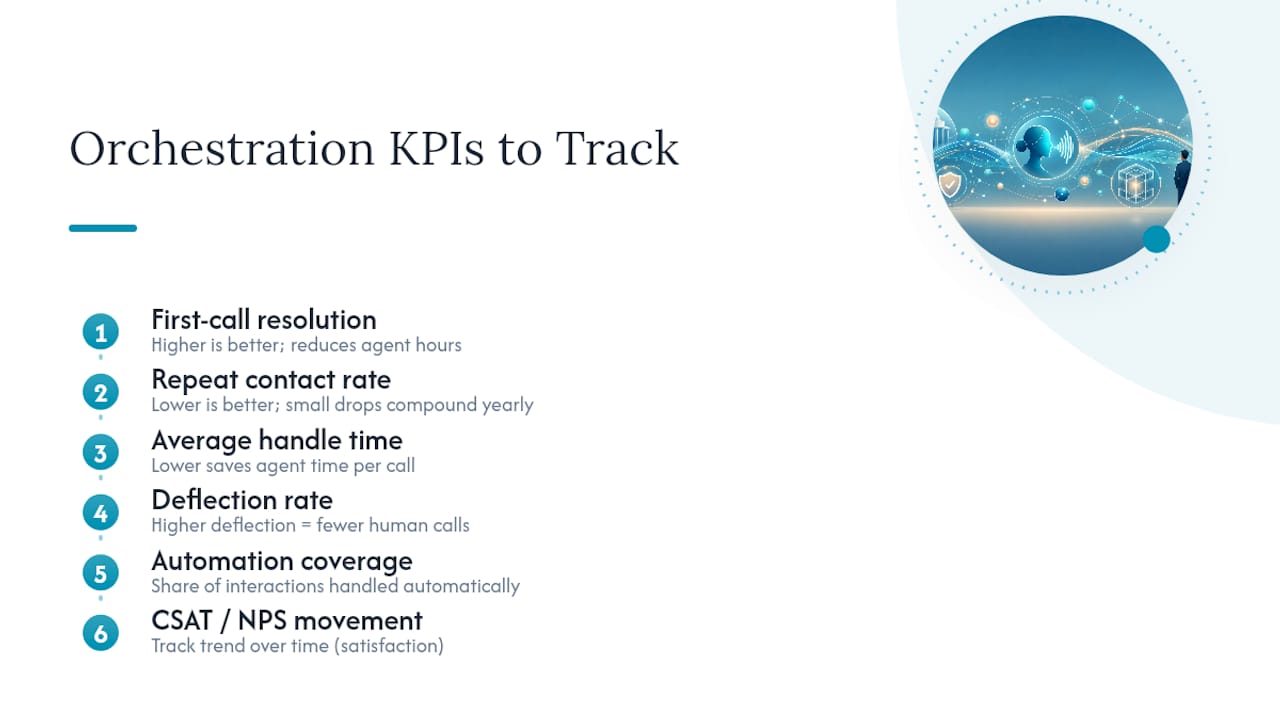
The ROI logic is straightforward once integration maturity is in place: orchestration’s value depends on integration quality, and improvements in FCR and deflection translate directly into fewer agent hours spent on calls that never needed a human in the first place. A contact center handling tens of thousands of monthly calls does not need a dramatic FCR shift to justify the platform. Even a modest reduction in repeat contact compounds across a full year of call volume.
Structure the ROI case in phases: measure the pilot’s narrow use case first, then project the same percentage improvement across adjacent use cases once the integration groundwork is reusable.
What Risks Should Regulated Organizations Watch For?
The most common orchestration failures are not exotic. They are data leakage across channels, retention policies that outlast their legal basis, latency spikes under peak load, and integrations that break the moment a backend system changes its schema.
Governance controls that address these directly include:
- Role-based access control on every system that touches customer context
- Data residency guarantees through private cloud or on-premise deployment where regulation demands it
- Encrypted call recordings and complete audit logs
- Explicit consent handling for any data reused outside the immediate interaction
Pro Tip: Run synthetic call tests against your integration layer before go-live. A brittle API dependency almost never shows up until real call volume hits it.
Voiceracx Perspective: What Actually Moves the Needle
Most orchestration failures trace back to sequencing, not technology. Teams integrate CRM and telephony last, after building decisioning logic, and then discover the context layer cannot keep pace. Integrate those two systems first. Choose a pilot that reduces repeat contacts specifically, since that metric is the fastest to move and the easiest to defend to a finance committee. For any organization uncertain about data residency obligations, a private cloud deployment shortens compliance review cycles considerably compared to starting in public cloud and migrating later.
— Voiceracx
See How Voiceracx Fits Your Orchestration Roadmap
Voiceracx replaces disconnected point solutions with one platform: voice and chat agents, InteractFlow orchestration, and telephony and CRM integrations that carry live context instead of losing it at every handoff.
Where most contact center stacks stitch together a voice vendor, a chat vendor, and a CRM connector as three separate procurement decisions, this platform runs orchestration, channel delivery, and integration through a single platform with cloud, private cloud, and on-premise deployment options. This approach benefits regulated organizations needing to manage data residency requirements without relying on third-party integrators after procurement.
If you are scoping the kind of pilot described above, the next step is a technical discovery call to map your telephony and CRM environment against Voiceracx’s contact center automation platform and define a realistic pilot timeline before you commit budget.
Sources
- What is Customer Journey Orchestration? | Definition from TechTarget
- Customer Journey Orchestration - WFM Labs
- Voice AI Integration: Connect Voice AI to CRM | AGIX Technologies
FAQ
What Is Customer Journey Orchestration?
It is the real-time coordination of conversational interactions across voice, chat, and messaging, using live customer context to trigger the most appropriate next action and reduce repeat contact.
How Is Orchestration Different From Journey Mapping?
Journey mapping is a design-time diagram of intended customer paths, while orchestration operates live, acting on real customer behavior as it happens.
How Long Does an Orchestration Pilot Typically Take?
Enterprise pilots of moderate complexity, touching 8 to 12 backend systems, typically run 6 to 10 weeks and can cost tens of thousands of dollars in initial integration work.
What Latency Should Voice AI Orchestration Achieve?
Under one second of total conversational latency is the target, achieved through caching, parallel API calls, and pre-fetching customer data before it’s needed.
Should Regulated Companies Use Cloud or On-Premise Deployment?
It depends on data residency and audit requirements; many regulated organizations start with private cloud, like the options Voiceracx offers, to shorten compliance review cycles before considering full on-premise deployment.