4–8 Week Launch: Operations First WhatsApp Chatbots for Enterprise
An operations-first guide to WhatsApp chatbots for enterprise. Learn Meta's 24 hour messaging window, template approvals, deployment models, and 4–8 week...
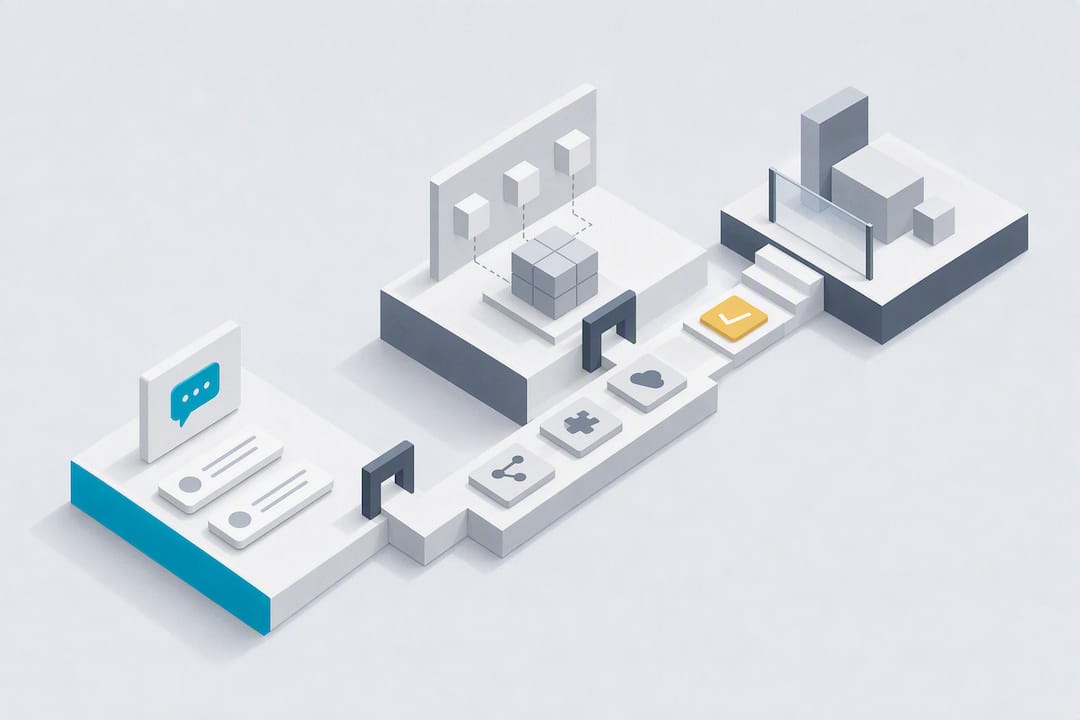
The right approach for most businesses is an API-backed AI chatbot deployed through a Business Solution Provider or an enterprise platform, rather than the free WhatsApp Business App. Scale requires the Cloud API, and every implementation must respect Meta’s 24-hour customer service window, template approval rules, and opt-in requirements. For regulated industries or high-volume operations needing tighter data control, an enterprise platform like Voiceracx is the more defensible long-term choice.
TL;DR:
- WhatsApp API-backed chatbots using Cloud API or enterprise platforms are essential for scalable, compliant automation, unlike the limited free WhatsApp Business App.
- Setting up a compliant WhatsApp chatbot requires creating a Meta app, verifying your business, handling webhook responses, and submitting templates for outside 24-hour messaging windows.
- Grounded AI chatbots with knowledge connectors, multichannel support, and native interactive features offer more reliable and personalized customer interactions.
- Costs involve Meta’s messaging fees—especially for templates outside the 24-hour window—and platform or AI processing charges, which can vary significantly based on usage.
- Deployment timelines often extend beyond engineering hours, typically taking four to eight weeks for mid-sized projects due to verification and approval processes.
What Are WhatsApp Chatbots and Which Setup Fits Your Business?
A WhatsApp chatbot is an automated system that sends and receives messages through WhatsApp using either the consumer Business App or the developer-facing WhatsApp Business Platform, commonly called the Cloud API. The distinction matters more than most guides suggest, because it determines whether you can scale past a few hundred conversations a day.
The WhatsApp Business App is free and works for a single phone, a handful of quick replies, and manual conversations. It has no real automation logic and caps out fast for any team fielding more than a trickle of inbound messages. The Cloud API, by contrast, is the foundation every serious automated WhatsApp messaging setup runs on. It exposes webhooks, supports multiple agents, and connects to a backend that can run rules or AI.
From there, businesses generally pick one of three paths:
- Direct Cloud API integration — full control, but you own the engineering, template submissions, and infrastructure.
- A Business Solution Provider (BSP) — a certified reseller layer that manages the API relationship, offers a visual builder, and typically speeds up template approval to 24 to 48 hours, compared with longer review windows for unmanaged direct access.
- An enterprise conversational AI platform — combines the API access with governance, CRM integration, and deployment flexibility that regulated businesses need.
Rule-based bots still have a place for simple menu navigation, but they break down the moment a customer phrases a question in a way the decision tree didn’t anticipate. A grounded AI chatbot that reads your help center and past support tickets handles that long tail far better, because it produces natural-language answers from real content instead of matching preset branches. For most small and mid-sized teams, a BSP with a visual builder is faster to launch than direct API work; enterprises with compliance obligations tend to prefer private-cloud or on-premise deployment for the auditability it provides.
How Do You Set Up a Compliant WhatsApp Business Chatbot?
Every WhatsApp bot integration, regardless of vendor, sits on the same Meta-defined foundation. Skipping or misunderstanding these rules is the single most common cause of delayed launches.
- Create a Meta app and add the WhatsApp product. You’ll retrieve a Phone Number ID and an access token, the two credentials that authenticate every message you send.
- Configure and verify your webhook. Meta sends a verification request to your endpoint with a token you define; your server must confirm it before any messages will flow.
- Acknowledge every incoming webhook immediately. Respond with an HTTP 200 before running any expensive logic. Meta retries deliveries if it doesn’t get a fast acknowledgment, which causes duplicate messages if your system processes the same event twice.
- Complete business verification through Meta Business Manager. Unverified accounts face lower messaging limits and slower template approval.
- Respect the 24-hour customer service window. Once a customer messages you, you can send free-form replies for 24 hours. After that window closes, only pre-approved message templates go through.
- Submit templates for approval covering any messaging you’ll need outside that window: order updates, appointment reminders, re-engagement.
Meta also offers Meta Business Agent, a tool that lets businesses chat with customers and manage some automation directly inside Meta’s own interface. It’s convenient for smaller operations that want to avoid building custom infrastructure, but it trades away the deeper integration control, custom logic, and data governance that a dedicated platform provides. Businesses with CRM systems, multi-agent handoff needs, or compliance requirements generally require more advanced platforms than this tool can provide.
Pro Tip: Never run your AI response generation or database lookups inside the webhook handler itself. Acknowledge with 200 OK first, then hand the actual work to a queue or background job. This single architectural choice prevents most of the duplicate-message bugs that plague early WhatsApp bot integrations.
What Features Should You Evaluate in a WhatsApp Chatbot?
Not every platform marketed as a “chatbot for WhatsApp” solves the same problem. The features that separate a genuinely useful automated WhatsApp messaging deployment from a brittle demo tend to fall into five categories.
Grounding and knowledge connectors. The chatbot’s answers are only as good as what it can reference. Look for connectors to your knowledge base, historical support tickets, and product catalogs, because grounded responses reduce the hallucinated or generic answers that erode customer trust fast on a channel as personal as WhatsApp.
Multichannel integration and handoff. A chatbot that can’t push context into your CRM or route a frustrated customer to a live agent with full conversation history creates more friction than it removes. Evaluate how cleanly the platform connects to telephony, email, and analytics systems, not just WhatsApp in isolation.
Interactive message support. WhatsApp’s platform supports reply buttons, list messages, and call-to-action URL buttons, along with template messages that accept positional variables for personalizing outbound notifications. A platform without native support for these formats forces customers back into typing free text for choices that should be a single tap.
Escalation logic and agent inbox quality. The best implementations automate the predictable questions first, order status, FAQs, and hours, while escalating refunds and billing disputes to a human. Check whether the agent inbox surfaces full conversation context or forces agents to start cold.
Deployment control and rate limits. Cloud-only platforms are the fastest to launch. Private cloud and on-premise options exist for businesses that need to keep conversation data inside their own security perimeter, a distinction that matters enormously for healthcare, finance, and government use cases.
A quick checklist to bring into vendor conversations:
- Does it ground responses in your actual content, or rely on generic training data?
- Can it hand off to a human agent without losing conversation history?
- Does it support WhatsApp’s native interactive message formats?
- What deployment models are available, and who controls the data?
- How does it handle Meta’s per-number messaging rate limits as you scale?
How Much Does a WhatsApp Chatbot Cost?
Costs stack in two distinct layers, and most budget surprises come from businesses accounting for only one of them.
The first layer is Meta’s own messaging fees, charged per delivered template outside the 24-hour window, plus fees tied to certain message categories. Meta has moved from a per-conversation pricing model toward per-delivered-message pricing for templates, with additional category-specific changes taking effect through 2026. Businesses running high template volumes, order confirmations, shipping alerts, appointment reminders, need to model this carefully because it scales linearly with conversation volume.
The second layer is platform and AI processing cost: what you pay the software running your chatbot logic, plus any AI or token costs if you’re using a large language model to generate responses. Vendors bill this differently, some by subscription tier, some per resolved conversation, some per seat, and the gap between the cheapest and most expensive model at high volume can be substantial.
Watch for a few things vendors don’t always volunteer:
- Whether “per conversation” or “per message” pricing applies to your dominant use case.
- Whether AI token costs are bundled into the subscription or billed separately as usage grows.
- Whether there’s a minimum seat count or contract length that doesn’t match your actual volume.
Voiceracx structures its chat automation around a transparent per-chat-session fee of $0.18 on top of tiered plans, which gives operations teams a cleaner way to forecast spend than bundled per-conversation pricing that shifts with Meta’s own policy changes.
What Does a Realistic Implementation Timeline Look Like?
Most teams underestimate calendar time, not engineering time. The actual build work for a working chatbot typically runs 20 to 40 hours, but Meta’s verification and template approval steps stretch the total project timeline well beyond that.
- Secure your phone number and Business Manager account. This has to happen before anything else, and verification alone can take several business days.
- Complete business verification and submit initial templates. Template rejections are common on the first pass, usually for vague variable text or promotional language disguised as a utility message.
- Connect your knowledge sources. Wire the chatbot to your help center, product catalog, or CRM so it can ground answers instead of guessing.
- Design the welcome flow and escalation paths. Decide up front which intents get automated and which route straight to a human.
- Test against edge cases before launch. Simulate customers who go silent for 23 hours, then message back, testing whether your system correctly reopens the free-form window.
- Publish and monitor closely for the first two weeks. Watch deflection rate, average response time, and resolution rate daily, not weekly, while you tune flows.
Pro Tip: Build your test plan around the 24-hour window edge case specifically. Most launch-week bugs come from templates firing when a free-form reply should have gone out, or vice versa, not from the AI logic itself.
Expect four to eight weeks from kickoff to stable production for most mid-sized deployments, with BSP-managed template approval windows of 24 to 48 hours shaving real time off the schedule compared with unmanaged direct API submissions.
What Compliance and Data Controls Matter Most?
WhatsApp chatbot governance isn’t optional infrastructure. It’s the difference between a deployment that survives an audit and one that creates liability.
Consent has to be explicit and logged. Customers must opt in before receiving template messages outside an active conversation, and that opt-in record needs to be retrievable if a regulator or a customer disputes it later. Message retention policies should be defined before launch, not discovered during an incident, since WhatsApp conversations often contain personal and financial details that fall under data protection obligations depending on your jurisdiction and industry.

For regulated sectors, deployment model is the real governance decision. A private cloud or on-premise deployment keeps conversation data inside infrastructure your business fully controls, which matters for healthcare, financial services, and public sector use cases where a third-party cloud processor introduces unacceptable risk. Cloud-hosted platforms are faster to launch, but the tradeoff is real.
A few non-negotiables worth building into any WhatsApp business automation rollout:
- Full audit trails covering every automated decision and every human handoff.
- Defined escalation rules for sensitive categories: refunds, medical questions, legal disputes, credential resets.
- Documented data residency commitments from your vendor, not just a general privacy policy.
- Clear service-level agreements covering backup frequency and recovery time.
None of this replaces legal review specific to your industry and jurisdiction, but it’s the baseline any enterprise deployment should meet before go-live.
When Does an Enterprise Platform Beat a Standard BSP?
Speed and cost favor BSPs for most straightforward deployments, and there’s no argument against that for a business running a single support use case with modest volume. The tradeoff appears once volume climbs, integrations multiply, or compliance obligations enter the picture.
The decision between a BSP and an enterprise conversational AI platform hinges less on company size and more on traits like regulatory exposure, integration depth, and message volume. A business managing thousands of daily conversations across WhatsApp, voice, and email, with CRM and telephony systems that all need to stay in sync, runs into the limits of a lightweight BSP builder fast. So does any organization that needs private cloud or on-premise deployment to satisfy an internal security team or an external auditor.
The businesses that get the most value from an enterprise conversational AI platform are the ones already juggling multiple channels and multiple compliance frameworks at once, not the ones just testing whether automation works.
— Voiceracx
Deploy WhatsApp Automation with Enterprise-Grade Control
Some platforms offer regulated and high-volume businesses private cloud and on-premise deployment options paired with AI grounding and CRM integration that makes cloud-only bots useful. That combination matters most for operations teams who need WhatsApp automation that satisfies both a compliance officer and a customer experience director.
The AI Chat Agents product line handles the conversational layer, grounded in your knowledge base and connected to live agent handoff, while InteractFlow orchestrates the workflow logic across WhatsApp, CRM, and telephony so nothing gets stuck in a channel silo. For organizations that need full infrastructure control, Vee Enterprise extends that same automation into private cloud or on-premise environments built for auditability. Pricing runs on transparent per-chat-session fees on top of tiered plans detailed on the Voiceracx plans page. If your team is evaluating WhatsApp business automation for anything beyond a single use case, request a demo and walk through your specific compliance and volume requirements with the Voiceracx team.
Where to Learn More About WhatsApp Business Automation
The rules governing WhatsApp chatbots come directly from Meta, and the technical guides below fill in the implementation details official documentation tends to leave sparse.
- WhatsApp Help Center: Meta Business Agent covers the 24-hour customer service window and template rules directly from Meta.
- Chat SDK’s WhatsApp adapter documentation walks through Cloud API credentials and setup steps.
- The Node.js Cloud API guide explains webhook acknowledgment and duplicate-delivery prevention in practical detail.
- eesel AI’s cost and tooling breakdown covers current pricing shifts and vendor billing models for 2026.
- For measuring how AI-driven channels convert, Cairrot’s guide to tracking AI conversions offers a practical setup for GA4 and Search Console attribution.
Sources
- Chat SDK — WhatsApp adapter / official documentation
- Building a WhatsApp Chatbot — Node.js guide
- About using Meta Business Agent to chat with customers — WhatsApp Help Center
- WhatsApp chatbot for business: costs, limits, and tools in 2026 | eesel AI
FAQ
What Is the Best Chatbot for WhatsApp?
There’s no single best option. It depends on volume and compliance needs: a BSP with a visual builder suits most small and mid-sized businesses, while an enterprise platform like Voiceracx fits regulated or high-volume operations that need private cloud deployment and deep CRM integration.
How Can You Tell If Someone on WhatsApp Is a Bot?
Automated accounts typically respond instantly regardless of time of day, offer structured menu options or quick-reply buttons, and often disclose their automated status in the first message per Meta’s business messaging guidelines. Inconsistent response speed or a sudden shift from instant replies to a delay usually signals human handoff.
How Do You Use a Chatbot in WhatsApp?
Businesses build WhatsApp chatbots on the Cloud API, connecting a Meta-verified phone number to backend logic that reads incoming webhooks and sends replies through the same API. Customers interact with it exactly as they would a regular WhatsApp contact, without installing anything extra.
How Much Does a WhatsApp Chatbot Cost?
Costs split between Meta’s own per-message and template fees and the software platform running your automation logic. Voiceracx prices its chat automation at $0.18 per chat session on top of tiered subscription plans, giving businesses a predictable way to forecast spend as volume grows.