85–95% Match Rate: Practitioner Build Plan for Unified Customer Profiles
Practical playbook to build unified customer profiles: six CDI steps, identity-resolution targets (85–95% match rate), and Voiceracx deployment advice for...
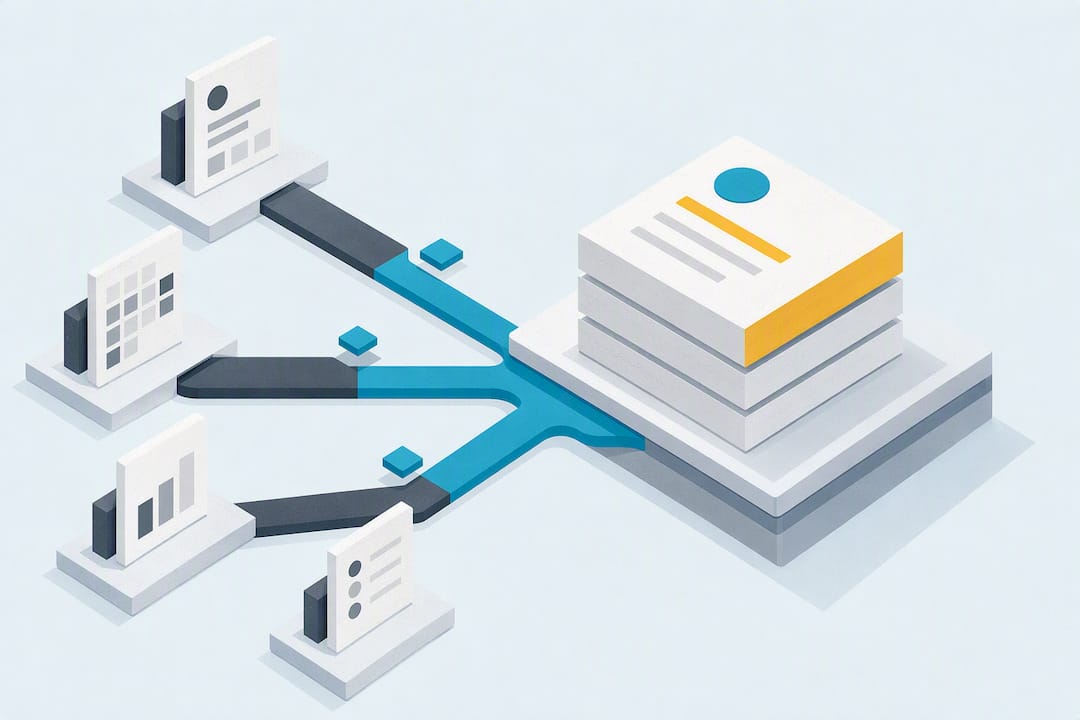
A unified customer profile is a continuously updated, single operational record that consolidates a person’s identity, transactions, and behavior across every channel. It pulls first-party, zero-party, and select third-party data into one accessible view, replacing the scattered records that live in a CRM, a support desk, and a marketing platform. The payoff is direct: personalization at scale, faster agent resolution, and analytics teams that can actually trust.
TL;DR:
- Profile automation should focus on high-confidence data sources like first-party and zero-party, with third-party data scrutinized and verified.
- Building real-time, continuously updated profiles requires robust identity resolution, layering deterministic and probabilistic matching protocols.
- Using a customer data platform is ideal for marketing activation, while a warehouse-based approach benefits analytics; hybrid architectures suit organizations needing both.
- Compliance entails encryption, access controls, and audit logs, with regulations like GDPR and CCPA demanding strict consent management and regular permission reviews.
- Achieving an 85-95 percent match rate is essential, with ongoing reviews needed to prevent drift, false merges, and stale profiles that compromise personalization and trust.
What Is a Unified Customer Profile Made Of?
A unified customer profile is only as useful as the data feeding it. The core work is deciding which attributes earn a permanent place in the record and which stay in source systems as reference data. Get this wrong and you end up with a bloated profile nobody trusts or a thin one that can’t support real personalization.
Most mature profiles are built from four data layers, each serving a distinct purpose:
- Identity data: email addresses, phone numbers, customer IDs, loyalty numbers, and device identifiers. These are the anchors identity resolution depends on, so prioritize the ones your systems capture most consistently.
- Transactional and behavioral records: orders, cart activity, session history, and support tickets. This layer shows what a customer actually does, not just who they are.
- Engagement data: email opens, click paths, messaging threads, call transcripts, and loyalty point balances. Voice and chat transcripts in particular carry intent signals that structured fields miss entirely.
- Custom fields and derived attributes: churn scores, lifetime value estimates, and preference tags computed from the other three layers.
Trustworthiness varies by source. First-party data (what a customer tells you directly through a purchase or a form) carries the highest confidence. Zero-party data (preferences a customer explicitly shares, like a stated product interest) is nearly as reliable because it’s volunteered rather than inferred. Third-party data, sourced from external providers, deserves the most scrutiny. It can fill gaps, but it should never override a deterministic match built from your own systems. Terminology gets muddled here, too. Single Customer View, Customer 360, and Unified Customer Profile are often used interchangeably, but they differ in emphasis: SCV focuses on aggregation, while a unified profile increasingly implies real-time updates feeding AI-driven interactions.
Why Do Unified Customer Profiles Matter for the Business?
The technical work only matters if it changes outcomes teams can measure. A unified customer profile turns fragmented records into decisions your marketing, support, and analytics teams can act on the same day data arrives, not weeks later after a manual reconciliation.
Personalization at scale is the most visible benefit. When an agent or an AI voice bot can see a customer’s last three interactions instantly, the conversation shifts from “how can I help” to solving the actual problem. Faster agent resolution follows naturally: support staff stop asking customers to repeat account details already sitting in six other systems. Reduced duplicate ad spend shows up when marketing suppresses churned or already-converted customers from acquisition campaigns instead of paying to re-acquire them. And improved analytics and attribution happen because a single source of truth stops three departments from reporting three different revenue numbers.
Brands using unified customer profiles have reported order value increases of up to 20%, a signal that consolidated data translates directly into commercial lift, not just cleaner dashboards.
Concrete use cases include:
- Personalized customer journeys triggered by real-time behavior, not last month’s segment.
- Agent desktop enrichment that surfaces chat and voice context before a call even connects.
- Churn prediction models that flag at-risk accounts using engagement decay signals.
- Suppression and orchestration rules that prevent conflicting offers across channels.
How Do You Build a Unified Customer Profile?
Building a durable profile is a Customer Data Integration (CDI) exercise: extract records from every silo, standardize them, resolve identities, and load the result into a system teams can query in real time, aligning with omnichannel marketing’s unified customer experience. Here’s the sequence that holds up in production, not just in a whiteboard diagram.
- Inventory sources and prioritize attributes. List every system holding customer data (CRM, e-commerce platform, support desk, telephony, loyalty program) and rank which fields actually drive a decision. Not every attribute deserves a place in the unified record.
- Ingest the data. Choose batch extraction for low-volume, low-urgency sources and streaming or change-data-capture (CDC) for systems where a stale record causes real harm, like a support queue or an active sales conversation.
- Normalize and cleanse. Standardize date formats, phone number formatting, and name casing before any matching logic runs. Dirty inputs guarantee dirty matches downstream.
- Run identity resolution. Apply deterministic matching first, using exact matches on email, phone, or a shared customer ID. Fall back to probabilistic matching, which scores similarity across multiple fields, for the records deterministic rules miss. Define your match hierarchy and confidence thresholds before you start, because changing that logic later forces a costly reprocessing of already-merged IDs.
- Consolidate and enrich. Merge matched records into one profile and layer in derived attributes like predictive scores or lifetime value estimates.
- Activate and close the loop. Push the profile to the systems that use it (marketing automation, contact center, analytics) and make sure activation events flow back in, so a completed purchase or a resolved support ticket updates the record automatically.
Assign clear ownership before you launch. A data steward should own match-rule accuracy and field-level definitions, while a technical owner handles pipeline reliability and connector health. Skipping this step is how profiles quietly go stale within a quarter. Build a rollback plan too. If a new matching rule starts merging unrelated customers, you need a way to unwind those merges without rebuilding the entire dataset.
Pro Tip: Run new identity-resolution rules in shadow mode against production data for at least two weeks before switching them live. Comparing shadow-mode match rates against your current rules catches false merges before they reach a customer-facing agent.
Manual deduplication works for a spreadsheet of a few thousand rows. It falls apart the moment record counts move into the millions, which is exactly when automated cleansing rules and a dedicated steward stop being optional.
Which Architecture Fits Your Unified Profile Strategy?
The right architecture depends on whether your priority is marketing activation, deep analytics, or both. Three patterns dominate current implementations, and each comes with real trade-offs.
- CDP-first: A customer data platform simplifies activation for marketing teams, pushing segments to ad platforms and messaging tools with minimal engineering overhead. It’s fast to launch but can struggle with complex analytical queries.
- Warehouse-first: Building the unified profile inside a data warehouse favors analytics depth and machine learning experimentation, since data scientists get direct query access. It typically demands more engineering investment to expose that data to non-technical teams for activation.
- MDM-led hybrid: Master data management platforms anchor the identity layer while feeding both a CDP and a warehouse downstream. This suits organizations with strict governance requirements but adds coordination overhead across teams.
Whichever pattern you choose, reliable CDI has to sit upstream of all three, because a warehouse or CDP built on inconsistent source data just produces inconsistent profiles faster.
Real-time needs push most enterprise deployments toward streaming and CDC rather than nightly batch jobs, particularly for contact centers where an agent needs the last five minutes of activity, not last night’s snapshot. Integration points matter just as much as the core architecture. A cloud contact center platform needs live connections to CRM, telephony, and voice systems, while analytics and activation endpoints need their own dedicated pipelines. Schema drift and fragile source connectors are the quiet killers of long-term stability. Build monitoring for both from day one, not after the first outage.
What Governance and Compliance Does a Unified Profile Require?
Consolidating customer data into one record raises the regulatory stakes, since a single breach or misuse now exposes everything about a person in one place. GDPR and CCPA both require documented consent and clear data provenance, meaning you need to know exactly where every field originated and under what permission it was collected.
The technical controls that satisfy those requirements are well established:
- Encryption at rest and in transit for every profile store and pipeline stage.
- Role-based access control (RBAC) that limits who can view or export full profiles.
- Immutable audit logs recording every access, edit, and merge event.
- Consent and preference records tied directly to each profile, not stored separately.
Operational policy matters as much as the technical layer. Unified profiles must incorporate consent records, provenance, and audit trails to meet regulatory expectations, but that only works if retention schedules and deletion workflows are actually enforced on a schedule, not left as a one-time setup task. Regular access reviews should confirm that RBAC permissions still match current job roles, since permission creep is one of the most common audit failures.
Pro Tip: Treat every profile as a living record, not a completed migration. Regulated industries in particular need continuous stewardship, since an audit trail with a six-month gap raises more questions than it answers.
How Do You Measure Whether Your Unified Profile Is Working?
A unified profile program needs its own scoreboard, separate from the business KPIs it eventually influences. Five metrics matter most:
- Profile coverage: the percentage of customer records that include the key identifiers needed for matching and activation.
- Match rate: how often identity resolution successfully links records that belong to the same person.
- Duplication rate: the share of profiles that turn out to be unresolved duplicates.
- Time-to-update: how long it takes a new interaction to appear in the unified record.
- Downstream lift: measurable change in conversion, CSAT, or resolution time once teams start using the unified data.
A useful working target is a match rate between 85% and 95%, with anything below that range signaling that your matching rules need revisiting before you scale activation further.
Most failures trace back to a handful of recurring pitfalls. Bad matching rules, set once and never revisited, quietly degrade as customer behavior changes. Siloed ownership, where no single team is accountable for profile accuracy, lets stale enrichment pile up unnoticed. Over-reliance on third-party data introduces noise that a deterministic match from your own systems would have avoided. The mitigation for all three is the same: a recurring steering review where a data steward audits match-rate trends and flags drift before it reaches production dashboards.
How Does Voiceracx Approach Unified Profiles in Contact Centers?
Omnichannel AI agents are only as personalized as the profile behind them. When a voice agent or chat bot can pull a customer’s order history, support history, and stated preferences into the same conversation, it resolves issues in one pass instead of transferring a customer between systems. Voiceracx’s approach to conversational AI turning raw customer data into CX strategy reflects that same logic.
Deployment model matters as much as the data model for regulated industries. A few points worth weighing:
- Cloud deployment suits organizations prioritizing speed of rollout and lower infrastructure overhead.
- Private cloud gives regulated businesses dedicated infrastructure while retaining cloud-style scalability.
- On-premise deployment keeps profile data entirely within an organization’s own network, which matters for institutions under strict data-residency rules.
The deployment decision should follow your compliance requirements, not the other way around.
Should You Aim for One Golden Record or Multiple Interoperable Views?
A single golden record makes sense when your systems are few, your match confidence is high, and one team owns the data end to end. Once complexity grows, pursuing a perfect single record often costs more than it returns, and multiple interoperable, context-specific views serve teams better. Target an 85 to 95 percent match rate and revisit rules quarterly. Ask three questions before committing: How many source systems genuinely need real-time sync? Does one team have clear ownership? Can your match logic hit that threshold without excessive false merges? If the answer to any is no, build interoperable views first.
— Voiceracx
Put Your Unified Profile to Work Across Every Channel
A unified profile only pays off once it reaches the conversation itself, and that’s where Voiceracx focuses. InteractFlow consumes unified profile data to personalize interactions across voice, chat, WhatsApp, SMS, and email in real time, while AI voice agents and AI chat agents draw on that same record to route conversations with full context instead of starting cold.
Enterprise IT and customer experience leaders running regulated or multi-channel operations get the most from this setup, as it supports cloud, private cloud, and on-premise deployment options for teams that require strict data control. Contact center automation built on a unified profile means agents and AI systems work from the same record instead of reconciling conflicting histories mid-call. If your organization is ready to see how that plays out with your own data, request a walkthrough of Voiceracx’s contact center platform and map it against your current profile architecture.
Sources
For CDI mechanics, see Fivetran’s guide. For terminology clarity, see CDP.com’s glossary. For hands-on setup, see Microsoft’s training module.
- Customer data integration (CDI): Types and benefits — Fivetran
- What Is a Unified Customer Profile? How to Create One — Shopify Enterprise
- Cdp
Recommended
- The New Standard in Customer Experience: Proactive, Predictive, Personalized
- The Cloud CX Advantage: Migrating Customer Experience to the Cloud for Agility and Scalability
- Voice of the Customer: Building a VoC Strategy That Drives CX Growth
- Enterprise Conversational AI Platform for Regulated Industries