RAG vs Fine-Tuning: How Enterprises Should Choose
RAG or fine-tuning for customer service AI? See what each changes, when to use RAG, when to combine both, and how to weigh governance and cost.

For customer service and contact center AI, the practical answer is to start with retrieval-augmented generation (RAG) and add fine-tuning only when a specific behavior still falls short. RAG connects a language model to your own documents at the moment a customer asks a question. Fine-tuning retrains the model so that it behaves differently by default. Customer conversations depend on policies, prices and account facts that change, and those facts belong in a governed knowledge source rather than in model weights. That is the design principle behind the AI chat agents we build.
TL;DR
- RAG changes what the model knows. It retrieves current, private information at query time and can cite the document it used.
- Fine-tuning changes how the model behaves. It suits consistent format, tone and narrow task patterns, and it is frozen until you train again.
- For support, policy and product questions, start with RAG. Updates take effect when content is re-indexed, and access controls sit in the retrieval layer.
- Combine both only when evidence demands it. Fine-tune for behavior, retrieve for facts, and evaluate each failure type separately.
- Regulated teams should weigh provenance first. Retrieval can show which source produced an answer, which is hard to do with model weights.
What each approach actually changes
RAG augments a model by connecting it to an organization’s proprietary database. It finds information relevant to the user’s query in internal sources and uses it to generate the response. Fine-tuning instead retrains a pretrained model on a smaller, focused set of labeled examples, adjusting its parameters so it handles a domain’s terminology and tasks better.
A useful shorthand: RAG changes what the model can access, while fine-tuning changes how it behaves. A customer asking about a refund window needs the current policy, which is a knowledge problem. A customer-facing agent that must always return a structured case summary in one format has a behavior problem.
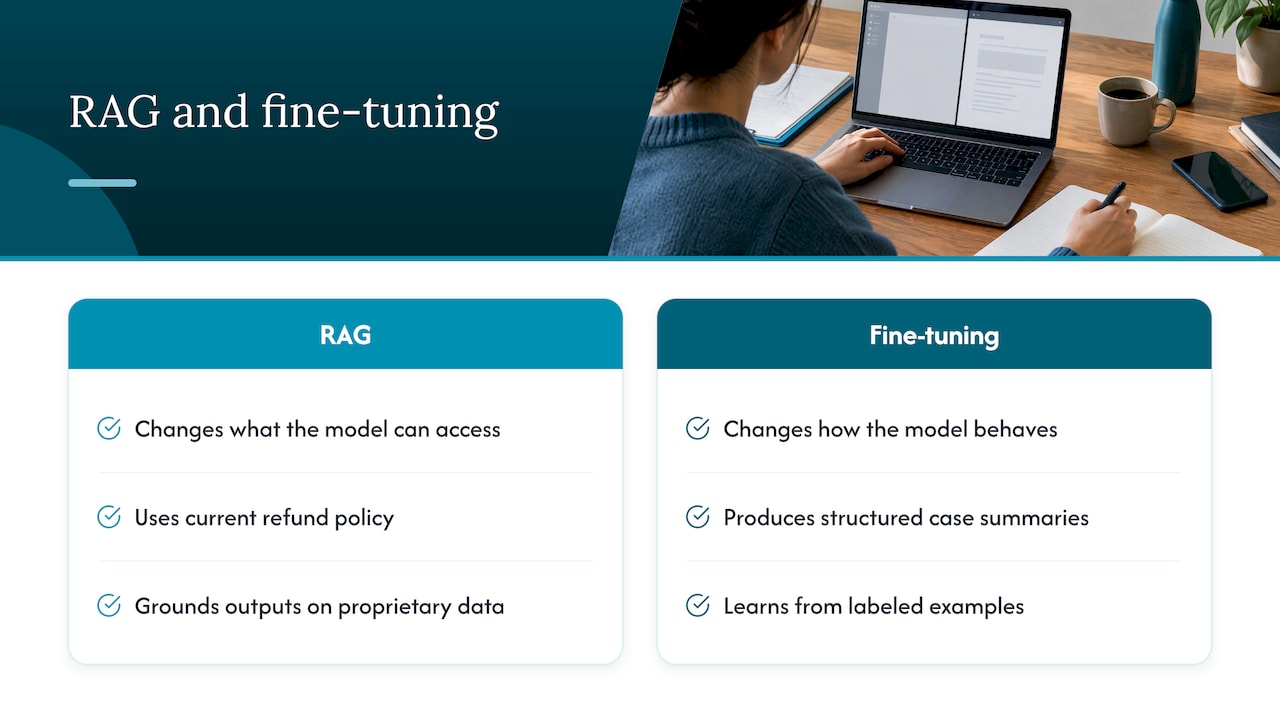
Google Cloud describes the same split: RAG grounds outputs on your data, supporting fresh and private information, while supervised fine-tuning teaches the model specific instructions for well-defined tasks such as classification or structured outputs.
Side-by-side comparison
| Criterion | RAG | Fine-tuning |
|---|---|---|
| Knowledge freshness | Reflects new data as soon as it is indexed | Limited to the training snapshot |
| Update method | Re-index changed content | Run another training cycle |
| Source citation | Can cite the retrieved document | No source to point to |
| Behavior and tone | Shaped mainly through prompts | Strong customization of style and format |
| Latency | Adds a retrieval step | Answers directly, which can be faster |
| Cost profile | Ongoing indexing, vector storage and embedding upkeep | Upfront training investment |
| Access control | Enforced in the retrieval layer | Harder to separate once data is in weights |
The cost and latency rows come from a 2026 comparison of the trade-offs, which notes that a smaller specialized model can lower inference costs after training, while RAG needs budget for indexing, storage and maintenance.
When to use RAG
Use RAG when answers depend on information that is private, changes often or must be auditable. In customer service that covers most of the workload:
- Support knowledge bases. Retrieval pipelines reflect new data as soon as it is indexed, with no retraining, which suits support bots built on continually updated articles.
- Product and policy questions. AWS describes a customer-service chatbot that checks the product documentation knowledge base first so its answers about current features stay accurate.
- Financial and regulatory content. AWS’s Nova case study lists dynamic data and strict compliance with sensitive data among the cases where RAG is optimal.
- Speed to deploy. AWS Prescriptive Guidance notes RAG can incorporate the latest documents in a few minutes, while fine-tuning can take hours to days and may need a data scientist.
The evidence for knowledge tasks is consistent. A review of five head-to-head studies reports that on 910 current-events questions with Mistral 7B, fine-tuning scored 0.504 against 0.875 for retrieval.
Real-world results
A NAACL 2025 industry paper studied RAG in a large financial institution’s call center. Over 26 weeks and 27,471 queries, 52.07% of responses received five-star accuracy ratings from agents. After retrieval was optimized, average response time fell from 21.91 seconds to 7.33 seconds. The lesson for contact centers is that retrieval design, not only the model, drives response time.
Retrieval quality sets the ceiling
RAG is only as good as what it retrieves: outdated or conflicting sources, weak ranking and permission handling determine the result. That is why content ownership, indexing cadence and ranking deserve the same attention as model choice. Our guides on knowledge base integration for enterprise chat and shipping RAG chatbots that prioritize retrieval cover that work in detail.
When fine-tuning earns its place
Fine-tuning is still relevant when the gap is behavioral. NVIDIA’s guidance says to consider it when one behavior pattern, such as tone, format or a workflow step, must be right by default across many calls and prompts, retrieval and templates still miss the bar. It also recommends gating the decision with evaluation against a prompt-and-retrieval baseline on held-out examples.
Typical candidates in customer interactions:
- A brand voice that must hold across thousands of conversations.
- Consistent structured output, such as converting a request into a fixed case format.
- Narrow, stable tasks where a smaller specialized model can replace a larger one.
- Strict latency targets where a retrieval round trip is unacceptable.
A cautionary example comes from a Manning case: an investment bank spent eight weeks and $55,000 in compute fine-tuning an 8B model on earnings transcripts. The model adopted financial language but could not answer questions about the previous day’s call, which retrieval would have solved. The decision turns on whether the gap is behavior or knowledge.
Combining RAG and fine-tuning
Many production systems use both. AWS describes a company that frequently updates product features: it fine-tunes every couple of months to keep tone aligned, while RAG supplies the latest product information. AWS Prescriptive Guidance recommends starting from a RAG-based approach for question answering over custom documents and using fine-tuning for additional tasks.
The hybrid carries two maintenance duties: keeping the knowledge source searchable and validating the model after adaptation. Failures should be investigated separately, since an answer can use the right source and still miss the required format, or look polished and contain outdated facts.
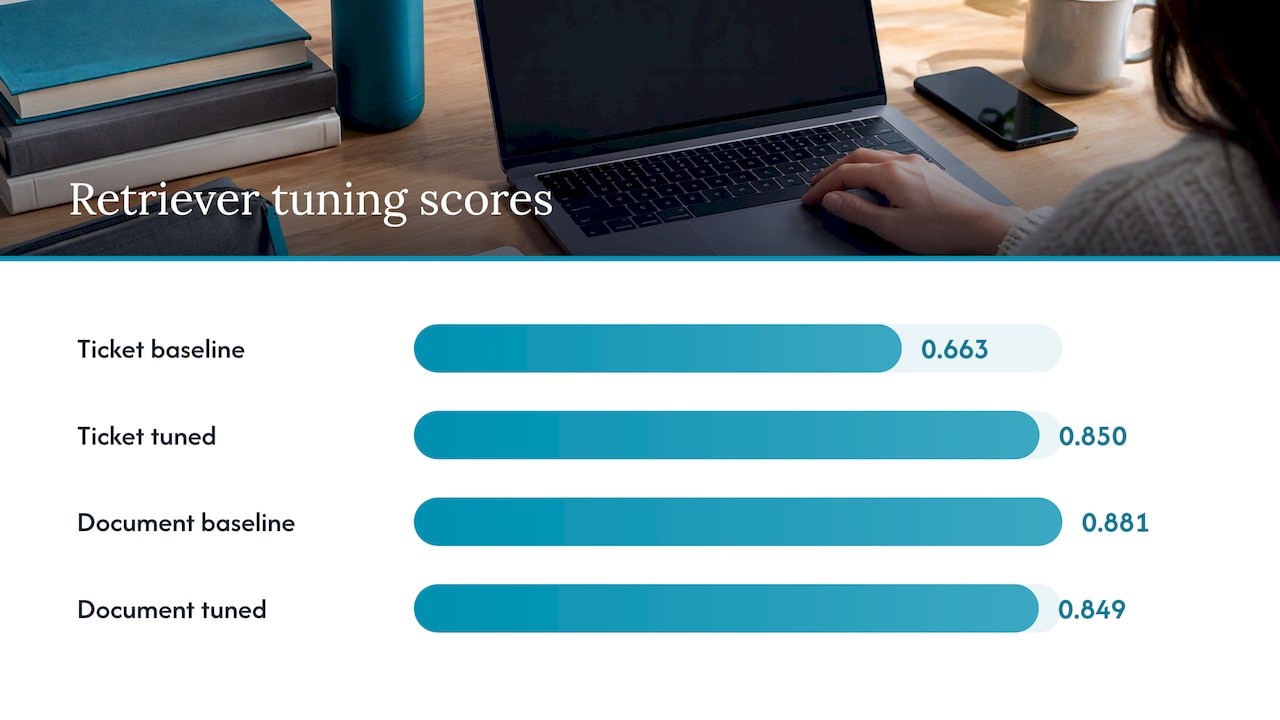
The hybrid also applies to the retriever. In the RAGAL study, fine-tuning a shared retriever on ticket data raised ticket recall@10 from 0.663 to 0.850 but lowered document retrieval from 0.881 to 0.849. The authors advise building per-domain evaluations before tuning any retriever that serves several content types.
Governance, security and data control
For regulated organizations, the strongest argument for RAG is provenance. Retrieved data is passed explicitly to the model, so pipelines can cite specific source documents, whereas an adapted model synthesizes answers from internal parameters, which makes tracing them hard. Keeping private data in a controlled retrieval layer also lets you change access without retraining.
A governance review should cover:
- Data lineage for both training datasets and retrieval document stores.
- Access controls. The FACTS paper on enterprise RAG chatbots states that retrieval must filter documents by the user’s access control lists before data reaches the model.
- Guardrails as a programmable layer. The same paper finds that relying on instructions such as “do not share sensitive data” is unreliable.
- Output audits for quality drift on any fine-tuned model.
- Data policy defining which private data may be used for training and which only through controlled retrieval.
Deployment location matters as well. Our overview of cloud versus on-premise for regulated organizations and our guide to data residency compliance set out how to keep the knowledge layer inside the boundary your regulator expects. On reducing wrong answers specifically, see AI hallucination reduction for enterprise customer service.
A practical decision sequence
- Define the gap. Write down whether failures are missing facts or wrong behavior.
- Build a baseline. Use prompts plus retrieval against a held-out set of real customer questions.
- Fix retrieval first. Clean sources, resolve conflicts, set the refresh cadence. Teams commonly refresh daily for fast-moving content and weekly for slower knowledge bases.
- Fine-tune only against evidence. If a specific behavior still misses the bar, tune for that pattern and compare with the baseline.
- Measure both failure types. Track knowledge accuracy and behavioral consistency separately.
The sequence matches the practitioner heuristic in Atlan’s decision guide: if the model needs to know something, use RAG; if it needs to behave differently, use fine-tuning. When in doubt, start with RAG alone because it is faster to iterate and easier to debug.
Retrieval is also how content reaches AI search engines. For the content side of that topic, see these fast retrieval actions for ChatGPT visibility.
Our perspective
Enterprise customer conversations are mostly knowledge problems: current policies, account context, product details. We design VOICERAcx so that this knowledge stays in systems the organization governs and the agent answers from it, across voice, chat, WhatsApp, SMS and email.
Retrieval gives auditability: an answer can be traced to a source, access can follow user permissions, and a corrected document changes the next answer without a training cycle. For regulated sectors that combination of compliance and auditability, together with cloud, private cloud or on-premise deployment, is what we build toward.
Our no-code agent setup and integrations with CRM and telephony systems exist so that teams spend effort on content quality and evaluation rather than model training. Behavior shaping through configuration comes first, and heavier customization is considered only after measured gaps.
Voiceracx
Putting retrieval-first agents to work
VOICERAcx provides AI chat agents and AI voice agents that integrate with CRM, telephony and existing business systems, with cloud, private cloud and on-premise options. Published plans on the pricing page start with a Free plan at $0 per month, followed by Basic at $199, Standard at $249, Advance at $399 and Pro at $999 per month. A chat session fee is $0.18 per session, and enterprise deployments run through Vee Enterprise.
FAQ
Is RAG better than fine-tuning?
For knowledge that changes or must be cited, RAG is the stronger starting point, because updates need only re-indexing and answers can point to a source. Fine-tuning is better for consistent tone, format and narrow task behavior. Most enterprises begin with RAG and add tuning when a measured behavioral gap remains.
Is fine-tuning still relevant?
Yes. It remains useful when one behavior pattern must hold by default across many calls, or when a smaller specialized model can lower inference cost. NVIDIA recommends testing it against a prompt-and-retrieval baseline first.
Can you use RAG and fine-tuning together?
Yes. The usual pattern is to tune the model for output behavior and use RAG for current facts at answer time. The model becomes a better reader of retrieved context, and you maintain two parts: the knowledge source and the tuned model.
Which is better for regulated industries?
RAG offers a provenance advantage, since retrieved documents can be cited and access can be restricted by user permissions in the retrieval layer. That supports audit requirements. Deployment control, such as private cloud or on-premise hosting, adds data control.
Sources
- RAG vs. Fine-tuning, IBM
- RAG vs Fine Tuning: Enterprise Decisions, Databricks
- RAG vs Fine-Tuning: Choosing the Right AI Customization Strategy, AWS Builder Center
- RAG vs. Fine-tuning and more, Google Cloud Blog
- RAG vs Fine-tuning: How to Choose for Your LLM, Fluence
- Tailoring foundation models for your business needs, AWS
- Model customization, RAG, or both: Amazon Nova, AWS
- Comparing RAG and fine-tuning, AWS Prescriptive Guidance
- Fine-Tuning vs RAG: 5 Studies and the Training Bill
- Implementing RAG on a financial institution call center, NAACL 2025
- RAG vs. LLM fine-tuning, Glean
- When Should You Fine-Tune an Open Model, NVIDIA
- Fine-tuning in LLM Customization, Manning liveBook
- RAGAL: A Frugal, Fully Local Retrieval-Augmented Assistant, arXiv
- FACTS About Building RAG-based Enterprise Chatbots
- Fine-Tuning vs RAG: Architecture, Tradeoffs, and a Decision Framework, Atlan
- 8 Fast Retrieval Actions to Rank in ChatGPT for Marketers