From 1% to Full Coverage: QA Automation for Regulated Contact Centers
Move regulated contact centers from 1% sampling to full coverage QA automation with evidence scoring, audit trails, and 90s–3min alerts.

Quality assurance automation applies automatic speech recognition and large language model rubric scoring to evaluate voice and chat interactions at full volume, not on a sampled subset. The operational payoff is faster breach detection, complete coverage instead of the traditional 1% to 5% sample, and a coaching loop that reaches agents in near real time. Enterprise platforms such as Vee Legion are built specifically to deliver this at regulated-industry scale.
TL;DR:
- Automated QA can evaluate all voice and chat interactions in real time, providing quicker breach detection and more accurate scoring than sampling methods.
- Full-coverage scoring typically adds 1% to 3% of agent labor costs and improves compliance monitoring, coaching speed, and trend visibility.
- Key technical layers include speech-to-text conversion, transcript normalization, LLM rubric scoring, and fast latency for real-time intervention.
- Successful pilots require staged rollout, rubric validation, data privacy checks, and clear procedures for human-model dispute resolution before full deployment.
- Metrics beyond coverage, such as auto-fail rate and coaching speed, are essential to demonstrate automated QA’s impact on agent performance and operational outcomes.
Why Automate Quality Assurance: ROI, Accuracy, and Operational Impact
Manual QA has always rationed attention. Most contact centers review only a small fraction of interactions by hand, which means the vast majority of agent conversations, including the ones that go badly, are never scored at all. Automated QA removes that ceiling by scoring every voice call and chat transcript against the same rubric, every time.
The business case is not theoretical. McKinsey’s analysis of AI-driven contact-center QA points to deployments reaching more than 90% scoring accuracy alongside QA cost reductions exceeding half in a financial-services case example. That combination, higher accuracy and lower cost, is what makes the shift from sampling to full coverage financially sound rather than just operationally appealing.
Statistic Callout: In McKinsey’s financial-services example, gen-AI-based QA scoring reached over 90% accuracy while cutting QA program costs by more than half compared with manual review.
Full-coverage scoring changes daily operations in ways that ripple beyond the QA team itself:
- Supervisors get breach alerts within minutes instead of finding compliance gaps weeks later during a quarterly audit.
- Coaching conversations reference the actual call or chat instead of a hypothetical “watch your tone” reminder.
- Headcount that once reviewed a thin sample can shift toward calibration, coaching, and rubric design.
- CSAT and first-contact resolution trends become visible at the team level within days, not the following month.
The incremental cost of scoring every interaction, rather than a sample, also scales predictably. Some vendors report that full AI QA coverage adds roughly 1% to 3% of agent labor cost, a figure worth putting in front of a CFO before that conversation happens organically.
What Are the Core Technical Components of Automated QA?
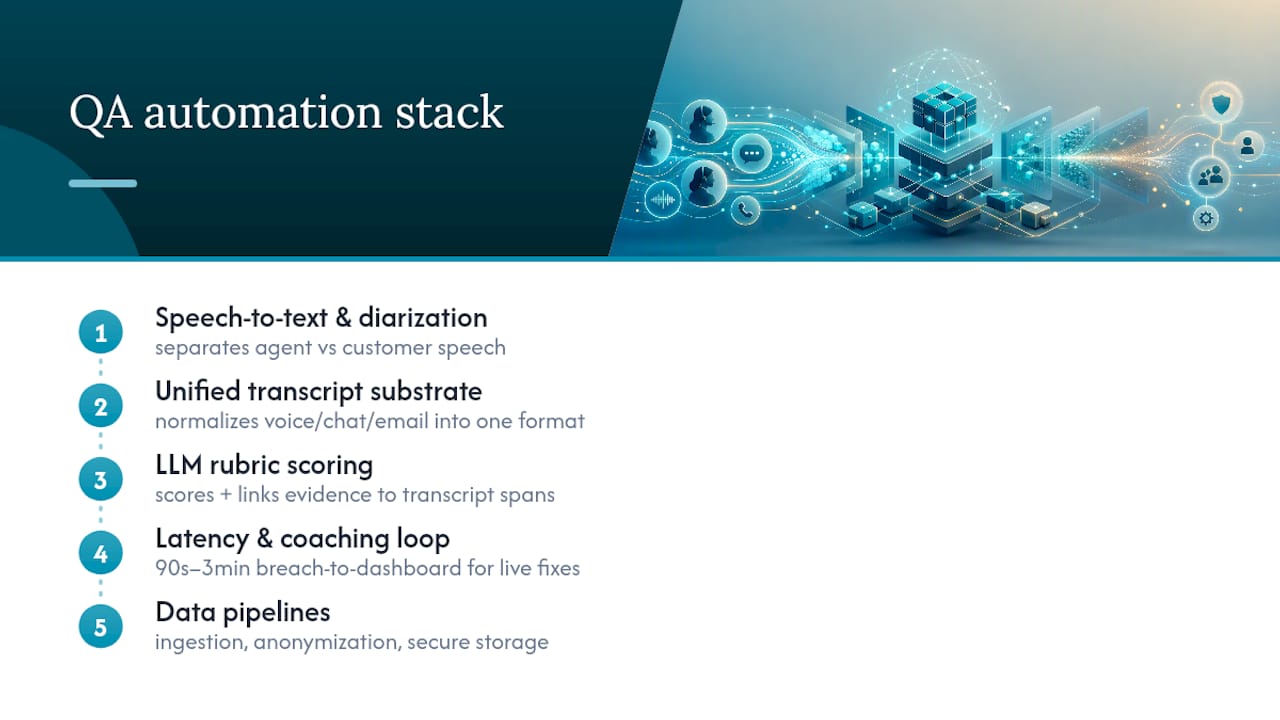
An enterprise QA stack rests on four layers and skipping any one of them produces blind spots that surface later as compliance risk or agent distrust.
Speech-to-text and speaker diarization convert voice calls into a transcript that separates agent speech from customer speech. Without accurate diarization, a scoring engine cannot tell who said what, which makes rubric scoring on things like disclosure language or de-escalation unreliable.
A unified transcript substrate normalizes voice, chat, email, and messaging into one format the scoring engine can read consistently. This is what makes channel parity possible: a rubric built for calls should not require a separate rebuild for WhatsApp threads.
LLM rubric scoring evaluates each interaction against a defined scorecard and returns structured output: numeric or category scores tied directly to the transcript span that produced them. Evidence-linked scoring, where every score points back to the exact line of dialogue that triggered it, is what turns automated QA from a black box into something an auditor or a skeptical agent can actually verify.
Latency and the coaching loop determine whether the system is useful for real-time intervention or only for after-the-fact reporting. Operational benchmarks from Callforce’s guide to full-coverage AI QA put breach-to-dashboard latency in the range of 90 seconds to 3 minutes, fast enough for a supervisor to intervene on a live escalation rather than discover it the next day.
Pro Tip: Ask any vendor how their system anonymizes personal data before it reaches the scoring model, and whether that anonymization happens before or after storage. The order matters more than the fact that it happens at all.
Data pipelines tie these layers together: ingestion from telephony and chat platforms, anonymization, secure storage, and integration back into CRM records. For regulated industries, this is also where deployment model decisions, cloud, private cloud, or on-premises, get made early rather than retrofitted later.
How Do You Run a Pilot to Validate Automated QA?
Rolling out full-coverage QA across an entire contact center on day one is how pilots fail. A staged approach surfaces rubric gaps and model errors while the blast radius is still small.
- Audit the current rubric. Define a core scorecard that applies to every channel, then layer channel-specific modifiers on top, following the core-plus-modifier structure Kaizo recommends for keeping scores comparable across voice and chat.
- Assess data quality and privacy. Pull a representative batch of transcripts and chat logs, confirm anonymization works as expected, and flag any gaps in call recording or chat retention before scoring begins.
- Build prompts and a validation dataset. Draft scoring prompts against the rubric and set aside a held-out batch of interactions with known human scores, never used to tune the prompts themselves.
- Score and compare against human reviewers. Run the model against the validation set and measure reviewer agreement directly, not just overall accuracy against a single grader.
- Refine and connect breach alerts. Adjust prompts and rubric wording based on disagreement patterns, then route confirmed breach flags into the supervisor workflow so coaching happens the same day.
- Scale in stages. Expand by team or channel rather than all at once, and use a structured AI Maturity Assessment to decide when the organization is ready for the next expansion.
Pro Tip: Define what counts as a “call” before you start scoring. Short disconnects, voicemails, and abandoned calls need explicit rules, or they quietly disappear from your coverage numbers without anyone noticing.
One overlooked step: decide in advance what happens when the model and a human reviewer disagree on a borderline call. That exception path, not the average accuracy score, is usually where trust in the system is won or lost.

What KPIs Prove Automated QA Is Working?
Coverage percentage is the obvious starting metric, but it is not the only one that matters. Auto-fail rate, internal quality score trends, reviewer agreement rate, and coaching velocity (the time from interaction to completed coaching session) together paint a fuller picture of whether the system is accurate and actually changing agent behavior.
QA scores only earn their keep when they correlate with downstream outcomes. Track how quality scores move against CSAT, first-contact resolution, escalation rate, and repeat contact rate over rolling periods rather than isolated snapshots.
Statistic Callout: Automated QA stacks reporting near-100% coverage still validate results against blind human audits on a recurring cadence, since evidence-linked scoring only earns trust when reviewers can independently confirm the model’s judgment on the same interactions.
Governance controls round out the metric set:
- Reviewer agreement rate against a held-out, human-scored validation dataset.
- Drift monitoring to catch when model performance degrades on new call types or products.
- Scheduled calibration sessions where reviewers and the model score the same batch and reconcile differences.
- Full audit trails linking every score to its transcript evidence and anonymization log.
What Enterprises Get Wrong About Automated QA
The most common mistake is treating vendor accuracy claims as settled fact instead of a hypothesis to test on your own data.
Bias and hallucination risk are manageable, but only with deliberate controls: prompt libraries built for your vertical, rubric overlays for regulated language, and continuous validation against unseen data rather than a one-time accuracy check at launch. Deployment model matters more than most procurement teams initially assume. Organizations with strict data residency or audit requirements should weigh private cloud or on-premises deployment from the start, not as a later migration. Tools like Vee Legion and a structured AI Maturity Assessment exist precisely to make that evidence, and that governance, visible before rollout rather than after an incident.
— Voiceracx
Bring Full-Coverage QA to Every Voice and Chat Interaction
Voiceracx built Vee Legion around the exact governance gap enterprise teams keep running into: scoring engines that claim high accuracy but cannot show you the transcript evidence behind a single score. Vee Legion links every score to the exact line of dialogue that produced it, and it deploys on cloud, private cloud, or on-premises infrastructure so regulated teams keep full data control instead of trading auditability for automation.
The platform integrates with existing telephony and CRM systems, which means the pilot steps outlined above, rubric design, validation dataset scoring, breach-alert routing, run against your own production data rather than a vendor demo environment. If your team is still deciding where to start, request an AI Maturity Assessment to identify which channels and teams are ready for full-coverage scoring first, or explore Vee Enterprise directly to scope a deployment built for regulated, multichannel operations.
Sources
- AI mastery in customer care: Raising the bar for quality assurance
- AI QA Call Center: 100% Call Quality Assurance Guide 2026
- Contact Center Quality Assurance: The Complete Guide - Kaizo
FAQ
What Is Quality Assurance Automation in a Contact Center?
Quality assurance automation uses speech recognition and LLM rubric scoring to evaluate voice calls and chat transcripts against a defined scorecard, without a human reviewer scoring each one manually. It allows full coverage of interactions instead of the 1% to 5% manual sample most contact centers rely on today.
How Accurate Is Automated Call Scoring Compared to Human Reviewers?
Accuracy depends heavily on rubric design and validation against your own data, but McKinsey’s case example reports gen-AI QA scoring reaching over 90% accuracy in a financial-services deployment. Reviewer agreement should still be measured continuously against a held-out validation dataset rather than assumed from a vendor’s published figure.
How Long Does It Take to Detect a Compliance Breach With Automated QA?
Well-built AI QA stacks surface breach flags on supervisor dashboards within 90 seconds to 3 minutes of the call disconnecting. That speed is what enables same-day coaching instead of a breach surfacing weeks later in a quarterly review.
Does a product exist for Automated Call Scoring?
Yes. Vee Legion is an evidence-linked QA scoring system, which ties every score to the transcript span that produced it and supports cloud, private cloud, or on-premises deployment. Pricing for broader platform plans, including Basic, Standard, Advance, and Pro tiers, is listed on the pricing page.
What Should a QA Automation Pilot Include?
A pilot should cover rubric design, data quality and privacy checks, a held-out validation dataset, and a comparison of AI scores against human reviewers to measure agreement. Following a core-scorecard-plus-modifier structure keeps results comparable as you expand from one channel to several.