Cut PCI DSS Call Center Scope by 96% With DTMF Masking
Practical v4.0.1 steps to shrink PCI audit scope: DTMF masking, IVR, tokenization, recording fixes, and the evidence QSAs expect.
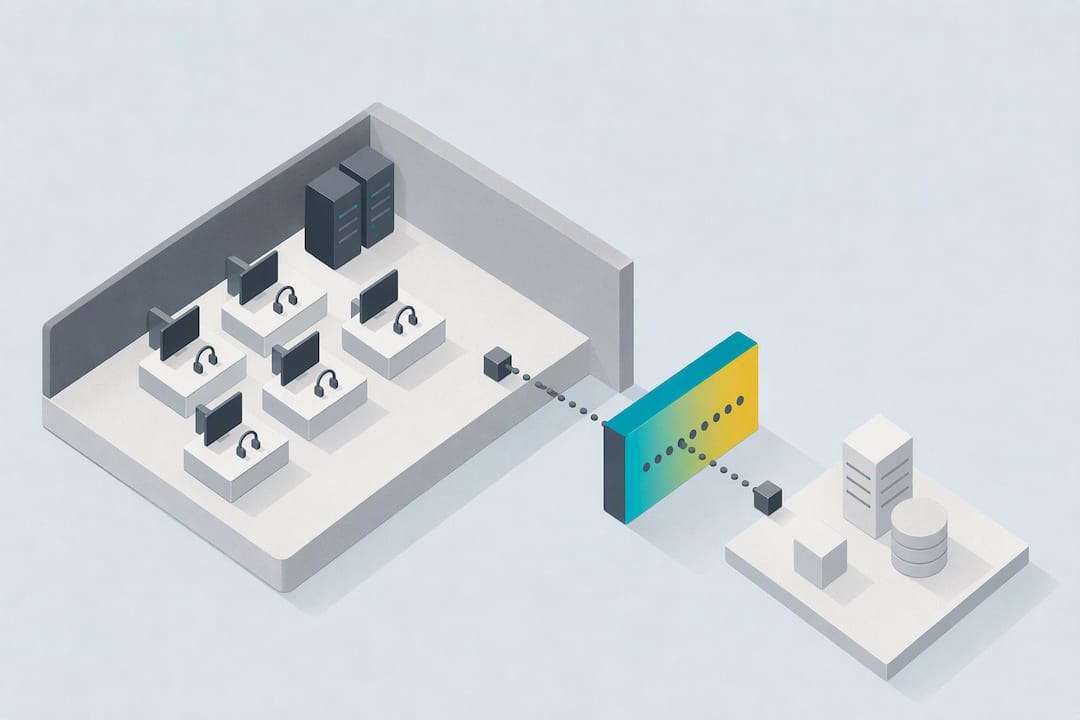
If your contact center agents ever hear, key in, or record a card number, PCI DSS applies to that environment, no exceptions for size or call volume. The fastest way to shrink audit scope is to keep primary account numbers (PAN) out of the agent and recording legs entirely, using DTMF masking or IVR self-service rather than relying on staff to pause and resume recordings. Where card data still touches your systems, Requirement 9 physical controls, Requirement 10 logging, and mandatory multi-factor authentication under PCI DSS v4.0.1 become non-negotiable.
TL;DR:
- Most contact centers should prioritize implementing DTMF masking or IVR self-service to significantly reduce PCI scope, especially for high-volume, predictable calls.
- Recording and archiving unredacted card data inherit PCI obligations, so retrospective redaction, encryption, or truncation are essential for existing recordings.
- Physical and operational controls, including physical access restrictions, logging, and multi-factor authentication, remain mandatory under PCI DSS v4.0.1, even for remote agents.
- Vendors claiming PCI compliance must provide up-to-date Attestations of Compliance, clear scope definitions, and detailed call-flow documentation to verify their security claims.
- Focus on architecture decisions that keep card data out of the agent environment first, as this approach provides the greatest audit scope reduction and simplifies compliance management.
What Does PCI DSS Mean for Call Centers?
PCI DSS scope in a telephone environment is triggered the moment cardholder data or sensitive authentication data (SAD) enters any system your contact center touches, whether that’s a softphone, a call recorder, a CRM screen, or a supervisor’s monitoring dashboard. The PCI SSC Information Supplement on telephone-based payment card data makes this explicit: any system that stores, processes, or transmits account data is in scope, and the supplement walks through call-flow diagrams to show exactly where that boundary, or demarcation point, sits in a typical operation.
Most compliance teams underestimate how far that boundary extends. If a supervisor can pull up a recorded call and hear a customer read out a 16-digit number, that recording platform, its backup system, and every workstation with playback access are all inside your Cardholder Data Environment (CDE). PCI DSS v4.0.1, mandatory in the United States since March 31, 2025, tightened expectations around exactly this kind of scope creep, particularly for the growing share of agents working from home.
The practical question every compliance officer should ask isn’t “are we compliant?” but “how much of our contact center actually needs to be?” That question drives every architecture decision covered below.
Which Technical Controls Keep Card Data Out of the Call?
The single highest-leverage decision a contact center makes is choosing where card data enters the system, and whether it enters at all. Three approaches dominate the 2026 landscape, each with distinct tradeoffs.
DTMF masking intercepts the touch-tone signals a caller enters and replaces them with flat tones before they reach the agent’s headset or any recording system. The agent sees a payment status update on screen but never hears, sees, or handles the actual digits. Because the masking layer sits between the caller and your infrastructure, everything downstream, the agent desktop, the call recorder, the CRM, can often be removed from PCI scope entirely. This is why masking typically produces the largest scope reduction of any single control.
IVR self-service routes the caller into an automated payment flow, either instead of or alongside the agent conversation. It works best for repeat payments, bill pay, or any scenario where the customer doesn’t need a live agent to complete the transaction. The tradeoff is customer experience: poorly designed IVR menus frustrate callers who expect a human to walk them through a first-time or complex payment.
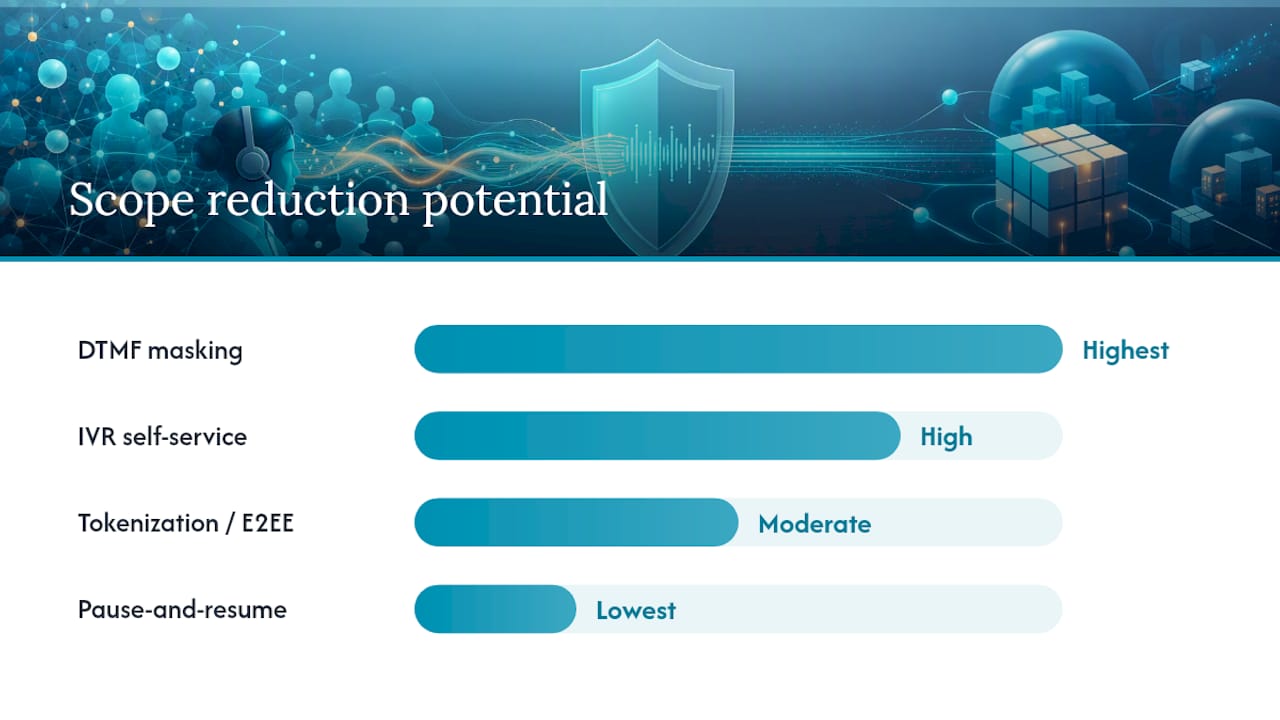
Tokenization and end-to-end encryption matter when you can’t avoid storing or transmitting PAN elements, such as for refunds, chargebacks, or recurring billing setups. Rendering the PAN unreadable through strong cryptography, and keeping encryption keys segregated from the encrypted data, satisfies PCI DSS Requirement 3 even when some card data legitimately needs to persist.
Pause-and-resume, where an agent manually stops a recording before asking for card details and restarts it afterward, remains the weakest option. It depends entirely on human execution getting it right every single time, and the Shuttle Global guide to contact center PCI compliance notes that auditors increasingly treat pause-and-resume as an unreliable control precisely because it fails under pressure, staff turnover, and simple human error.
- DTMF masking: highest scope reduction, no change to agent workflow
- IVR self-service: best for unattended or repeat transactions, weaker for complex first-time payments
- Tokenization/E2EE: necessary when PAN must be stored or transmitted for legitimate business reasons
- Pause-and-resume: lowest cost to implement, highest audit risk and human-failure exposure
Pro Tip: Don’t treat pause-and-resume as a stopgap while you plan a “real” solution later. QSAs increasingly ask for automated proof that the pause actually happened, and most legacy telephony systems can’t produce that evidence on demand.
How Should You Handle Call Recordings That Contain Card Data?
A recording that captures a spoken card number or unredacted DTMF tones is stored cardholder data, full stop, and every backup, archive, and disaster recovery copy of that file inherits the same PCI obligations as your live production systems. The PCI SSC supplement’s guidance is blunt on this point: eliminate SAD from recordings wherever possible, and where you can’t, secure what remains with the same encryption, access restriction, and logging you’d apply to any other CHD.
That leaves three practical remediation paths for recordings already sitting in your archive:
- Redact at capture. Configure your recording platform to automatically blank or tone-mask the payment segment of a call before it’s ever written to disk, so nothing sensitive exists to protect later.
- Encrypt the whole file with managed keys. For recordings you can’t redact retroactively, apply strong encryption and store the keys separately from the recordings themselves, rotating them on a documented schedule.
- Truncate or tokenize the PAN within the transcript or metadata. Many contact centers store call metadata alongside audio; that metadata needs the same scrutiny as the recording file.
Before any of that works, you need an honest inventory. Pull a sample of recordings from the last 12 to 24 months, listen to a statistically meaningful subset, and flag any that contain spoken or DTMF card data. Systems like EchoTrace can help surface which recordings and access logs actually touched payment moments, which speeds up that sampling exercise considerably. Once you know the scope of the problem, either purge recordings past their legitimate retention window or migrate the surviving ones into a properly secured, access-controlled archive.
Retention policy matters here as much as the technical fix. PCI DSS favors data minimization: keep cardholder data only as long as a legitimate business or legal reason requires it, and align that window with whatever local privacy regulation applies, including GDPR contact center rules if you handle European callers, since GDPR call recordings carry their own erasure and minimization obligations layered on top of PCI’s.
How Do Architecture Choices Change Your Audit Scope?
Where you draw the line between “in scope” and “out of scope” isn’t a compliance afterthought, it’s the single biggest lever you have over audit cost and complexity. The core principle is channel separation: isolate the payment capture moment into its own PCI-certified environment, distinct from your general voice, CRM, and recording infrastructure, so that a breach or audit finding in one doesn’t cascade into the other.
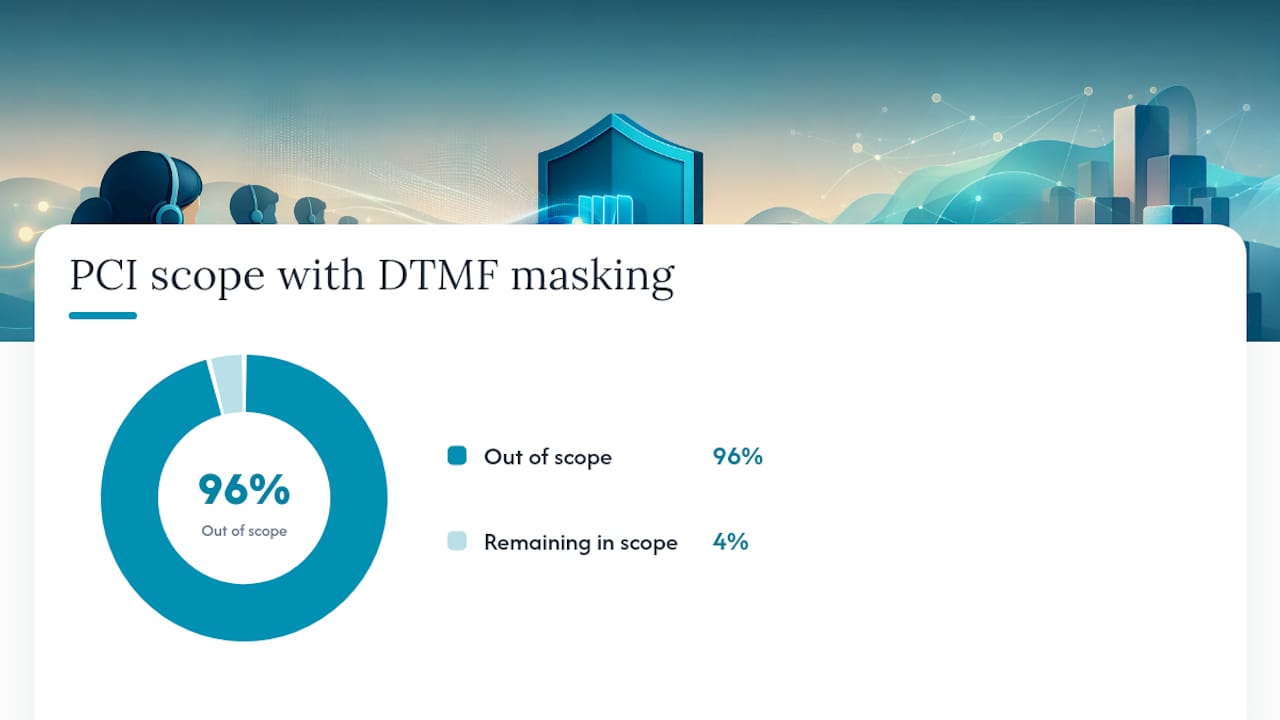
The scope difference between architectures is dramatic in practice. DTMF masking implementations can remove roughly 96% of contact center systems from PCI scope, often shifting an organization from a Self-Assessment Questionnaire D (SAQ D), the most demanding tier, down to SAQ A, the lightest. That’s not a marginal improvement. It’s the difference between an audit that touches your entire telephony stack and one that touches almost none of it.
Which architecture fits depends heavily on call volume and workforce model:
- High-volume contact centers with predictable payment flows benefit most from IVR self-service layered with masking, since automation absorbs the repetitive transactions.
- Low-volume or highly consultative sales environments often need masking without full IVR, preserving the live agent conversation while still stripping the sensitive digits.
- Remote and hybrid agent models carry the highest inherent risk, since home networks and personal endpoints sit outside your controlled perimeter; masking is the cleanest way to keep remote agents out of scope as long as you pair it with managed endpoints and MFA.
Getting there is a project, not a toggle switch. Start by mapping every CDE demarcation point in your current call flow, documenting exactly where card data enters and exits each system. Collect the evidence your auditor will want, call-flow diagrams, sample logs, and masking configuration exports, before you request a formal scope reassessment. Phase the rollout by queue rather than attempting a big-bang cutover, so you can validate that masking or IVR performs correctly on real call volume before retiring your old pause-and-resume process.
Which Operational Controls Stay Mandatory Under v4.0.1?
Even a well-descoped contact center retains a core set of operational obligations, and v4.0.1 raised the bar on several of them rather than relaxing anything.
Requirement 9 treats your contact center floor as a sensitive area, a fact many compliance teams miss because they assume physical access rules only apply to server rooms. The PCI SSC’s own FAQ confirms that any floor where staff can access systems storing, processing, or transmitting CHD needs physical controls: badge access, visitor logs, and camera monitoring at minimum. That obligation extends to remote agents too, which is where it gets genuinely hard to enforce, since you can’t badge someone’s home office.
Requirement 10 governs logging, and for a contact center that means capturing who accessed a recording, who initiated playback, and every administrative change to the masking or IVR configuration. Logs need a defined retention window and a documented, regular review cadence, not just a database quietly filling up that nobody checks until something goes wrong.
Multi-factor authentication is now required for all non-console and administrative access to any system inside the CDE under v4.0.1, closing a gap that many older SAQ D environments had left open through simple password-based admin access.
Training and QA evidence round out the operational picture: annual PCI awareness attestation for every agent with CDE access, documented QA sampling that specifically checks for improper card-data handling, and retained records proving both happened on schedule.
- Requirement 9: physical access controls for the contact center floor and any remote workspace touching CHD
- Requirement 10: centralized logging of recording access, admin changes, and playback events
- MFA: mandatory for all non-console and administrative CDE access under v4.0.1
- Annual training attestation and QA sampling records, retained as audit evidence
Pro Tip: Remote-agent physical controls trip up more audits than any other Requirement 9 item. Document a compensating control, like a clean-desk policy plus screen-lock enforcement, rather than leaving that gap unaddressed until your QSA finds it first.
What Should You Ask a Telephony or Payment Vendor Before You Sign?
A vendor’s marketing page telling you their platform is “PCI compliant” isn’t evidence. What you need is a document trail your QSA can independently verify.
- Request a current Attestation of Compliance (AOC) and check that it covers the exact call flows and architecture you intend to deploy, not a different product tier or an outdated version of their platform. An AOC more than 12 months old is a red flag worth pushing back on.
- Confirm PCI DSS Level 1 service provider status where the vendor processes meaningful transaction volume on your behalf, and check the date range that evidence actually covers.
- Negotiate contract clauses covering data segregation, subprocessor disclosure, breach notification timelines, audit rights, and a specific service-level commitment on masking or descoping guarantees, not vague language about “industry-standard security.”
- Hand your QSA a complete evidence package: call-flow diagrams marking the demarcation point, sample access logs, and documented retention and deletion records for any card data the vendor’s systems touch.
How Modern AI Voice Agents Can Approach PCI-Aware Voice Payments
Modern AI voice agents complicate the scoping conversation, since an automated agent handling a payment conversation needs the same card-data isolation a human agent does. An architecture that pairs channel separation with masking can prevent PAN from reaching the conversational AI layer, the recording pipeline, or the analytics engine, regardless of whether a human or an AI agent is on the line.
Deployment model matters for regulated customers specifically: cloud, private cloud, and on-premise options each carry different audit implications, and enterprises with strict data-residency requirements may move faster through a QSA review with private cloud or on-prem evidence in hand rather than relying solely on shared-cloud assurances.
A sensible pilot: map your highest-volume payment call type, implement masking on that single queue, collect the auditor evidence it generates, then scale the pattern once it’s proven.
The Real Priority Isn’t the Checklist, It’s the Architecture
Most PCI guidance for call centers reads like a compliance checklist: do these twelve things, get your AOC, move on. That framing misses the actual lesson of v4.0.1: the organizations spending the least on audits year after year aren’t the ones with the most thorough pause-and-resume training programs. They’re the ones who removed the need for that training entirely by keeping card data out of the agent and recording legs in the first place.
The conventional advice to “train staff better” on manual controls like pause-and-resume treats a human-reliability problem as if it were solvable through better documentation. It isn’t. Auditors have caught on to this, which is exactly why v4.0.1 raises the evidentiary bar for anything that depends on a person doing the right thing under pressure, forty times a day, for a full shift.
If you’re prioritizing one thing this year, prioritize the descoping decision, not the training deck. Get masking or IVR live on your highest-volume payment queue first. Everything else, logging, MFA, physical controls, legacy recording remediation, gets meaningfully easier once fewer systems actually hold cardholder data.
— Voiceracx
Ready to Talk to a Vendor About PCI-Aware Voice Payments?
Once you’ve mapped your call flows and identified where DTMF masking or IVR could pull systems out of scope, the next step is finding a platform built to hold that boundary rather than just promise it. VoicePay supports PCI-aware payment capture with channel separation baked into the architecture, so PAN stays out of the agent desktop and recording pipeline whether the conversation is handled by a human or an AI voice agent.
Voiceracx’s enterprise conversational AI platform offers cloud, private cloud, and on-premise deployment, which matters when your QSA wants data-residency and governance evidence that goes beyond a shared-cloud attestation. If you’re evaluating vendors ahead of a scope reassessment, request a compliance-focused demo and bring your current AOC and call-flow diagrams to the conversation. It’s the fastest way to see exactly which systems a masking-first architecture would remove from your next audit.
Sources
Share the PCI SSC’s Information Supplement on telephone-based payment data with your technical team early, since its call-flow diagrams and Appendix D recording decision process are the reference most QSAs cite directly. Pair it with the PCI SSC’s FAQ on sensitive-area requirements for Requirement 9 clarity on physical controls.
- Protecting Telephone-based Payment Card Data (PCI SSC Information Supplement)
- PCI Compliance for Telephone Payments Explained (Paytia)
FAQ
What Is PCI Compliance for a Call Center?
It means any contact center system that hears, stores, processes, or transmits cardholder data must meet PCI DSS requirements, covering everything from call recordings and agent desktops to the payment capture method itself.
What Does PCI DSS Stand For?
PCI DSS stands for Payment Card Industry Data Security Standard, the set of technical and operational requirements payment card brands require of any business that handles cardholder data.
Why Am I Getting Calls Referencing PCI Compliance?
Vendors, QSAs, and payment processors often reach out about PCI compliance when a merchant’s card-processing volume, contract renewal, or recent security assessment triggers a required review of their current controls.
What Are the Core Requirement Areas Under PCI DSS?
PCI DSS organizes its controls into twelve requirement areas covering network security, cardholder data protection, vulnerability management, access control, monitoring, and formal information security policy; for call centers, Requirements 3, 9, and 10 carry the most specific telephone-environment guidance.
Does Pause-and-Resume Recording Satisfy PCI DSS on Its Own?
Not reliably. Auditors increasingly treat pause-and-resume as a weak control because it depends on consistent human execution, and technical alternatives like DTMF masking or IVR are considered stronger, more auditable descoping methods.