Blog
Decide IVA vs IVR in 4 Steps for Contact Centers
Four step playbook for contact centers to choose or combine IVA and IVR, with an actionable checklist and a migration plan for regulated operations.

IVR is a menu-driven routing tool built on scripted prompts and DTMF input, while IVA is a conversational AI that understands natural language and can resolve many contacts end-to-end. Choose IVR for simple, repeat-call routing where budget and simplicity matter most. Choose IVA when personalization, multi-turn resolution, or outbound automation determine whether a call becomes a cost or a conversion.
TL;DR:
- IVR excels in low-cost, predictable routing for scripted, repeat callers, with limited need for data integration or complex resolution.
- IVA offers multi-turn, personalized conversations that can resolve complex tasks directly, but requires extensive integration and ongoing tuning.
- For high-intent variability, multilingual support, or after-hours service, an IVA provides more effective self-service than traditional IVR.
- Compliance and risk concerns favor IVR’s deterministic logic unless your use case demands IVA’s real-time data access and task automation.
- Most enterprises benefit from hybrid systems, starting with targeted IVA pilots on high-value flows or layered IVA extensions onto existing IVR infrastructure.
IVR vs IVA: What Is Interactive Voice Response?
Interactive Voice Response systems route calls through pre-recorded scripted prompts, with callers pressing keys (DTMF tones) or speaking simple, single-word answers to navigate a fixed menu tree. There is no understanding of intent, only pattern matching against expected inputs. The system asks a question, waits for one of a limited set of answers, and moves to the next branch.
IVR still does three jobs well:
- Authenticating callers with account numbers, PINs, or date of birth before routing to a live agent
- Directing traffic to the correct department or queue based on a simple selection
- Delivering static self-service information: account balances, store hours, order status lookups
The appeal is cost and predictability. A well-built IVR tree is inexpensive to deploy, easy to audit, and rarely breaks in unexpected ways because its logic is deterministic. That reliability makes it the right fit for regulated, scripted flows where the outcome needs to be the same every time, and for repeat callers who already know the menu path. Practitioner guidance from CallFactory notes IVR remains the better fit specifically for these scripted, repeat-caller scenarios rather than for varied or ambiguous requests.
IVR vs IVA: What Is an Intelligent Virtual Assistant?
An Intelligent Virtual Assistant uses natural language understanding (NLU) and natural language processing (NLP) to hold a real conversation, not just parse a keypress. A caller can say “I need to change my flight to next Tuesday and add a bag,” and the IVA extracts multiple intents from one sentence, asks a clarifying follow-up if needed, and acts on all of it in a single multi-turn exchange.
That capability depends on integration, not just algorithms. An IVA pulls customer history from a CRM to personalize the conversation, recognizes returning callers through voice biometrics, and can hand off structured data to backend systems to complete a task rather than simply routing to someone who will complete it manually. Typical IVA capabilities include:
- Multi-turn dialogue that remembers context across the call
- CRM-driven personalization using purchase history, account status, or prior tickets
- Multilingual support without separate menu trees per language
- Outbound workflows: appointment reminders, collections calls, proactive service alerts
- Voice biometrics for frictionless, layered authentication
None of this is plug-and-play. IVAs require training data, integration engineering, and ongoing tuning of the language model against real call transcripts, which raises both the setup cost and the operational overhead compared with a static IVR tree. TechRepublic’s comparison frames this correctly: IVA adds personalization, CRM integration, and real-time responses that IVR cannot match, but that power comes with a bigger implementation lift. The sensible trigger for that investment is call volume with high intent variety, a customer base that expects self-service outside business hours, or a use case (bookings, payments, lead qualification) valuable enough to justify piloting a full conversational build.
What Actually Separates IVR From IVA?
The differences are not cosmetic. They run through how each system handles intent, data, and risk.
- Interaction model: IVR presents a fixed menu; IVA holds an open, natural-language conversation.
- Turn structure: IVR is single-turn (one prompt, one input); IVA supports multi-turn dialogue that carries context forward.
- Data integration: IVR typically operates with no live data integration; IVA connects to CRM and backend systems in real time, per independent comparisons of conversational IVR and voicebots.
- Task completion: IVR routes callers to a human or a static answer; IVA can complete the task itself, such as rescheduling an appointment or processing a payment.
- Compliance and risk exposure: IVR’s deterministic logic is simple to audit; IVA’s conversational flexibility requires stronger governance around NLU training data, voice biometric storage, and authentication design, an area where NIST’s guidance on risk-based authentication becomes directly relevant.
The practical takeaway: if your call volume is dominated by a handful of predictable intents, the gap between IVR and IVA matters less. If your intent distribution is wide or your callers expect the system to actually solve their problem rather than route them somewhere else, the gap becomes the whole decision.
Which Delivers Better Benefits: IVA or IVR?
Every advantage on one side comes with a corresponding cost on the other. Here is the honest trade-off, not the vendor pitch.
- IVR’s advantage is reliability at low cost. It is cheap to build, simple to maintain, and behaves identically every time. Its limitation is a hard ceiling on resolution: it can route, but it rarely resolves a nuanced request, which pushes complex calls to agents anyway and can frustrate callers who just repeat themselves through menu layers.
- IVA’s advantage is containment and personalization. It resolves varied, unscripted requests without a live agent and remembers context across a multi-turn exchange. Its limitation is setup and operational demand: NLU model training, ongoing tuning, and monitoring for the AI to keep performing as intents shift require sustained investment.
- The realistic middle ground is matching the flow to the call type. A billing-balance check is well served by IVR. A “why was I charged twice and can you fix it” call needs IVA’s ability to look up the account and act on it.
Pro Tip: Map your call transcripts by intent variety before choosing anything. If intent variety is high, that same IVR spend gets absorbed by agent escalations instead.
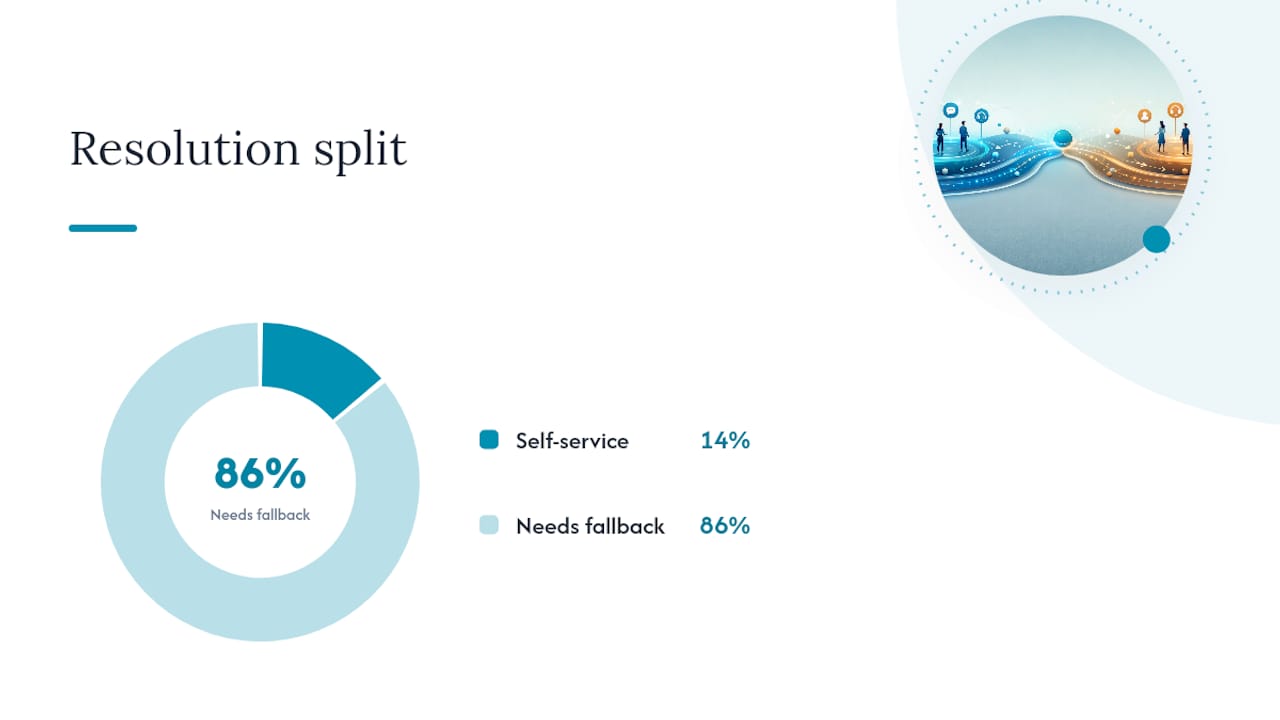
Neither approach eliminates the ceiling on self-service. A 2024 Gartner survey found only 14% of customer-service issues are fully resolved in self-service industry-wide, a reminder that automation without careful design and integration underdelivers regardless of which technology sits behind it.
How Do You Choose Between IVR and IVA?
Start with four variables: call complexity, volume, compliance exposure, and the state of your legacy systems. High volume with narrow intent variety and heavy regulatory scripting favors IVR or a light IVA overlay. High volume with wide intent variety, multilingual callers, or after-hours demand favors an IVA-first design.
Before signing with any vendor, ask these questions directly:
- Does the platform offer native CRM connectors, or does every integration require custom engineering?
- Are audit logs available for every automated decision and authentication event?
- Is private cloud or on-premise deployment supported for data that cannot leave your infrastructure?
- Who controls NLU training data, and can your team retrain the model without vendor involvement?
Treat these as red flags: opaque data handling practices, no audit trail for automated interactions, and no clean failover path to a human agent when the AI hits its confidence threshold. Any of these should stop a deal, particularly in regulated industries where an unauditable automated decision is a liability, not a feature.
Most enterprises land on a hybrid pattern rather than an all-or-nothing switch. Balto’s analysis of voicebot and conversational IVR use cases supports two low-risk hybrid patterns worth testing: IVA-first with IVR fallback for high-confidence, high-volume flows, or IVR-first with targeted IVA extensions layered onto specific pain-point intents. Remember the Gartner finding above: only 14% of issues resolve fully in self-service, so build the fallback path with the same care as the automation itself.
How Do You Integrate an IVA Into Existing Telephony and CRM Systems?
Migration works best as a staged process, not a rip-and-replace event.
- Audit your integration surface first. Map every CRM connector, telephony API, and data field the IVA needs to read or write, then flag anything touching payment data (PCI) or health information (HIPAA) for extra review, informed by authentication guidance from Pindrop on layered voice verification.
- Choose your deployment model deliberately. Cloud deployment moves fastest and suits standard integrations; private cloud balances speed with tighter data control; on-premise fits organizations bound by data residency rules that rule out shared infrastructure. Voiceracx’s cloud contact center platform supports all three, which matters when different business units carry different compliance requirements.
- Pilot on one high-value use case before scaling. Appointment booking, payment collection, or lead qualification are common starting points precisely because success or failure is easy to measure, a pattern echoed in TechRepublic’s guidance on IVA rollouts.
- Govern the NLU model after launch, not just before. Set a cadence for reviewing misrouted intents and retraining on real transcripts.
Pro Tip: Track auditability from day one, not after a compliance review flags a gap. Every automated authentication decision should be logged in a format your compliance team can pull without engineering help.
For a deeper walkthrough of migrating off legacy IVR infrastructure, see Voiceracx’s guide on transitioning from legacy IVR to voice AI.
What ROI Metrics Should You Track After Deployment?
The metrics that matter are the ones finance and operations already track for the contact center, applied consistently before and after deployment:
- Containment rate: the share of calls resolved without human escalation
- First contact resolution (FCR): whether the issue is solved in one interaction, not passed along
- Average handle time (AHT): how deployment changes agent-side call length for escalated contacts
- Abandonment rate: how many callers hang up before reaching resolution
- Cost per contact: the blended cost across automated and human-handled interactions
Most organizations see early containment gains within the first pilot cycle, with clearer FCR and cost-per-contact movement once the model has processed a few months of real call variety. Build your ROI case around the pilot’s single use case rather than projecting enterprise-wide savings from day one. The Gartner finding that only 14% of self-service issues resolve fully industry-wide is a useful benchmark: measure your containment rate against that baseline, not against a vendor’s marketing claim.
What Migration Mistakes Show Up Most Often?
The most common failure is treating IVA as a bigger IVR menu instead of a conversation design problem, which produces a bot that technically understands language but still forces callers through rigid, IVR-style steps. The second is skipping the audit-log and failover planning until after launch, which turns a compliance question into a fire drill. Design governance and escalation paths before the pilot, not after.
— Voiceracx
Where Voiceracx Fits Your IVR-to-IVA Decision
If your contact center is stuck choosing between a cheap IVR refresh and a full conversational rebuild, the real answer is rarely either extreme. Voiceracx is built for the middle ground: enterprise-grade IVA with cloud, private cloud, or on-premise deployment, so regulated industries get conversational automation without giving up data control.
This platform fits mid-to-large enterprises running high call volumes with real intent variety, teams juggling CRM and telephony integrations across multiple systems, and organizations bound by compliance requirements that rule out a generic cloud-only chatbot. The platform connects to existing CRM and telephony infrastructure, supports secure voice payments, and includes agent desktop tools and voice analytics enabling operations teams to measure containment and FCR early rather than guessing at ROI months later.
If the decision framework above points your organization toward IVA, whether IVA-first or as a targeted extension of your current IVR, start with a scoped pilot on one high-value flow. Review Voiceracx’s AI voice agents for inbound and outbound use cases, or explore the enterprise conversational AI platform built specifically for regulated industries, and request a pilot scoped to your highest-volume intent.
Sources
- NIST 800-63 FAQ
- Gartner press release: 2024 survey on self-service resolution
- IVA vs IVR: Which One is Right for Your Business? | TechRepublic
- Voicebot vs Traditional IVR | CallFactory
FAQ
What Is the Difference Between IVR and IVA?
IVR routes calls through fixed, menu-driven prompts using DTMF key presses or simple spoken commands, with no real understanding of intent. IVA uses natural language understanding to hold multi-turn conversations and can resolve tasks end-to-end by connecting to CRM and backend systems, as TechRepublic’s comparison outlines.
What Does IVA Stand for in Call Centers?
IVA stands for Intelligent Virtual Assistant, a conversational AI system that understands natural language and can complete tasks like rebooking appointments or processing payments without human intervention. It differs from a simple chatbot by integrating directly with live customer data and business systems.
Is IVR Still Relevant?
Yes. IVR remains the right tool for scripted, repeat-caller flows, regulated authentication steps, and simple routing where predictability and low cost matter more than conversational flexibility, a point CallFactory’s practitioner guidance makes directly. Many enterprises run IVR and IVA side by side rather than replacing one with the other.
What Does IVA Stand for in the Context of IVR?
In IVR discussions, IVA specifically refers to the conversational upgrade path: a system that replaces or extends static IVR menus with natural-language understanding, CRM-driven personalization, and multi-turn dialogue. Platforms like Voiceracx offer this as a deployable enterprise product rather than a custom research build.
Which Is Better, IVA or IVR?
Neither is universally better. IVR wins on cost and simplicity for narrow, repeat-call scenarios, while IVA wins on containment and personalization for high-variety, complex call volume, and the right choice depends on your call mix, compliance needs, and legacy infrastructure.