Get Intelligent Call Routing Live in Weeks for Regulated Enterprise CX
Operational plan for enterprise CX teams: deploy overlay intelligent call routing with private cloud and governance options, and pilot a narrow scope to...

Intelligent call routing uses intent detection, CRM data, and skills based matching to send each caller to the resource most likely to resolve their issue on the first try. Enterprises deploying it report fewer transfers, shorter handle times, and stronger agent utilization, but those gains depend entirely on data quality and a skills taxonomy that gets maintained, not just built once and forgotten.
TL;DR:
- Effective intent detection accuracy across all languages is crucial, with a predefined confidence threshold triggering a human intervention when confidence is low.
- CRM and telephony systems must share unified data through open APIs and CTI integrations to ensure routing decisions are based on complete customer information.
- Omnichannel session continuity, preserving full context during escalations across chat, voice, and SMS, is essential for maintaining a seamless customer experience.
- Rapid deployment is possible with an overlay approach that layers on top of existing systems, enabling go-live in weeks instead of months or quarters, especially in regulated environments.
- Focusing on a few high-volume intent categories during pilot phases yields measurable improvements and stakeholder confidence before expanding to broader coverage.
How Does Intelligent Call Routing Work?
Most enterprises don’t rip out their existing phone systems to adopt intelligent routing. Instead, they place an overlay layer in front of the existing IVR or CCaaS platform, which intercepts the call before it hits the legacy menu tree and applies smarter logic on top. This overlay approach is why go-live timelines for intelligent call routing often run in weeks rather than the months a full telephony replacement would demand.
The routing pipeline unfolds in a specific sequence once a call or chat session arrives:
- Caller identification: the system captures ANI (automatic number identification) or a digital session ID, then queries the CRM to pull account history, tier, open tickets, and prior interactions.
- Intent detection: natural language understanding models parse the caller’s spoken or typed request, assign a confidence score to the likely intent, and flag ambiguous cases for clarification prompts rather than guessing.
- Data enrichment: CRM data lookup merges account context with the detected intent so the routing engine knows both what the caller wants and who they are.
- Skills matching: the engine checks a skills taxonomy against real-time agent availability, factoring in language, product specialization, and historical performance on similar cases.
- Outcome selection: the system either resolves the request automatically through a self-service flow, routes directly to the best-matched agent, escalates to a specialist queue, or falls back to a general queue when confidence is low.
That fallback step matters more than most rollout plans acknowledge. A routing engine that forces every borderline case into a specific queue will misroute a meaningful share of calls; one that defers uncertain cases to a broader, well-staffed fallback queue protects the customer experience while the model keeps learning. Predictive variants of this same architecture go a step further, using historical interaction outcomes to forecast which agent is statistically most likely to resolve a given case, not just which agent has the matching skill tag.
Voice-specific deployments add another layer: AI voice agents can handle the identification and intent steps conversationally, resolving simple requests without ever touching a human queue, and handing off only the calls that genuinely need a person.
What Features Should an Intelligent Routing System Have?
Specification documents and RFPs tend to underweight the features that separate a functional pilot from a system that survives contact with a real call volume. A few capabilities belong on every requirements list.
Skills based routing has quietly replaced generic ACD queues as the default architecture in contact centers of any size, largely because it lets organizations route by specialization instead of pure availability. But skills based routing only works when the taxonomy behind it is genuinely maintained — a stale or overly broad skills list can erase most of the benefit before it ever reaches a caller.
Beyond the taxonomy itself, look for omnichannel session continuity, meaning a chat that escalates to voice, or a voice call that continues by SMS, carries its full context forward.
- Intent detection accuracy across every supported language, not just the primary one, with a documented confidence threshold below which the system defers to a human.
- CRM and telephony integration through open APIs, webhooks, and CTI screen-pop, so agents see context the instant a call connects instead of asking the caller to repeat themselves.
- Omnichannel session continuity, meaning a chat that escalates to voice, or a voice call that continues by SMS, carries its full context forward. Public sector guidance on contact center technology treats this continuity as a baseline requirement, not a nice-to-have.
- Dynamic queuing with live estimated wait times and an automated callback option when queues exceed a defined threshold.
- Predictive and performance-based routing modes that go beyond simple skill tags to weigh which agent has actually closed similar cases successfully.
- Audit logging and role-based access controls, essential for any regulated business where every routing decision may need to be reconstructed later.
Statistic to watch: vendors that train intent models directly on a customer’s own historical call recordings report meaningfully faster accuracy gains than generic off-the-shelf models, which is one reason overlay deployments often outperform their pilot-stage projections within the first few months.
What Business Results Does Intelligent Routing Produce?
The core mechanism behind every downstream metric is simple: fewer misroutes mean fewer transfers, and fewer transfers mean faster resolution. When a caller reaches the right resource on the first attempt, First Call Resolution climbs and Average Handle Time drops, because agents stop spending minutes re-diagnosing an issue someone else already triaged incorrectly.
The knock-on effects reach further than the call itself:
- Abandonment rates fall when accurate intent detection shortens the queue a caller actually waits in.
- CSAT and NPS scores tend to rise, though isolating the routing contribution requires comparing scores for correctly-routed versus escalated interactions, not just a before-and-after average.
- Agent utilization improves because specialists spend more time on matched work and less time on calls outside their skill set.
- Handle time variance narrows, which makes workforce management forecasts more reliable and reduces the padding schedulers build in to cover unpredictable call mixes.
Before rollout, baseline every metric below for at least two to four weeks so post-launch comparisons mean something.
| Metric | What to baseline | Suggested measurement cadence |
|---|---|---|
| First Call Resolution | Current FCR rate by queue | Weekly during initial rollout |
| Average Handle Time | Mean and median AHT by intent type | Weekly during initial rollout |
| Transfer rate | Percentage of calls transferred at least once | Weekly during initial rollout |
| Wait time / abandonment | Average queue time and abandon rate | Daily during pilot, weekly after |
| CSAT / NPS | Post-interaction survey scores by routing path | Monthly |
| Agent utilization | Percentage of scheduled time on matched work | Monthly |
Pro Tip: Segment your CSAT data by “correctly matched on first route” versus “escalated or reassigned” before you claim credit for a score improvement. Blending the two hides exactly the signal you’re trying to prove.
How Do You Roll Out Intelligent Call Routing?
A rollout succeeds or fails on preparation most teams skip in the rush to see a working demo. Follow this sequence rather than jumping straight to model configuration.
- Inventory existing systems and decide between an overlay approach or a full replacement. Overlay deployments generally win for speed, since the routing logic can be configured on top of existing IVR and CCaaS platforms without changing customer-facing phone numbers.
- Build a skills taxonomy that maps agent roles to specific intents and proficiency levels, then have supervisors from each department validate it before launch. A taxonomy built by IT alone rarely survives contact with real call patterns.
- Clean CRM and telephony data: deduplicate account records, standardize canonical fields, and confirm API access works both ways, since routing logic is only as good as the data it queries.
- Prioritize integrations in this order: CTI and ACD first, CRM second, workforce management and analytics pipelines third. Trying to connect everything simultaneously is the most common cause of delayed go-lives.
- Design a pilot with a narrow, defensible scope: pick two or three high-volume intent categories, define success metrics before the first call routes, and set A/B testing against the existing routing method as the control.
- Set rollback criteria in writing before launch, so a spike in misroutes triggers an automatic reversion rather than a scramble.
- Build governance from day one: role-based access controls, full audit logging of routing decisions, and privacy checks that align with FTC identity-fraud guidance for any flow touching account access or payments.
Pro Tip: Tune your intent model on your own historical call recordings before launch rather than relying solely on a generic pretrained model. Practitioners consistently find this step shortens the accuracy curve during the first weeks of live traffic.
What Goes Wrong With Intelligent Call Routing?
Most failures trace back to four recurring problems, and each has a known fix.
- Data silos: when CRM, telephony, and workforce systems don’t share a common record, routing decisions get made on partial information. Fix it with a unified data plan and prioritized connectors before, not after, launch.
- Weak skills taxonomy: an outdated or overly generic taxonomy caps routing accuracy no matter how good the AI model is. Cross-functional workshops with supervisors, followed by an incremental rollout by intent category, catch gaps early.
- Model drift: intent accuracy degrades as products, promotions, and customer language shift over time. A monitoring dashboard with a defined retraining cadence, often quarterly, keeps accuracy from silently eroding.
- Privacy and identity-fraud exposure: routing flows that touch account access or payments carry real fraud risk if verification is weak. Building verification checkpoints and audit logging into the routing path closes this gap before it becomes an incident.
How Voiceracx Deploys Intelligent Routing in Regulated Environments
Enterprise contact centers rarely get the luxury of a clean-slate deployment. They need routing intelligence layered onto phone numbers, scripts, and compliance obligations that already exist, which is precisely the deployment pattern Voiceracx’s platform is built around.
- Deployment flexibility: Cloud Contact Center runs on cloud, private cloud, or fully on-premise infrastructure, letting regulated industries keep sensitive call data within their own environment when policy requires it.
- Overlay compatibility: the platform sits on top of an existing IVR or CCaaS stack rather than forcing a rip-and-replace, which keeps customer-facing numbers and existing scripts intact during rollout.
- Workflow orchestration: InteractFlow handles the multi-step orchestration behind a routing decision, coordinating escalations and handoffs across voice, chat, and messaging channels in a single workflow.
- Conversational resolution: AI voice agents built on the platform can resolve straightforward intents conversationally before a call ever needs human routing, reducing the volume that reaches the queue at all.
- Governance for regulated customers: role-based access, audit logging of routing decisions, and data residency controls are built into the deployment options rather than bolted on afterward.
That combination of overlay speed and governance depth is why go-live expectations for enterprise deployments of this kind typically measure in weeks for a scoped pilot, not the quarters a full platform migration would require.
What Contact Center Leaders Get Wrong About Rolling This Out
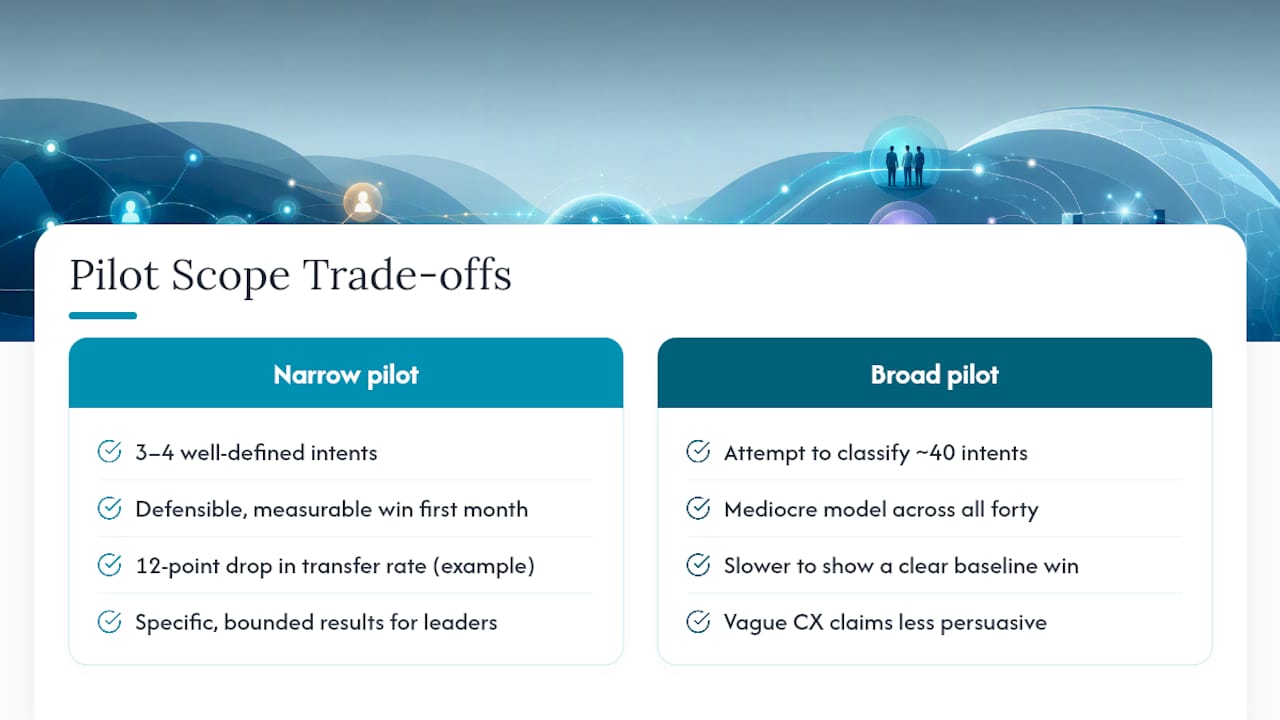
The biggest misconception operations leaders bring into an intelligent routing pilot is that broader intent coverage beats speed to a working baseline. It doesn’t. Teams that try to classify forty intent categories on day one almost always ship a mediocre model on all forty, when three or four well-defined categories with a tight fallback queue would have produced a defensible, measurable win in the first month.
The second misjudgment is stakeholder communication. A 12-point drop in transfer rate on a narrow pilot scope is a far more persuasive number to bring to leadership than a vague claim about improved customer experience across the whole call volume. Specific, bounded pilots build the credibility that funds the next phase. Start narrow, measure honestly against a real baseline, and let the results argue for expansion. That approach beats a sprawling rollout every time, because it gives skeptical stakeholders a number they can actually trust.
— Voiceracx
Ready to Pilot Intelligent Call Routing?
Voiceracx is built for the exact overlay pattern this article describes: routing intelligence layered on your existing IVR or CCaaS stack, with private cloud or on-premise deployment for teams that can’t move sensitive call data off their own infrastructure. That’s a meaningfully different starting point than a rip-and-replace platform migration, and it’s why enterprise pilots on Voiceracx typically scope to weeks rather than quarters.
The Cloud Contact Center platform maps directly to the routing needs covered above: AI Voice Agents handle conversational intent detection and automatic resolution, while InteractFlow manages the escalation and handoff logic once a case needs a human. Enterprise deployments run through Vee Enterprise with custom integration support, while teams that want to test the model before committing to a full build can start on the Basic plan at $199 per month. Request a scoped pilot on two or three high-volume intent categories and you’ll have a measurable baseline to bring back to stakeholders inside your first month.
Where to Verify These Claims
- Digital covers accessibility and channel continuity standards.
- FTC Red Flags Rule resources detail identity-verification obligations relevant to routing flows.
- Wikipedia’s overview of skills based routing explains the taxonomy concept in plain terms.
Sources
- Skills-based routing — Wikipedia
- Digital
- Fighting identity theft: Red Flags Rule — FTC
- What is Intelligent Call Routing & How Does it Work? — GetVoIP
FAQ
What Is Intelligent Call Routing?
Intelligent call routing is a technology that uses AI, intent detection, and CRM data to match a caller with the agent or automated resource most likely to resolve their issue on the first contact. It differs from traditional ACD or IVR systems by making routing decisions based on the reason for the call and real-time performance data, not just menu selections or agent availability.
What Is Intelligent Routing, Exactly?
Intelligent routing is the broader term for any system that applies real-time data, natural language understanding, and skills matching to direct a customer interaction, whether by voice, chat, or email, to the best available resource. It typically layers on top of existing telephony or CCaaS infrastructure rather than replacing it.
What Is Predictive Call Routing?
Predictive routing uses historical interaction outcomes to forecast which agent is statistically most likely to produce a positive result for a given caller, going beyond a simple skills based match. It weighs past performance patterns, not just whether an agent has the right skill tag, which makes it more precise but also more dependent on clean historical data.
What Does Optimal Call Routing Actually Do?
Optimal routing minimizes transfers and wait time by sending each caller directly to the resource that resolves their specific issue fastest, whether that’s a self-service flow, a specialist agent, or an escalation queue. Voiceracx’s overlay deployment model is built specifically to get enterprises to that kind of accuracy quickly by training intent models on their own historical call data.
Does Intelligent Routing Require Replacing Our Existing Phone System?
No. Most enterprise deployments use an overlay layer that sits in front of the existing IVR or CCaaS platform, which means customer-facing phone numbers and core telephony infrastructure stay unchanged during rollout.