Reach 90% First Contact Resolution in 60–90 Days for Contact Centers
An operations-first playbook for contact center leaders to raise first contact resolution. Fix routing and knowledge gaps, empower agents, and validate...
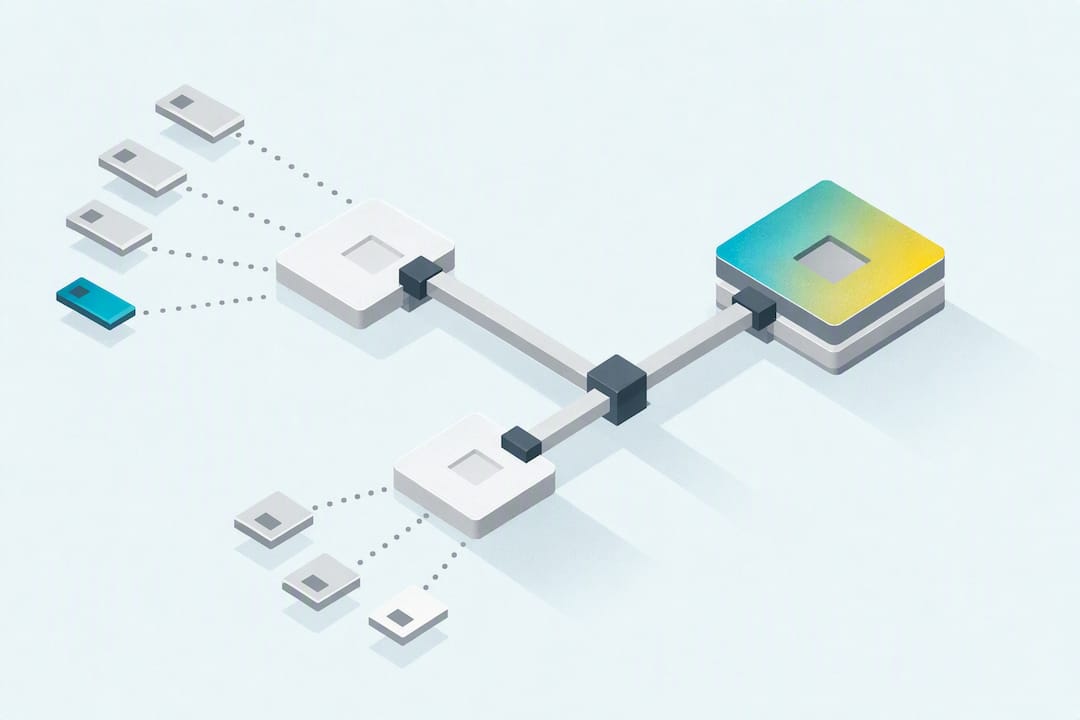
First contact resolution (FCR) measures whether a customer’s issue gets fully resolved during their first interaction, with no follow-up contact needed. Organizations that raise FCR typically see measurable gains in customer satisfaction and lower operating costs, since fewer repeat contacts mean fewer agent hours and less customer frustration. The metric matters because it is one of the few contact center numbers that connects directly to both experience and expense.
TL;DR:
- Most contact centers achieve an FCR rate between 70% and 85%, with top operations reaching above 90% through advanced routing and knowledge management.
- Measuring FCR accurately requires blending objective repeat-contact proxies with customer surveys, as agent flags often overstate true resolution rates.
- Common causes of low FCR include misrouting, knowledge gaps, limited agent authority, systemic access issues, unnecessary transfers, and missing customer data.
- Achieving a 5-point FCR increase can save thousands of follow-up interactions monthly, significantly reducing costs and improving agent satisfaction.
- Implementing quick routing fixes, expanding agent authority, and deploying AI tools can boost FCR within 60 to 90 days, especially with continuous weekly measurement.
What Is First Contact Resolution, and How Does It Differ From First Call Resolution?
First contact resolution and first call resolution describe the same underlying idea, but the terms are not perfectly interchangeable. “First call resolution” is the older, narrower term, born in inbound phone centers before chat and messaging existed as service channels. “First contact resolution” is the channel-agnostic version, covering voice, chat, email, and messaging as the customer service landscape expanded beyond the phone.
The distinction matters for how you set up measurement. A center that only tracks “calls” will miss resolution failures happening in chat queues, social media replies, or email threads, and those gaps compound quickly in an omnichannel operation.
FCR applies wherever a customer opens a service interaction:
- Inbound and outbound voice calls
- Live chat and asynchronous messaging (SMS, WhatsApp)
- Email and web form submissions
- Social media customer service replies
- IVR self-service sessions that resolve without a live agent
The most accurate read on resolution comes from the customer’s own judgment of whether their problem is solved, not from an agent’s checkbox or an internal system flag. That distinction, customer-determined versus agent-determined, drives most of the measurement debate covered later in this piece.
Why FCR Matters: CSAT, Cost, and Agent Experience
FCR is one of the few contact center metrics with a direct, provable link to customer satisfaction. When a customer’s issue gets solved the first time, they don’t have to re-explain their problem, wait on hold again, or escalate their frustration to a supervisor. Atlassian’s service management research ties first call resolution directly to customer experience gains, noting that repeat contacts erode trust in a support relationship faster than almost any other failure point.
Pro Tip: If you only track one downstream metric alongside FCR, track repeat-contact rate within 7 days. It’s the fastest early warning sign that your FCR number is inflated or your fixes aren’t holding.
The operational math is straightforward. Every contact that doesn’t resolve on the first try becomes a second contact, and often a third. Each of those repeat touches consumes agent time, adds to queue volume, and increases average handle time reporting even when individual calls run short. Beyond the cost side, agents who spend their day closing issues cleanly, rather than fielding the same frustrated customer twice, report higher job satisfaction and lower burnout, which shows up later in attrition and training costs.
How Do You Measure First Contact Resolution?
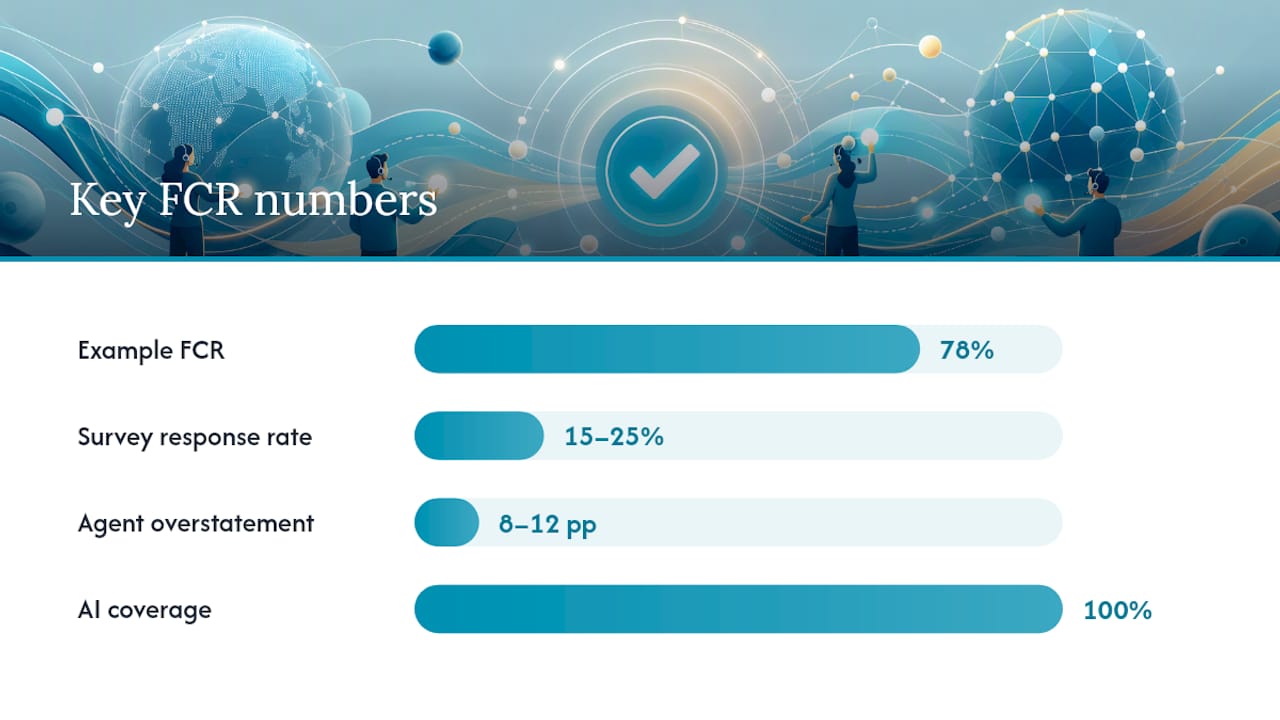
The FCR formula is simple: divide the number of issues resolved on first contact by the total number of contacts, then multiply by 100. If a team handles 1,000 contacts in a week and 780 of them close without a follow up, FCR for that week is 78%.
Where teams disagree is not the formula. It’s which contacts count as “resolved,” and that decision depends entirely on which measurement method you choose.
| Method | How it works | Accuracy | Automation effort |
|---|---|---|---|
| Internal repeat-contact proxy | Flags a contact as resolved if the customer doesn’t reach back out within a set window (commonly 7 days) | Objective but can miss cases where a customer gives up instead of calling back | High; runs automatically off contact history |
| Post-contact survey | Asks the customer directly whether their issue was resolved | Most accurate reflection of customer perception | Low; typical response rates run 15% to 25%, leaving large data gaps |
| Agent-marked resolution | Agent flags the contact as resolved at close | Fast to collect but tends to overstate FCR by 8 to 12 percentage points versus what customers report | Low effort, but self-reported and prone to bias |
| AI or speech-analytics detection | Analyzes conversation content and repeat-contact patterns across the full interaction volume | Strong coverage; can analyze 100% of interactions for resolution and repeat signals | Moderate to high upfront setup, low ongoing effort |
For most contact centers, the practical answer is a blended approach: run the repeat-contact proxy as your primary, automated, objective metric, and layer in a targeted post-contact survey on a meaningful sample to validate what customers actually experienced. ContactBabel’s operational guidance supports using a defined repeat-contact window as the backbone metric precisely because it scales without manual tagging.
What Is a Good First Contact Resolution Rate?
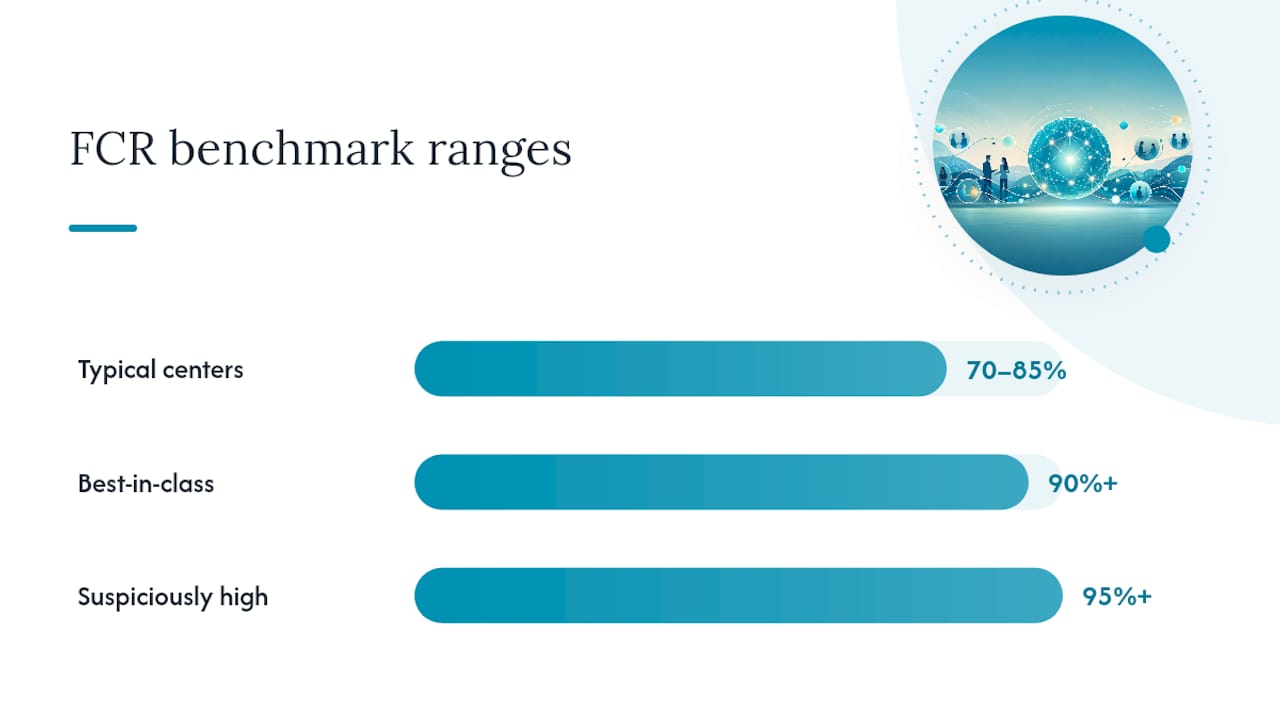
Most contact centers land in the 70% to 85% range, and that band holds fairly consistently across industry benchmarking data. Best-in-class operations, ones running mature routing, strong knowledge management, and empowered agents, can sustain FCR above 90%.
A few factors shift where your realistic target should sit:
- Product and issue complexity: a billing question resolves faster than a multi-system technical escalation
- Industry norms: telecom and technical support tend to run lower than retail or simple account service
- Channel mix: voice and chat resolve differently, so blended FCR across channels needs context
One counterintuitive point worth flagging: an internal FCR rate sitting suspiciously high, say, north of 95%, often signals a measurement problem rather than genuine excellence. It can mean your repeat-contact window is too short, your agent-marked data is inflated, or a channel is dropping unresolved contacts instead of counting them.
What Causes Low First Contact Resolution?
Low FCR rarely comes from one single failure. It usually traces to a handful of recurring, diagnosable causes.
- Misrouting. Sending a customer to the wrong queue or skill group is one of the most common and most fixable drivers of repeat contacts.
- Knowledge gaps. Agents lack accurate, current information to resolve the issue on the spot.
- Limited agent authority. Policies force escalation for decisions a frontline agent could make directly.
- System or data access limits. Agents can see part of a customer’s history but not the full picture across channels.
- Unnecessary transfers. A contact bounces between departments instead of resolving with one owner.
- Missing customer information. The customer wasn’t asked for or didn’t provide the details needed to solve the issue upfront.
Start diagnosis with two operational signals: transfer rate and repeat-contact tags. Those two numbers typically reveal whether routing logic or knowledge gaps are the dominant problem in your environment, which tells you where to spend your first improvement dollar.
How Do You Improve First Call Resolution?
Improving FCR works best as a tiered plan: quick fixes you can ship this month, structural changes that take a quarter, and technology investments that compound over time.
Immediate wins (weeks 1 to 4):
- Audit and correct routing rules that send common issue types to the wrong queue
- Update knowledge base articles for your top 20 contact reasons, written for scanning, not reading
- Establish a warm-transfer protocol so escalations carry full context instead of forcing the customer to repeat themselves
- Set clear decision thresholds so agents know exactly when they can resolve without escalating
Medium-term structural change (60 to 90 days):
- Integrate CRM and case history into a single agent desktop so agents aren’t toggling between systems mid-call
- Expand agent authority for common resolution types, paired with audit logging to satisfy compliance and QA review
- Retrain QA scoring to weight resolution confirmation, not just call handling mechanics
Higher-leverage technology (ongoing):
- Intelligent routing that matches issue type and complexity to the right skill group on the first pass
- AI agent assist that surfaces relevant knowledge base content in real time during the interaction
- Speech analytics to detect callback patterns and flag resolution gaps across your entire interaction volume, not just a survey sample
Pro Tip: Measure ROI in avoided repeat contacts, not just raw FCR percentage. A 5-point FCR gain on 50,000 monthly contacts means 2,500 fewer follow-up interactions. Multiply that by your average handle time to get a real cost figure for the business case.
Mpathic’s research on FCR programs shows centers combining routing fixes with knowledge management investment can move meaningfully toward 90%+ FCR within that 60 to 90 day window, provided leadership tracks the metric weekly rather than quarterly.
How Enterprise AI Supports FCR Improvement
Each root cause above maps to a specific technology lever. Misrouting responds to intelligent routing systems that match contacts to the right skill group automatically. Knowledge gaps respond to AI agent assist that surfaces answers in the flow of conversation. System access gaps respond to CRM-integrated agent desktops that eliminate tool switching.
When evaluating any contact center automation platform, check four things: security and governance controls, deployment flexibility (cloud, private cloud, or on-premise), depth of CRM and telephony integration, and whether the vendor supports a measurable pilot tied to your actual FCR baseline before you commit to a full rollout.
Don’t Let FCR Become a Vanity Metric
Chasing a higher internal FCR number is easy. Chasing genuine resolution, the kind customers actually feel, is harder. Blend your measurement methods, and make FCR a shared goal across operations, product, and compliance, not a number one team can quietly inflate.
— Voiceracx
Put FCR Improvements Into Practice With Voiceracx
Most of the fixes covered above, better routing, stronger knowledge access, unified agent tools, require technology that connects cleanly to what your agents already use. An enterprise AI platform combining intelligent routing, AI agent assist, and omnichannel automation across voice, chat, and messaging, with CRM and telephony integration can prevent agents from stitching together answers from multiple different screens.
For regulated industries, Voiceracx supports private cloud and on-premise deployment so data control and auditability stay intact while automation scales. Speech analytics and AI detection capabilities also give you a way to measure resolution signals across full interaction volume, not just the slice that responds to a survey.
The practical next step is a pilot: pick one queue or contact type, set a measurable FCR target, and run it against your current baseline for 60 to 90 days. Explore the Cloud Contact Center platform to see deployment options, or check current plans and pricing to scope a pilot that fits your team’s size and channel mix.
Sources
The benchmarks, formulas, and measurement comparisons in this article draw from Tollanis’s FCR benchmarking research, Mpathic’s program guidance for reaching 90%+ FCR, and Atlassian’s service management resources on the customer experience link. Background on the metric’s origin and definition comes from Wikipedia’s overview of first call resolution, and measurement-window practices reference ContactBabel’s industry FCR report. For a broader view of channel consistency in measurement, see this guide on unifying customer experience across channels. Readers building an internal business case should pair these sources with their own transfer-rate and repeat-contact data before setting targets.
- First call resolution
- ContactBabel FCR report (archive)
- First Call Resolution (FCR): What it is, Why It
FAQ
What Is a Good First Contact Resolution Rate?
A good FCR rate typically falls in the 70% to 85% range, with best-in-class contact centers sustaining above 90%. The right target for your team depends on issue complexity, industry, and channel mix, so treat these ranges as a starting benchmark rather than a fixed goal.
What Does FCR Mean?
FCR stands for first contact resolution, meaning a customer’s issue is fully resolved during their first interaction with support, with no follow-up contact required. The term expanded from the older “first call resolution” to cover voice, chat, email, and messaging channels as service moved beyond the phone.
How Do You Improve First Call Resolution?
The fastest gains come from fixing routing rules, updating knowledge base content, and giving agents clear authority to resolve issues without escalating. Longer-term, integrating CRM data and deploying AI agent assist tools compounds those gains by keeping resolution-relevant information in front of agents during the interaction itself.
Why Is First Contact Resolution Important?
FCR matters because it connects directly to customer satisfaction and operating cost. Fewer repeat contacts mean fewer frustrated customers, lower average handle time across the queue, and better agent morale, since agents spend more time closing issues cleanly instead of reworking the same case twice.