Blog
Collections Automation With AI: What to Automate and How
How AI collections automation works, which receivables tasks it covers, what results to measure and which TCPA and Regulation F controls to build in from day one.

Collections automation with AI uses machine learning and conversational agents to prioritize accounts, contact customers on the right channel, handle routine payment conversations and give collectors real-time support, while compliance rules are enforced by the system rather than left to individual memory. For enterprises, particularly in regulated industries, the deciding factors are less the model itself than the controls around it: consent, call-frequency limits, disclosure, auditability and the ability to keep data in an environment the organization governs. VOICERAcx is built for that combination, with voice and chat agents, an outbound dialer, CRM and telephony integration, and cloud, private cloud or on-premise deployment.
This guide is written for operations, customer experience and IT leaders who run collections or accounts receivable (AR) follow-up at scale and need to decide what to automate first, what to measure and what to put in place before the first automated call goes out.
TL;DR
- AI in collections covers four layers: prediction and prioritization, outreach across voice, SMS, email, WhatsApp and web, collector assistance and monitoring and quality assurance. Rules-based automation covers only fixed schedules and templates.
- Published industry benchmarks for well-run programs report higher early-stage cure rates, more promises to pay kept and fewer complaints, which makes compliance a measurable output and not only a constraint.
- In the United States, AI-generated voices fall under the Telephone Consumer Protection Act (TCPA), so consent state must be verified before every automated call attempt.
- Deployment choice, integration depth and governance (role-based access control, audit trails, recording and analytics) determine whether a pilot can become a production program.
- VOICERAcx publishes plans from $0 to $999 per month for self-serve use and offers custom contracts for private cloud and on-premise enterprise deployments.
What AI adds to collections that rules-based automation does not
Traditional collections automation follows fixed logic: send a reminder at day 3, a second notice at day 10, place a call at day 15. Every account in the same bucket receives the same treatment, regardless of its history or likelihood of paying.
AI changes three things:
- Who is contacted first. Models estimate the probability that an invoice or account will be paid late, so effort goes to accounts where intervention changes the outcome.
- How the contact happens. Conversational voice and chat agents can hold a two-way exchange: confirm identity, discuss the balance, take a promise to pay, route to a payment method or escalate.
- What humans see. Collectors receive live prompts, summaries and flagged issues instead of working from a static call list.
Analysts treat this as a distinct implementation category. Gartner publishes an implementation guide for accounts receivable AI agents aimed at finance leaders who need to assess, pilot and operationalize agents that cut manual effort and improve the customer experience at scale. The sequence it names, assess, pilot, operationalize, is a sound frame for the rollout described below.
Which collections and AR tasks AI can handle
Payment prediction and prioritization
Prioritization is the least visible and often the highest-value use. An academic study built with a multinational bank trained a prototype on 175,552 invoices from 3,725 customers across eight Latin American countries and predicted on-time versus late payment with up to 77% accuracy. More important for operations, ranking customers by invoice value multiplied by late-payment probability, instead of by amount overdue alone, changed roughly half of the ranking order. Collector time moved toward accounts that were genuinely at risk.
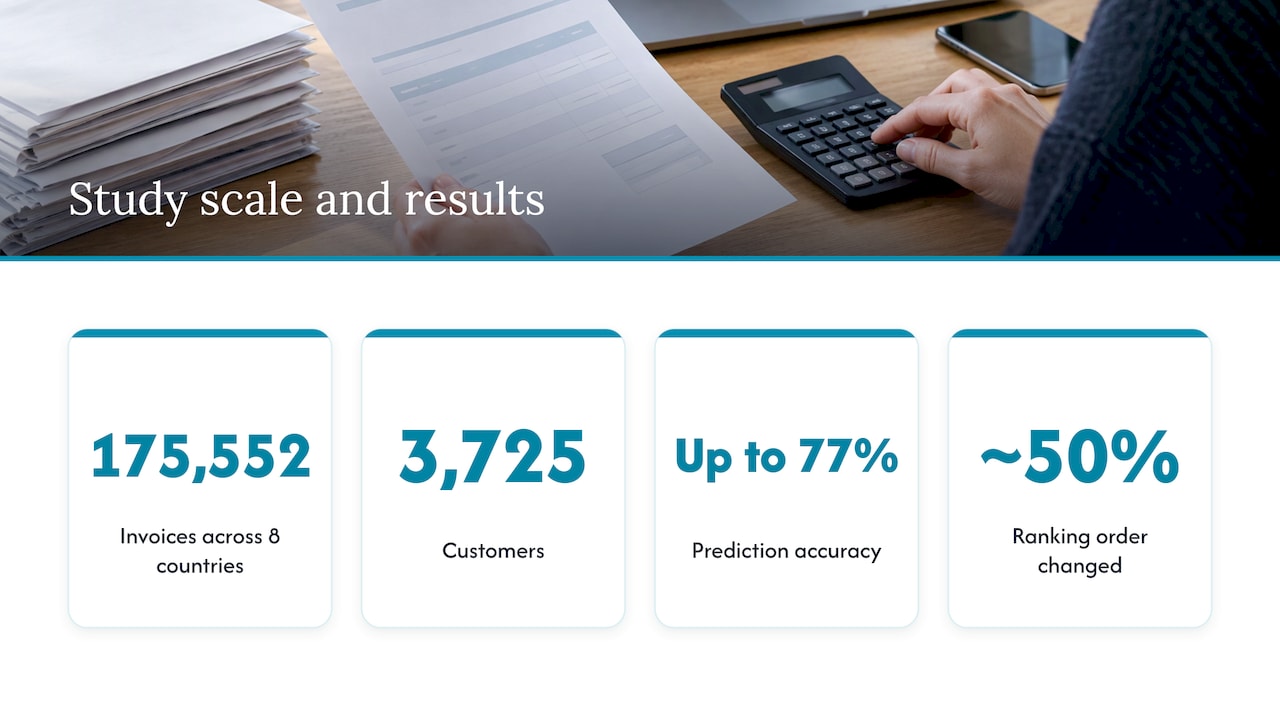
The lesson for an enterprise is practical: even a modest prediction model changes the work queue, and the queue is where cost and recovery are decided.
Customer outreach across channels
Outreach is where conversational AI operates. Typical use cases include:
- Early-stage reminders by voice, SMS, WhatsApp or email, before an account becomes seriously delinquent.
- Inbound and outbound conversations that confirm the balance, offer payment options and record a promise to pay.
- Follow-up on missed promises, scheduled automatically.
- Secure payment capture during the call.
The value of working across channels is continuity: a customer who receives a text, replies by chat and then calls should meet one conversation history, not three disconnected systems. This depends on integration with the CRM and telephony stack, discussed below.
Collector assistance
Not every conversation should be automated. Disputes, hardship cases and high-value accounts usually belong with a person. AI still helps there with live guidance, transcription, summaries and flags. For regulated centers, latency matters in this role: guidance that arrives after the customer has moved on is of no use, a point covered in our piece on real-time agent assist for regulated contact centers.
Monitoring and quality assurance
Manual review typically samples a small share of calls. Automated analysis of recorded conversations can score every interaction for required disclosures, prohibited phrases and unresolved disputes. For collections, this turns compliance from a periodic audit into a continuous control. Our article on QA automation for regulated contact centers describes the move from sampling to full coverage.
What results to measure
A program needs a baseline before it needs a model. The metrics that matter in collections are:
| Metric | What it shows |
|---|---|
| Early-bucket cure rate | Share of accounts 1 to 30 days past due that pay before rolling further |
| Promise-to-pay kept rate | Whether commitments taken in conversation actually convert |
| Right-party contact rate | Share of attempts that reach the actual account holder |
| Days sales outstanding (DSO) | Average time to collect on B2B receivables |
| Complaints per 1,000 accounts | A direct signal of conversation quality and compliance |
| Blended cost per resolved account | Labor, technology and oversight combined |
Benchmark data gives a sense of the range. A June 2026 white paper from an outsourcing provider reports that top-tier programs reached a 71% early-bucket cure rate against a baseline near 55%, a 62% promise-to-pay kept rate against about 47%, a 31% lift in right-party contact, an 8-day improvement in B2B DSO and 0.4 complaints per 1,000 accounts against about 2.1. The same paper describes a US equipment-finance case with roughly $2.1 billion in receivables that reported $2.61 million in first-year gross value, a 5.6x first-year return.
These figures describe programs in that report and its period, not a guaranteed outcome. Their use is as a template for what to track: set your own baseline for each metric above, then measure the change after each phase of rollout.
Compliance controls to build in before the first call
In collections, the cost of a compliance failure is higher than the cost of a missed recovery. Controls therefore belong in the architecture from the start.
Consent for AI voice
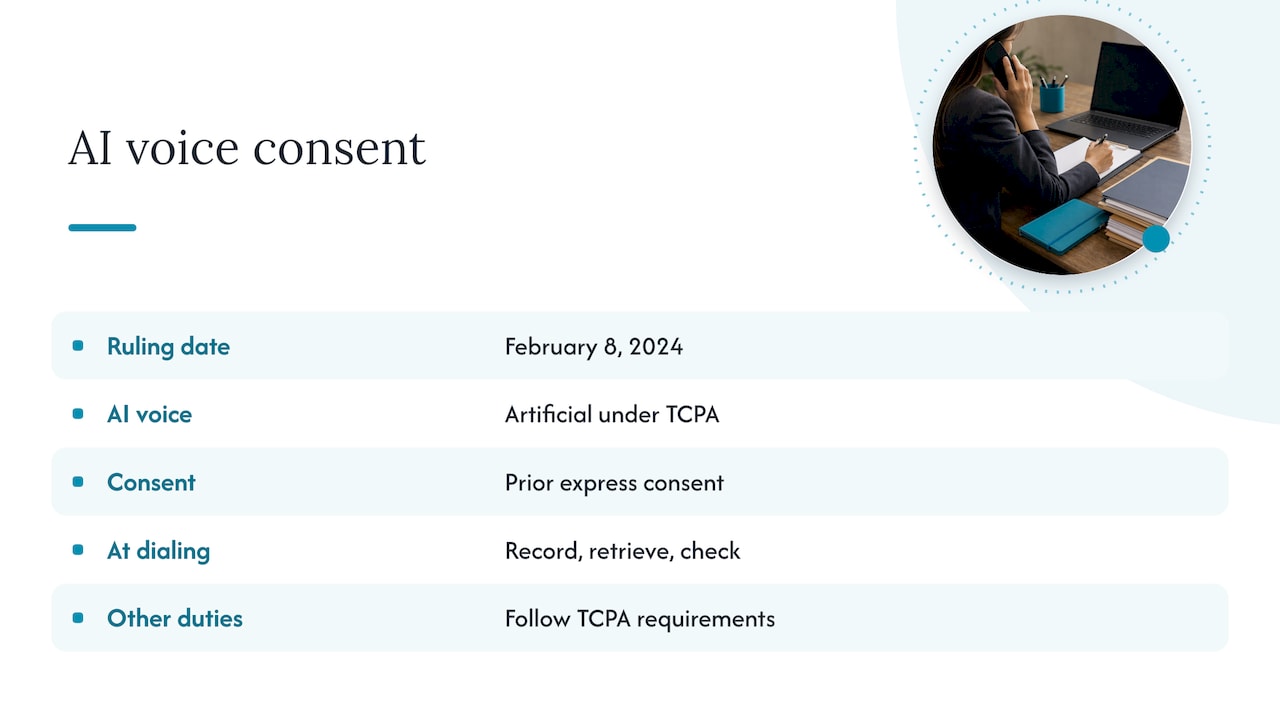
In a ruling issued on February 8, 2024, the Federal Communications Commission declared AI-generated voices to be “artificial” under the TCPA. Businesses using AI voices must obtain at least prior express consent from the person called and otherwise follow the TCPA. Consent therefore has to be recorded, retrievable and checked at the moment of dialing. Our guide to TCPA dialer compliance, AI consent and live scrubs covers the mechanics.
Contact rules enforced by the system
Under the Fair Debt Collection Practices Act and its implementing rule, Regulation F, collectors operate under limits on call frequency and on the times of day they may call. The practical principle, which the same outsourcing white paper frames as compliance by instrumentation, is that caps should be enforced by the dialer and not by an agent’s memory, that consent status should be checked before every attempt, and that scripts should be versioned and reviewed. Every element should be inspectable and samplable.
Disclosure and escalation
Design each automated conversation to identify itself as automated where required, to recognize a dispute or a request to stop contact, and to hand off to a person promptly. An agent that can detect those moments and route them correctly is a safer agent than one that tries to resolve everything itself.
Rules that differ by jurisdiction
US federal rules are only one layer. State laws, sector regulators and, for multinational operations, privacy regimes add requirements. Confirm current obligations with your legal and compliance teams before launch and re-confirm when a new channel or market is added. For banks, our overview of banking contact center compliance requirements and controls maps the common control set.
Data, integration and governance requirements
The technical foundation determines whether automation can be trusted at scale.
- CRM and account data. The agent needs balance, due date, payment history, contact preferences and consent state in real time. Without them, conversations are generic and compliance checks are incomplete.
- Telephony. Dialer, call routing and recording have to connect to the same platform that holds conversation logic, so that caps, time windows and recordings are consistent.
- Payment capture. Collecting a payment in the call should happen in a secure flow that keeps card data out of the agent and the transcript.
- Access control and audit trail. Role-based access control, versioned scripts and full logs of what was said, sent and decided are the evidence base for any audit or dispute.
- Deployment environment. Regulated organizations often need to decide where data and models run. Cloud, private cloud and on-premise each trade speed of rollout against direct control, a decision explored in cloud versus on-premise for regulated contact centers.
Security mapping is a distinct workstream. The relevant frameworks, including PCI and NIST, are laid out against contact center controls in our guide to contact center security for regulated organizations.
A phased rollout
- Baseline. Record current cure rates, promise-to-pay performance, DSO, complaints and cost per account, by bucket and portfolio.
- Start with the lowest-risk, highest-volume segment. Early-stage reminders and payment-link follow-ups are typically the first candidates, as the balance is clear and disputes are rarer.
- Add prioritization. Use predicted payment risk to order queues and to select which accounts receive a call, a message or a human touch.
- Introduce voice. Move to AI voice only once consent capture, call caps and escalation paths are tested end to end. Our article on the enterprise AI outbound dialer describes a rollout of 6 to 12 weeks with compliance protected.
- Extend to collector assist and full-coverage QA. Every conversation, automated or human, is scored against the same standards.
- Review monthly. Compare each metric with baseline, sample transcripts and update scripts under version control.
How VOICERAcx supports collections automation
VOICERAcx is an enterprise platform for AI voice and chat agents, omnichannel engagement and contact center automation, with collections named among its core workflows alongside customer service and sales. AI Voice Agents and AI Chat Agents hold the conversations, Vee Dialer handles AI outbound dialing, and agents are set up without code and integrated with CRM and telephony systems. Voice recording and analytics support review of every interaction, and secure IVR voice payments cover payment capture.
Deployment can be cloud, private cloud or on-premise, which matters for organizations that must keep data under their own control. Published self-serve plans on the VOICERAcx plans page run from Free at $0 per month, through Basic at $199, Standard at $249 and Advance at $399, to Pro at $999 per month, with a Pay As You Go option and a chat session fee of $0.18 per session. Enterprise integrations and private cloud or on-premise deployments are handled through custom contracts, starting with Vee Enterprise.
Perspective
We see collections automation as a governance problem first and a conversation problem second. A fluent agent is easy to demonstrate; an agent whose every action can be explained to an auditor, a regulator or a customer is what a regulated enterprise can actually run.
That is why our platform keeps conversation logic, dialing, recording, analytics and integration in one environment. When consent state, call windows and scripts are enforced where the call is placed, compliance stops depending on individual discipline and becomes a property of the system.
It is also why we offer private cloud and on-premise deployment. Collections data is among the most sensitive an enterprise holds, and full data control should be a deployment choice available to the organization, not a concession.
Our advice is to begin with the segments where automation is clearest, measure against a baseline, and let humans handle disputes and exceptions with AI assistance. Unified omnichannel automation and human oversight work together; the best programs use both.
Voiceracx
FAQ
Is AI for accounts receivable the same as collections automation?
The two overlap. AI for accounts receivable usually covers the whole cycle, including invoice matching, payment prediction and cash application, while collections automation concentrates on contacting customers about overdue balances. Most enterprises begin with outreach and prioritization because the effect on cash is quickest to measure.
What is the difference between automation and AI in collections?
Automation executes fixed rules, such as sending the same reminder to every account at day 10. AI adjusts to the account: it predicts payment likelihood, orders the work queue, holds a two-way conversation and flags issues for a human. Most production programs combine both, with rules enforcing compliance limits and AI deciding priority and content.
Do AI voice calls need customer consent in the US?
Yes. The FCC ruled in February 2024 that AI-generated voices count as artificial voices under the TCPA, so businesses need at least prior express consent before placing such calls. Consent should be stored with the account and checked before each attempt.
Which collections tasks should stay with people?
Disputes, hardship situations and high-value or sensitive accounts are best handled by trained staff, supported by live AI guidance and summaries. Automated agents should recognize these cases and transfer promptly.
Can collections AI run inside our own environment?
Yes, where the platform supports it. VOICERAcx offers cloud, private cloud and on-premise deployment, with custom contracts for private and on-premise enterprise setups.
Sources
- Gartner, AI Implementation Guide: Accounts Receivable Agents
- Optimize Cash Collection: Use Machine Learning to Predict Invoice Payment (arXiv)
- The Recovery Curve: Collections and AR Recovery white paper (June 2026)
- FCC Rules AI-Generated Voices Are Artificial Under the TCPA (Wilson Sonsini)