Call Recording Laws in the US: Consent Rules for Businesses
Is it legal to record calls? How US federal and state call recording laws work, which states require all-party consent, and how to stay compliant at scale.
Recording a call is legal under US federal law when at least one participant consents, but a group of states requires every party to agree, and a business that calls or receives calls across state lines is effectively bound by the strictest rule that touches the call. For a contact center, the practical answer is to build consent into the call flow itself, so that disclosure, consent capture, retention and access controls work the same way on every call, whether a human agent or an AI voice agent answers it.
This guide explains the federal baseline, the one-party and two-party (all-party) consent distinction, the states that require all-party consent, the penalties, and how to apply these rules to automated and AI-led calls.
TL;DR
- Federal law allows recording when one party to the call consents, and states may be stricter.
- Thirteen states are classed as all-party consent jurisdictions, so a recorded call touching one of them should follow the stricter rule.
- Penalties include criminal fines and prison terms, plus civil damages, so consent should be captured and documented on every call.
- AI voice agents and automated dialers do not change the consent rule, and they add telephone-marketing obligations on top of it.
- This article is general information, not legal advice: confirm your call flows with counsel before deployment.
What the federal rule says
The federal Wiretap Act, 18 U.S.C. § 2511(2)(d), allows a person to record a call they are part of, or a call where one party has given prior consent, unless the recording is made to commit a criminal or tortious act. This is the one-party consent rule: if your company is a party to the call and agrees to the recording, the federal baseline is satisfied.
Two points matter for enterprises. First, the federal rule is a floor, and states are free to set stricter requirements. Second, recording a conversation to which no participant has consented, and which you are not part of, is almost always illegal, and so is disclosing the contents of an illegally intercepted call.
One-party and two-party consent, defined
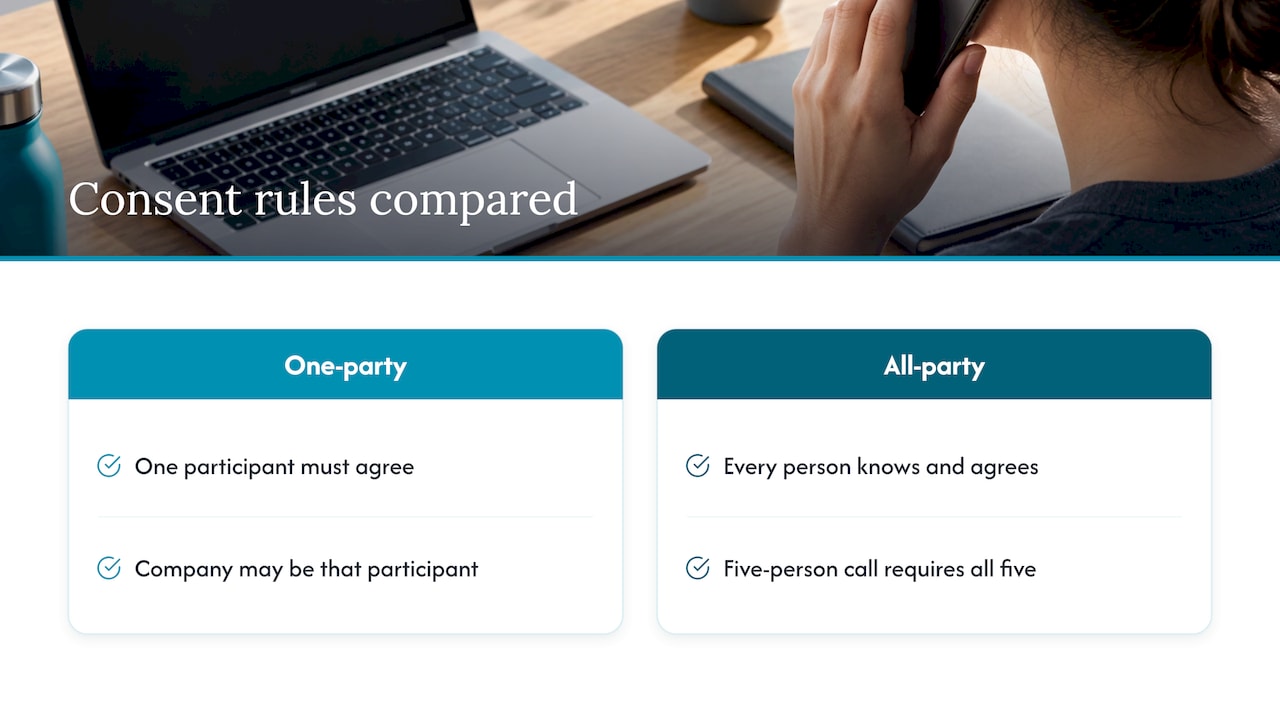
One-party consent means one participant must agree to the recording. In a business setting, the company recording its own call is that participant.
Two-party consent, more accurately all-party consent, means every person on the call must know about and agree to the recording. The name “two-party” is a shorthand: a conference call with five participants requires all five.
Consent can be given in several ways. A July 2024 wiretap chart from the law firm Kilpatrick Townsend lists the methods generally recognized in the FCC context: verbal or written consent before recording, verbal notification before recording begins, or a repeated audible beep tone. In Washington, the statute states that consent may be obtained by an announcement recorded along with the call, which is the model most contact centers follow with their opening disclosure.
Which states require all-party consent
The same Kilpatrick chart classifies 13 states as all-party consent jurisdictions, with 37 states plus DC following one-party consent:
| All-party consent states (July 2024 chart) |
|---|
| California, Connecticut, Delaware, Florida, Illinois |
| Maryland, Massachusetts, Montana, Nevada, New Hampshire |
| Oregon, Pennsylvania, Washington |
Classification is not always clean. Other legal summaries treat Connecticut, Delaware, Michigan, Nevada and Oregon as split or unsettled, for example because a statute distinguishes civil from criminal liability or in-person from telephone conversations. The Kilpatrick chart itself notes that state wiretap laws usually sit within criminal eavesdropping or interception statutes and may not mention telephone recording explicitly, which makes interpretation necessary. Michigan illustrates the point: its eavesdropping statute is commonly described as requiring consent from all parties for recorded conversations.
The practical consequence is that a state-by-state memorized list is a weak control. A better control is a single consent standard applied to every call that your counsel has validated against the states you serve.
Calls that cross state lines
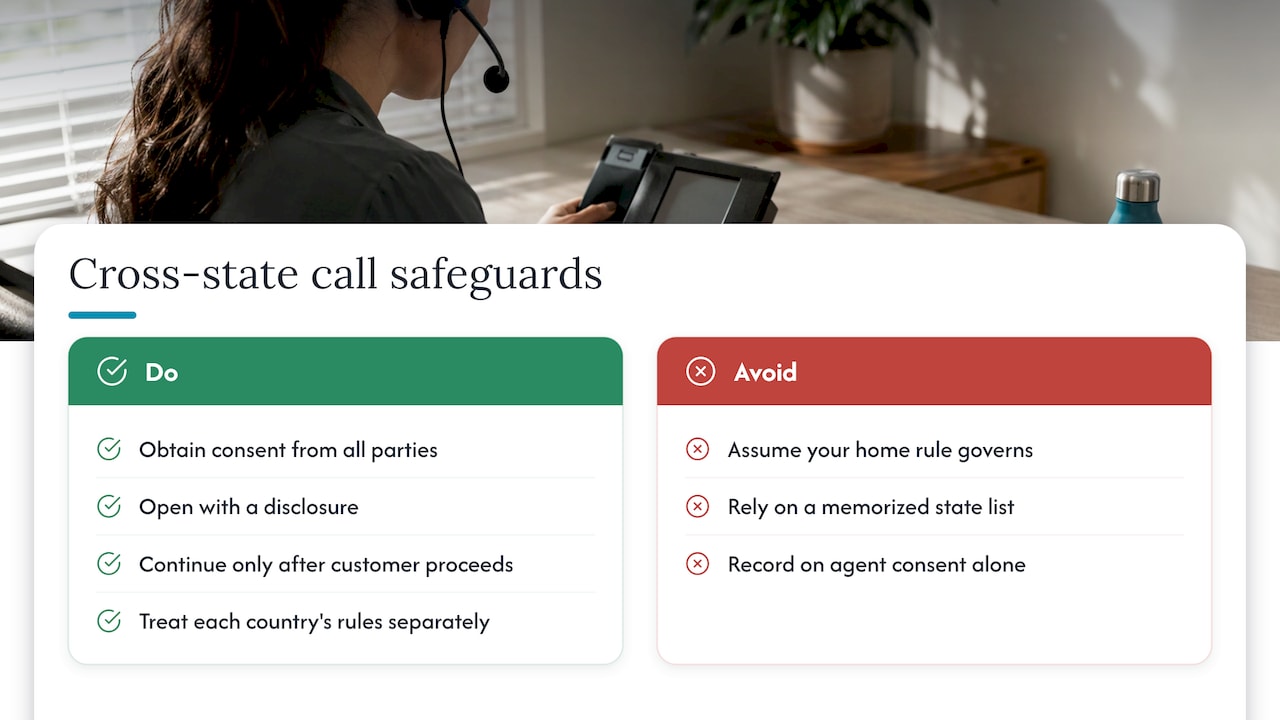
Most enterprise contact centers handle calls between callers and agents in different states. The Digital Media Law Project advises that when participants are in more than one state, you should obtain consent from all parties.
The case that anchors this advice is Kearney v. Salomon Smith Barney (2006). The California Supreme Court held that California’s all-party rule applied to a call recorded in Georgia, a one-party state, when the clients were in California, as described in the Justia 50-state survey. A company located in a permissive state therefore cannot assume its home rule governs a call with a caller in a stricter one.
A worked example: an outbound collections team in Texas, a one-party state, calls a customer in Illinois, an all-party state, and records the call with only the agent’s consent. The Texas rule does not protect the company. Opening the call with a disclosure, and continuing only after the customer proceeds, treats every call as if it were governed by the stricter state.
The same logic holds internationally. Under GDPR, a recording of an identifiable person is personal data that needs a lawful basis and a transparency notice, and in the EU no rule resolves conflicts between member states’ recording laws, so the stricter jurisdiction is the safe choice. Canada’s Criminal Code allows a participant to record, but businesses must also follow PIPEDA or provincial equivalents, which require notification and a stated purpose. If you serve callers outside the US, treat each country’s rules separately.
Penalties and exposure
The consequences are both criminal and civil.
- Federal: the Congressional Research Service summarizes violations as punishable by up to five years’ imprisonment and fines up to $250,000 for an individual or $500,000 for an organization. Under 18 U.S.C. § 2520, affected persons may seek actual or statutory damages, generally the greater of $100 per day of violation or $10,000, plus punitive damages where appropriate and attorneys’ fees.
- California: Penal Code § 632 punishes intentional recording of a confidential communication without all parties’ consent with a fine up to $2,500 per violation, up to one year in jail or prison, or both, and up to $10,000 per violation after specified prior convictions. Section 632.7 extends comparable penalties to cellular and cordless phone communications.
- Maryland: willful interception without all-party consent is a felony with up to five years’ imprisonment, a fine up to $10,000, or both, with civil remedies including actual and punitive damages, according to a March 2026 summary of the statute.
A recording program at contact-center scale multiplies the exposure, because every non-compliant call is a separate potential violation. That is the reason consent handling belongs in system design and not in individual agent habits.
Exceptions that exist, and those that rarely apply
Statutes contain narrow exceptions. California § 632 excludes public gatherings and circumstances where the parties may reasonably expect to be overheard or recorded, plus specified utility, tariff-service, correctional-facility and hearing-aid uses. Washington’s statute permits one-party-consented recording of emergency communications, threats, extortion, anonymous or repeated harassing calls, and hostage situations.
These exceptions are limited and fact-specific. They are not a basis for routine customer-call recording, and a contact center should not design its operations around them.
A consent routine for business call recording
A defensible routine has five parts, and each can be built into the call flow.
- Apply the strictest applicable standard. Treat all calls as all-party consent calls, unless counsel has confirmed a narrower approach for a defined population.
- Disclose at the start of the call. State that the call may be recorded and why, before substantive conversation. For inbound calls, put the notice in the greeting. For outbound calls, deliver it before the call purpose is discussed.
- Give the caller a real choice. Canadian privacy guidance treats voiceprint use, where a recording verifies identity on future calls, as an issue that may need express consent, and expects organizations to offer alternatives where recording is not integral to the service. A route to an unrecorded interaction, or a decision to end the call, supports that.
- Keep evidence of consent. Store the disclosure played, the timestamp and the outcome with the recording, so that you can show how consent was obtained.
- Limit what is kept and who sees it. Recordings often capture payment card numbers and health details. Redaction, access controls and retention schedules reduce the risk, and our guides on PII redaction in call recordings and contact center data retention describe the controls in detail.
Where recordings must remain in a given country or environment, deployment location matters too. See data residency compliance for regulated teams for how legal requirements translate into technical controls.
AI voice agents and automated calls
An AI voice agent that speaks with a customer and records the exchange is subject to the same recording consent rules as a human agent. The recording law does not distinguish by the identity of the speaker: the company is the recording party, and the caller is the other party whose knowledge and consent the all-party states require.
AI adds a second layer for outbound calling. In a ruling issued on February 8, 2024, the FCC declared that AI-generated voices are “artificial” under the Telephone Consumer Protection Act, which brings AI-voiced outbound calls within the TCPA’s consent requirements. Recording consent and telemarketing consent are different obligations, and an outbound program needs both. Our article on TCPA compliance for contact center dialers covers the dialer side.
Three design points follow for AI deployments:
- Open with the disclosure. The agent’s first utterance should state that the call is recorded and, where relevant, that the caller is speaking with an automated agent.
- Log consent as structured data. A consent flag attached to the interaction record in the CRM lets compliance teams query and audit it.
- Cover every channel. Voice, SMS, WhatsApp and web chat each have their own notice requirements, and a unified platform should apply one policy across them. Businesses that answer calls with an automated service, such as AI phone answering services, face the same question of which state’s consent rule governs a call that crosses state lines.
Industry rules layer on top. Banks, healthcare providers and payment-taking teams carry additional obligations, covered in our guides to banking contact center compliance, HIPAA for phone systems and AI and PCI DSS call center scope.
Our perspective
Recording laws are written around a simple event, one person recording another, but an enterprise contact center runs thousands of such events per day across voice, chat and messaging channels, in several jurisdictions at once. At that scale, compliance cannot depend on each agent remembering a script.
We design VOICERAcx so that governance sits in the platform: voice recording and analytics, integration with CRM and telephony systems, and deployment in cloud, private cloud or on-premise environments, so regulated organizations keep control of where recordings are held. Our AI voice and chat agents can be configured without code, which lets compliance teams adjust call flows and disclosures with the business units that own them.
Our position is that consent should be treated as a property of the interaction record, in the same way as the transcript or the outcome, so that it is auditable after the fact. Organizations that begin from the strictest consent standard and enforce it uniformly are the ones best placed to scale automation without scaling legal risk.
Voiceracx
Applying this with VOICERAcx
For regulated enterprises that need recording, analytics and automation under one governed platform, Vee Enterprise offers deployment options that include private cloud and on-premise, with CRM and telephony integration. Teams running outbound programs can look at Vee Dialer, and those building automated conversations can start with AI Voice Agents.
To see how recording, consent and retention controls fit your call flows, begin on the VOICERAcx home page and choose the product that matches your channels.
FAQ
Is it legal to record phone calls?
Under federal law it is legal when at least one party to the call consents, and a company that is a party to its own call can supply that consent. Many states follow the same rule, but a group of all-party states requires every participant’s consent. Because penalties can be criminal and civil, businesses generally apply the stricter standard to all calls.
What does two-party consent recording mean?
It means everyone on the call must know about and agree to the recording, not only the person recording. The phrase is used even when more than two people take part. Consent is usually given by an announcement at the start of the call followed by the caller continuing, or by an explicit verbal or written agreement.
Does a business have to tell callers it is recording?
In all-party consent states, yes, in effect, because the callers’ knowledge and consent are required. In one-party states the federal baseline does not require notice, but calls often cross state lines, and the Kearney decision shows a stricter state’s law can apply. A disclosure on every call is the simplest way to cover both situations.
Do the same rules apply to AI voice agents?
Yes. The recording rules apply to the company regardless of who or what speaks for it. Outbound AI-voiced calls also fall under the TCPA, since the FCC has declared AI-generated voices to be artificial voices under that law. Your counsel should review both the recording disclosure and the calling consent.
Sources
- Recording Phone Calls and Conversations, Digital Media Law Project
- Kilpatrick Townsend wiretap laws chart, July 2024
- One-party and two-party consent states, explained
- Washington RCW 9.73.030
- Recording Phone Calls and Conversations, 50 State Survey, Justia
- EU recording laws guide
- Canada recording laws guide
- CRS overview of the Electronic Communications Privacy Act
- California Penal Code § 632
- California Penal Code § 632.7
- Maryland Wiretapping and Electronic Surveillance Act
- FCC Rules AI-Generated Voices Are “Artificial” Under the TCPA