Call Encryption: How to Protect Voice Calls End to End
Call encryption explained for businesses: transit vs end-to-end, SRTP and SIP, what cellular lacks, and how to secure recordings and AI voice agents.
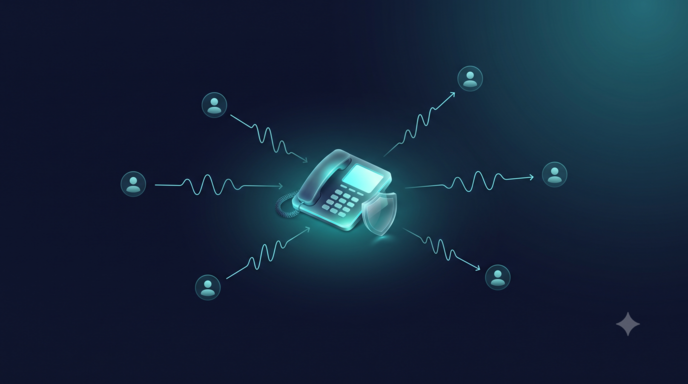
Call encryption converts voice audio into ciphertext with cryptographic keys, so that any packet intercepted between the parties is unintelligible to everyone except the endpoints that hold the keys. For an enterprise, however, protecting a call is not a single setting. It depends on the media protocol, the signaling that carries the keys, the network the call crosses, and what happens to recordings, transcripts and metadata after the conversation ends. This guide explains the mechanisms, the difference between encryption in transit and end-to-end encryption, the limits of ordinary cellular calls, and a practical checklist for contact centers that run telephony, AI voice agents and connected business systems.
TL;DR
- Call encryption makes intercepted voice packets unreadable; in VoIP it is typically delivered by Secure RTP (SRTP) for media, with signaling protected so the keys are exchanged safely.
- Encryption in transit protects audio between two points on a network, while end-to-end encryption keeps it protected from the sender’s device to the recipient’s device.
- Standard cellular voice calls and SMS do not provide end-to-end encryption, according to CISA, so sensitive conversations belong on vetted, encrypted channels.
- Encrypting the audio does not hide metadata such as phone numbers, call duration and timing, nor does it protect recordings, transcripts or CRM records.
- Enterprises should treat call security as a system: media, signaling, storage, access control, redaction, deployment model and auditability.
What call encryption does
A voice call is digitized, split into packets and sent across one or more networks. Without encryption, anyone with access to a point on that path can capture the packets and reconstruct the audio. With encryption, the audio payload is transformed using a key, and only a party holding the matching key can turn it back into speech.
In voice over IP, two layers are commonly used. NIST guidance on VoIP security describes protecting voice traffic at the IP layer with IPsec or at the application layer with Secure RTP. The same document cautions that cryptographic processing can add packet size and latency, and that excessive overhead may degrade voice quality. Capacity planning and codec selection therefore belong in the encryption project from the start, not as an afterthought.
Secure RTP is the protocol most enterprise voice deployments rely on for media. It encrypts the RTP payload, and it can also authenticate packets so that the receiver rejects any that have been altered in transit. That integrity property matters as much as confidentiality: an attacker who cannot read a call may still try to inject or modify packets.

Encryption in transit versus end-to-end encryption
The two terms are often used interchangeably, and the difference determines who can access the audio.
| Aspect | Encryption in transit | End-to-end encryption |
|---|---|---|
| Where protection applies | Between one point and another, typically a client and a server | From the sender’s device to the recipient’s device |
| Intermediate servers | May decrypt and re-encrypt the media | Cannot decode the media |
| Data at the endpoints | May be stored in plaintext at source and destination | Protected until the recipient’s device decrypts it |
| Typical use | Carrier-to-carrier trunks, client-to-platform media, server-side processing | Person-to-person calls on vetted secure apps |
The distinction follows AWS’s explanation of messaging security, which describes transit encryption as protecting data between a client and a server while data may remain in plaintext at either end, and end-to-end encryption as securing it from the sender’s device until the recipient decrypts it.
Google’s documentation for its meeting product illustrates the end-to-end model in practice. Google states that in end-to-end encrypted calls, audio and video are encrypted from one caller’s device to the other, and only the shared secret key held by those devices can decode them. Relay servers may pass the media between the callers but cannot decode it, because they do not possess that key. Microsoft describes the same property for one-on-one Teams calls: information is encrypted at its origin and decrypted only at its intended destination.
For a contact center, this distinction has a direct consequence. A platform that transcribes calls, analyzes sentiment, redacts card numbers or lets an AI agent respond must process the audio on the server side. Such workloads rely on strong encryption in transit and at rest under the organization’s control, rather than on true end-to-end encryption between two humans. Choosing which model applies to which call type is a design decision, and it should be documented.
What ordinary phone calls do not protect
Many organizations assume that a call placed over the mobile network is private. The CISA guidance on communicating securely on a mobile device states that cellular protocols, from 2G through 5G, do not provide end-to-end encryption for voice calls or text messages, which leaves those communications vulnerable to interception. CISA also notes that networks may route voice and SMS over older protocols while carrying data over a faster one such as 5G, which can make security inconsistent from one call to the next.
The practical recommendations from the same source are straightforward:
- Use a properly vetted secure messaging app with end-to-end encryption and VoIP functionality for sensitive voice calls.
- If traditional voice calls or text messaging must be used, do not share sensitive data over them.
For enterprise teams, the second point is the operational rule: define which information may never be spoken or texted on an unprotected channel, and give agents and customers a protected alternative, such as masked keypad entry for card data. The client’s guidance on secure IVR payments and DTMF masking covers how that works architecturally.
What encryption does not hide
Even a perfectly encrypted call leaves traces. Google Fi notes that end-to-end encryption makes call content unreadable if intercepted and limits listening to the two eligible participants, but phone numbers, call duration, time and voicemail are not end-to-end encrypted.
The Berlin Group working paper on privacy and security makes the same point at a policy level: traffic data, including the identifiers of the communicating parties, communication preferences, the length of encrypted packets and online status, can reveal a surprising amount of information. It recommends limiting the data exposed to intermediaries.
For a business, metadata minimization means asking several questions:
- Which systems log caller numbers, durations and routing paths, and for how long?
- Who has access to call detail records, and is that access role-based and logged?
- Do third-party services in the call path receive more identifying information than they need?
- Are retention periods defined and enforced, not merely documented?
Securing the signaling as well as the media
Encrypting media alone leaves a gap if the keys are negotiated over an unprotected channel. RFC 8862 explains that comprehensive protection for SIP media requires SIP, SDP and RTP, specifically SRTP, to work together, and that SIP must integrity-protect the media keying information carried in SDP. In other words, call security is a system and not a single switch: signaling securely conveys the keys, and SRTP then protects the negotiated media session.
For teams moving to a new carrier connection, this has concrete implications for trunk design. Signaling should be encrypted between the enterprise border controller and the provider, media should be negotiated with SRTP, and both sides must agree on the supported profiles before cutover, otherwise calls may fall back to unencrypted media or fail. The client’s article on SIP trunk integration checks lists the verification steps that engineering teams run before migrating production traffic.
NIST adds a caution that remains relevant: VoIP deployment requires careful preparation, because administrators may wrongly assume that digitized voice can simply be plugged into an already secured network and remain secure. Voice has latency and jitter requirements that firewalls, address translation and encryption overhead can affect, so testing under real call volumes is part of the security work.

Recordings, transcripts and stored data
A call that was protected in transit becomes a data-at-rest problem the moment it is recorded. Recordings, transcripts, summaries and analytics outputs often contain the same sensitive content as the live conversation, and they usually persist for far longer. Controls should include:
- Encryption of stored audio and transcripts, with keys managed separately from the storage that holds the data. A useful primer on encryption at rest explains how to choose the layer at which data is encrypted and then secure the keys.
- Redaction of personal and payment data before or during storage. The client’s article on PII redaction in call recordings sets out the methods, their limits and the controls that should surround them.
- Role-based access control, so that supervisors, quality teams and analysts see only the recordings their function requires.
- Audit logs recording who played, exported or deleted a recording.
- Defined retention and deletion schedules aligned to the regulation that governs the business.
Where card data is involved, keeping it out of the recording altogether reduces the compliance scope substantially. The client’s analysis of PCI DSS scope reduction through DTMF masking quantifies that effect for call centers.
Regulatory and standards context
Which standard applies depends on the sector and the jurisdiction. Several reference points recur in enterprise reviews:
- U.S. federal systems. NIST notes that FIPS 140-2 applies to federal agencies using cryptographic security systems to protect sensitive information in computer and telecommunications systems, including voice. Organizations selling to federal agencies should confirm the validation status of the cryptographic modules involved.
- Public safety radio. The Project 25 user needs statement published in March 2025 says encryption must use AES 256 and records that NIST and other public safety bodies strongly recommend AES for these organizations.
- Healthcare. Telephony, recordings and AI summaries all carry protected health information, which the client’s guide to mapping HIPAA to phone systems, recordings and AI addresses control by control.
- Payments. Card data spoken or keyed during calls falls under PCI DSS requirements, covered in the client’s contact center security mapping.
These sources describe obligations and recommendations in the United States. Organizations operating in other regions should confirm local requirements with their compliance counsel, since data residency and lawful-access rules differ by country.
A practical checklist for enterprise voice security
The following sequence suits most contact center and AI voice deployments.
- Inventory the call paths. Map every route a call can take: carrier trunks, SIP gateways, softphones, mobile devices, AI agents, recording systems and CRM integrations.
- Set the encryption standard for each hop. Require encrypted signaling and SRTP media wherever the endpoints support them, and document exceptions with an owner and an expiry.
- Decide where decryption happens. Server-side processing such as transcription or AI response requires decryption inside a controlled environment. Specify which systems may do so and under what access rules.
- Protect stored artifacts. Apply encryption at rest, key separation, redaction, retention limits and access logging to recordings, transcripts and analytics.
- Reduce metadata exposure. Limit what intermediaries and third-party services receive, and set retention for call detail records.
- Verify identity. Encryption protects the channel but does not confirm who is on it. Pair it with caller authentication and, for chat channels, user verification by risk tier. Caller identity attestation is covered in the client’s note on STIR/SHAKEN compliance steps.
- Choose the deployment model deliberately. Regulated organizations frequently need cloud, private cloud or on-premise options so that keys, recordings and logs stay under their own governance.
- Test under load and audit regularly. Confirm that encryption does not degrade voice quality at peak volume, and review logs and configurations on a fixed schedule.
Securing AI voice and chat agents
AI agents add components to the call path: speech recognition, language models, text-to-speech, orchestration and the integrations that read and write customer records. Each component should be evaluated against the same questions as any other system touching a call. Where does the audio get decrypted? Which service stores the transcript? Which credentials does the agent use to reach the CRM, and are they scoped to the minimum necessary? Can every action the agent takes be reconstructed from an audit trail?
Omnichannel deployments extend the question further. The same customer may begin on a phone call, continue over messaging and finish by email, so protection and logging need to be consistent across channels. Messaging channels have their own audit requirements, which the client discusses in its article on audit-ready WhatsApp support, and automated SMS flows raise handoff and compliance questions covered in its piece on SMS chatbots.
Perspective
VOICERAcx approaches call encryption as one control within a governed system, not as a feature to be switched on. In our experience with regulated customers, the questions that matter in a security review are rarely about the cipher. They concern who can reach a recording, where keys are held, how an automated agent’s actions are logged, and whether the organization can demonstrate all of this to an auditor.
For that reason we offer cloud, private cloud and on-premise deployment, so that enterprises can keep voice data, recordings and keys within the boundary their policies require. Our platform brings voice agents, chat agents, omnichannel engagement and CRM and telephony integration under one governance model, with role-based access control, analytics and auditability applied consistently across channels. Our no-code agent setup is designed to let operations teams change conversation flows without opening new paths for sensitive data.
We recommend that every organization begin with the call-path inventory described above, and that it treat the deployment model as a security decision made early, not a procurement detail settled late.
Voiceracx
How VOICERAcx supports secure voice automation
VOICERAcx is an enterprise AI platform for building and deploying voice and chat agents, with omnichannel engagement, contact center automation, AI outbound dialing, secure IVR voice payments, voice recording and analytics, and integration with CRM and telephony systems. Organizations that need to review architecture, deployment options and governance can start with Vee Enterprise or explore the AI Voice Agents and AI Chat Agents pages.
Teams that want to evaluate the platform at smaller scale can review the published plans on the Vee Lite plans page: Free at 0 USD per month, Basic at 199 USD per month, Standard at 249 USD per month, Advance at 399 USD per month and Pro at 999 USD per month, plus a pay-as-you-go option and a 0.18 USD fee per chat session. Private cloud and on-premise deployments are arranged through custom contracts.
FAQ
Are regular phone calls encrypted?
Not end to end. CISA states that cellular protocols from 2G to 5G do not provide end-to-end encryption for voice calls or text messages, so those communications are vulnerable to interception. For sensitive conversations, use a vetted secure app with end-to-end encryption or a protected business telephony channel, and avoid sharing sensitive data over ordinary calls.
Can a service provider listen to an end-to-end encrypted call?
When end-to-end encryption is correctly implemented, the provider cannot decode the audio. Google explains that its relay servers can pass media between callers but cannot decode it, because only the callers’ devices hold the shared key. Providers may still retain metadata such as phone numbers, device identifiers and call times.
What is the difference between SRTP and end-to-end encryption?
SRTP is a protocol that encrypts and authenticates the media of a VoIP call. Whether it amounts to end-to-end encryption depends on where it terminates. If the media is decrypted at a server or gateway, it is protected in transit but not end to end. If only the two callers’ devices hold the keys, it is end to end.
Does encrypting calls make a business compliant?
No. Encryption is one control among several. Compliance frameworks such as PCI DSS and HIPAA also address access control, retention, redaction, logging and vendor management, so recordings, transcripts and connected systems need protection as well. Confirm the requirements that apply to your sector with your compliance team.
Do AI voice agents weaken call security?
Not inherently, but they add systems that process call audio and customer data. Evaluate where audio is decrypted, where transcripts are stored, which credentials the agent uses and whether its actions are fully logged. A platform with controlled deployment options and audit trails makes these questions answerable.
Sources
- NIST SP 800-58, Security Considerations for Voice Over IP Systems
- RFC 8862: Best Practices for Securing RTP Media Signaled with SIP
- CISA: How to Communicate Securely on Your Mobile Device
- Google Meet: Learn about call and meeting encryption
- Microsoft: Use end-to-end encryption for Teams calls
- Google Fi: Secure calls with Fi
- AWS Security Blog: Reduce the security and compliance risks of messaging apps
- Berlin Group working paper on privacy and security issues
- CISA: Statement of Project 25 User Needs, March 2025