BYOK Encryption: How It Works for AI Contact Centers
BYOK encryption explained for enterprise customer service: how envelope encryption works, how BYOK differs from HYOK, and what to check before you deploy.

Bring your own key (BYOK) encryption lets an organization generate and control the keys that protect its data inside a cloud or SaaS service. For a contact center that records calls, stores chat transcripts and feeds customer data to AI agents, the practical question is where the keys live and who can revoke them. Our answer at VOICERAcx is to match the deployment model to the sensitivity of the data. Cloud, private cloud and on-premise options let regulated teams place key control where their compliance obligations require it.
TL;DR
- BYOK means you create the master key outside the provider and import it into the provider’s key management service (KMS). IBM describes the envelope pattern: your master key encrypts the data keys that encrypt the data.
- BYOK gives policy control and faster revocation. It does not stop the provider from decrypting data while the key sits in the provider’s KMS, according to the Cloud Security Alliance.
- HYOK (hold your own key) keeps keys entirely in your own systems, at the cost of latency, availability and operating effort.
- For AI voice and chat, key control must cover recordings, transcripts, logs, caches and vector stores, not only the primary database.
- Where regulation demands maximum data control, private cloud or on-premise deployment is the strongest option.
What BYOK encryption means
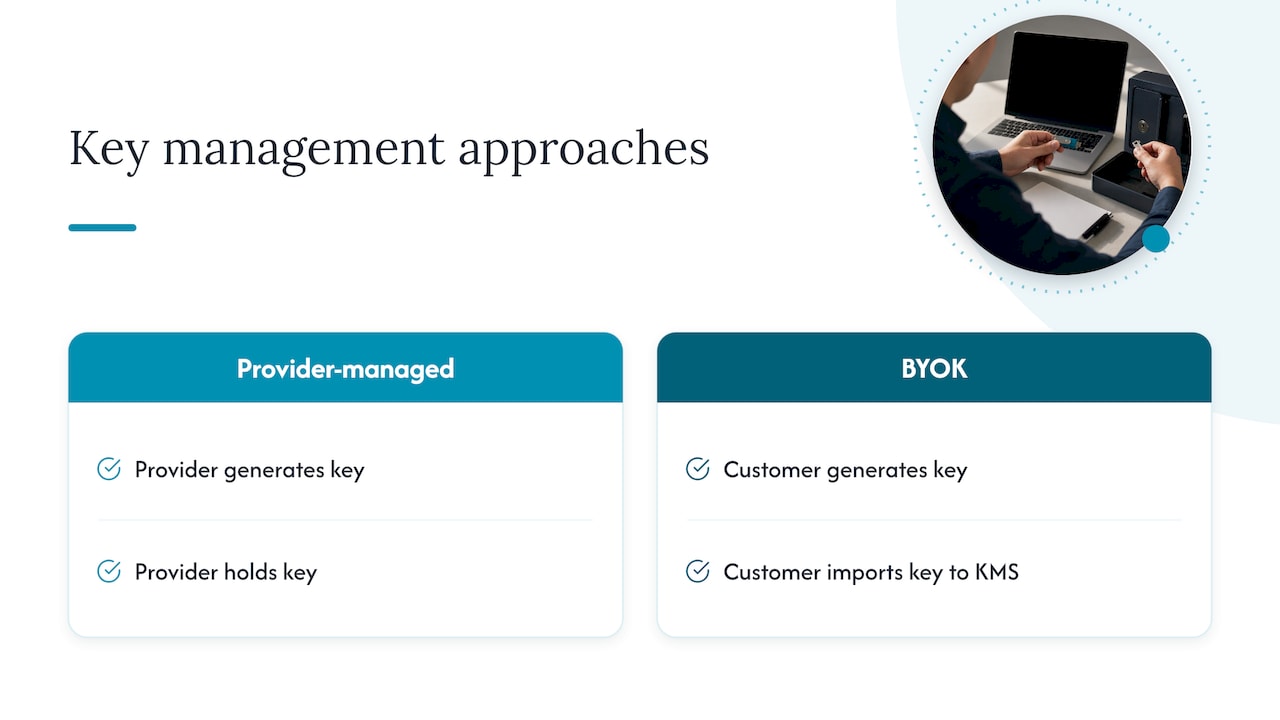
Every cloud service encrypts stored data. The difference lies in who creates and controls the key. With provider-managed keys, the provider generates and holds everything. With BYOK, the customer generates the key and imports it into the provider’s KMS, a service that stores keys and performs cryptographic operations. Microsoft’s key management overview defines BYOK as a customer-managed key scenario in which keys are imported from an external location into a cloud key management service.
The term “customer-managed encryption keys” is the broader category. AWS describes customer managed keys as keys in your own account that you create, own and manage, with control over key policies, rotation and scheduled deletion. BYOK is the variant in which the key material originates outside the cloud provider.
How the key hierarchy works
BYOK normally uses envelope encryption, which layers keys so that the master key never touches bulk data. IBM’s explainer outlines the sequence:
- You generate a master key, often in an on-premises hardware security module (HSM), a tamper-resistant device for key generation and storage.
- You wrap that key with the provider’s public key and import it through a secure API.
- The provider’s KMS creates a single-use data encryption key (DEK) that encrypts the data.
- Your master key encrypts the DEK, and the encrypted DEK is stored alongside the data.
Because only the encrypted DEK is stored with the data, disabling or destroying the master key makes the data unreadable. Google Cloud calls this crypto-shredding and lists it among the controls customer-managed keys provide, together with key location, rotation, access logging and destruction.
What BYOK does and does not protect
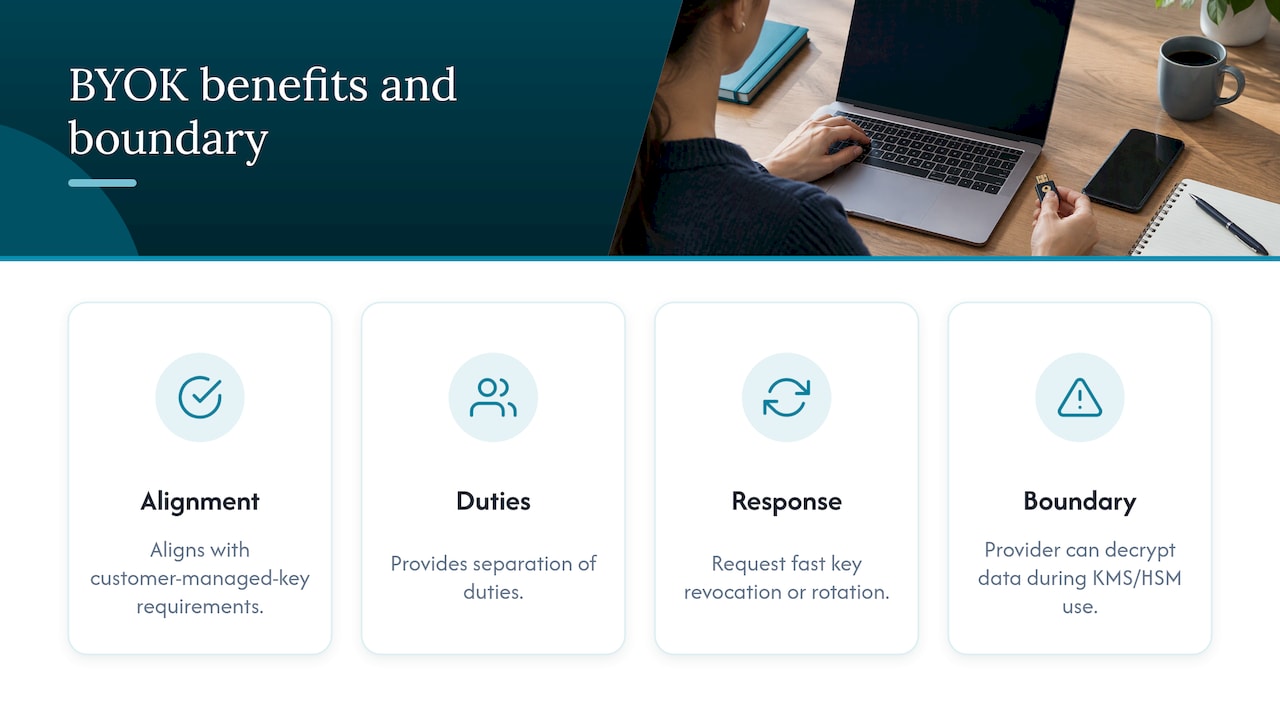
The Cloud Security Alliance lists three benefits of BYOK: alignment with customer-managed-key requirements, separation of duties, and improved incident response, because you can ask the provider to revoke or rotate keys quickly. It also states the boundary: while keys are used inside the provider’s KMS or HSM, the provider is technically able to decrypt data.
Canada’s Communications Security Establishment makes the same point in its cloud cryptography guidance. It adds a jurisdictional dimension: where the provider controls the KMS, it may be compelled to respond to foreign law-enforcement requests. Organizations may therefore use provider-controlled keys for most data and customer-controlled keys for the most sensitive data.
The UK’s National Cyber Security Centre advises using BYOK or HYOK where regulation requires it, because imported keys add complexity. That is the right frame for a compliance owner: BYOK is a control you adopt to satisfy a defined requirement, and the requirement should be written down first.
BYOK vs HYOK
The two models differ in where the key lives and who can reach it.
| Criterion | BYOK | HYOK |
|---|---|---|
| Key generation | Outside the provider, in your HSM or KMS | In your own key manager |
| Key location in operation | Imported into the provider’s KMS | Stays in your environment |
| Provider access | Provider can decrypt while the key is in its KMS | Provider has no access to the key |
| Revocation | Fast, through key disable or deletion | Immediate, you stop answering key requests |
| Operational effort | Moderate | High: you run and secure the KMS or HSM |
| Availability risk | Low to moderate | Latency and availability depend on your key service |
The Cloud Security Alliance notes that HYOK requires you to operate and secure a KMS or HSM and to own backup, disaster recovery and audit responsibilities. ControlPlane adds that in HYOK the provider calls your key manager to wrap or unwrap every data key, which introduces latency and availability exposure. For a live voice channel, where a delayed key call is audible to the caller, that exposure deserves design attention.
Why AI voice and chat raise the stakes
A contact center holds some of the most sensitive customer data an enterprise processes: payment details, health information, identity checks and call audio. AI agents multiply the places that data lands. ControlPlane lists the surfaces a tenant key strategy must cover for AI workloads:
- Per-tenant vector collections or mandatory tenant metadata filters
- Tenant-scoped prompt and response caches
- Conversation memory and logs scoped to tenant, user and session
- Per-tenant fine-tuning with provenance records
- Tenant-scoped credentials for agent tools
- Model-provider data retention and training opt-out settings
- Per-tenant region pinning for data residency
A key policy that protects the primary database but ignores transcripts, caches and backups leaves gaps. The same source notes that revoking a tenant’s key breaks reads, writes, backups, search and AI inference for that tenant, so the impact of revocation should be documented before launch.
Sector rules sharpen the requirement. Our guides on banking contact center compliance and HIPAA for healthcare contact centers map the controls those industries expect, and call encryption covers protection of the voice path itself.
Rotation, revocation and deletion in practice
These three operations are often confused.
- Rotation replaces the active key version on a schedule. In Google Cloud’s model, as described in one GCP engineering guide, rotation creates a new primary version without re-encrypting existing data or disabling older versions.
- Revocation disables the provider’s ability to use the key, which stops decryption until access is restored.
- Deletion destroys key material. It is the remediation for a compromised key, and it is the basis of crypto-shredding.
That guide also states that crypto-shredding is valid only when every copy, including backups, snapshots, replicas and indexes, is under the destroyed key version, and the key was never shared across tenants or data classes. Pair key lifecycle with a retention schedule so that deletion obligations and key destruction agree; our guide to contact center data retention covers that schedule.
Questions to settle before choosing a key model
- Which rule requires it? Identify the regulation, contract or audit finding. Compliance motivations and jurisdictional considerations differ by market, as this overview of cybersecurity and compliance drivers illustrates for online businesses.
- Which data classes need customer-controlled keys? Call recordings and payment data usually rank above general analytics.
- Where must the data reside? Key location and data location should agree. See our guide to data residency compliance.
- Who operates the key service? BYOK needs key custodians and a recovery plan. HYOK needs an always-available key service.
- How does it integrate? Keys must work across CRM, telephony and every channel the AI agents touch.
- What is the tenancy model? Isolation shapes how keys are scoped. Read about single-tenant SaaS.
Google’s recommended practices favor centralized key governance for organizations with strict regulatory requirements, where a security team sets policy and controls key operations.
Our perspective
Key control is a deployment decision as much as a cryptographic one. The question is not only who holds the master key, but where the whole conversation lifecycle runs: audio, transcripts, logs, analytics and the AI layer.
This is why VOICERAcx is offered in cloud, private cloud and on-premise deployments, with governance, auditability and data control built for regulated industries. A bank or a healthcare provider can choose the environment that matches its policy, instead of adapting policy to a single hosting model.
We also treat integration as part of security. Voice, WhatsApp, SMS, email and web agents connect to CRM and telephony systems, and every connection is a place where data must stay governed. A platform that unifies those channels lets one set of access controls and audit trails apply across them.
Our recommendation is to begin with the requirement, map it to data classes, and then select the deployment model that meets it. For the most sensitive workloads, private cloud or on-premise deployment gives the most direct data control.
Voiceracx
Where VOICERAcx fits
VOICERAcx provides AI voice and chat agents, omnichannel engagement and contact center automation with CRM and telephony integration, deployable in cloud, private cloud or on-premise environments. Regulated teams can review Vee Enterprise for enterprise deployments, or see the published plans, from Free at $0 per month to Pro at $999 per month, on the plans page. For the architecture trade-offs, read cloud versus on-premise for regulated organizations.
FAQ
Is BYOK the same as customer-managed encryption keys?
BYOK is one type of customer-managed key. With customer-managed keys in general, you control the key’s policies, rotation and deletion. With BYOK, you also generate the key material yourself and import it into the provider’s KMS.
Does BYOK stop the provider from reading my data?
Not by itself. While the key is used inside the provider’s KMS, the provider can technically decrypt data, as the Cloud Security Alliance explains. BYOK gives you policy control and fast revocation. HYOK or an on-premise deployment gives stronger exclusion.
When should I choose HYOK over BYOK?
Choose HYOK when a regulation or contract requires that the provider never holds your key. Plan for the extra effort: you operate the key service, and its latency and uptime affect the application.
What happens if I delete or lose my key?
Data encrypted under it becomes unreadable, which is the point of crypto-shredding. Back up key material under a controlled recovery process and document the effect on backups, search and AI inference before go-live.
Sources
- What Is Bring Your Own Key (BYOK)? | IBM
- Overview of key management in Azure | Microsoft Learn
- AWS KMS keys
- Customer-managed encryption keys | Google Cloud
- CMEK recommended practices | Google Cloud
- Choosing a Cloud Key Management Model | CSA
- Choosing and configuring a KMS | UK NCSC
- Guidance on cloud service cryptography (ITSP.50.106) | Canadian Centre for Cyber Security
- Multi-Tenant Isolation for SaaS and AI | ControlPlane
- Cloud KMS and Cryptographic Controls | Megalith’s Big GCP Book
- Cybersecurity and compliance drivers for e-commerce