Skip Months: Answering Machine Detection APIs and Webhooks for Dialers
Engineer guide to answering machine detection for dialers. Compare API modes and webhooks, test live traffic accuracy, and deploy at scale.
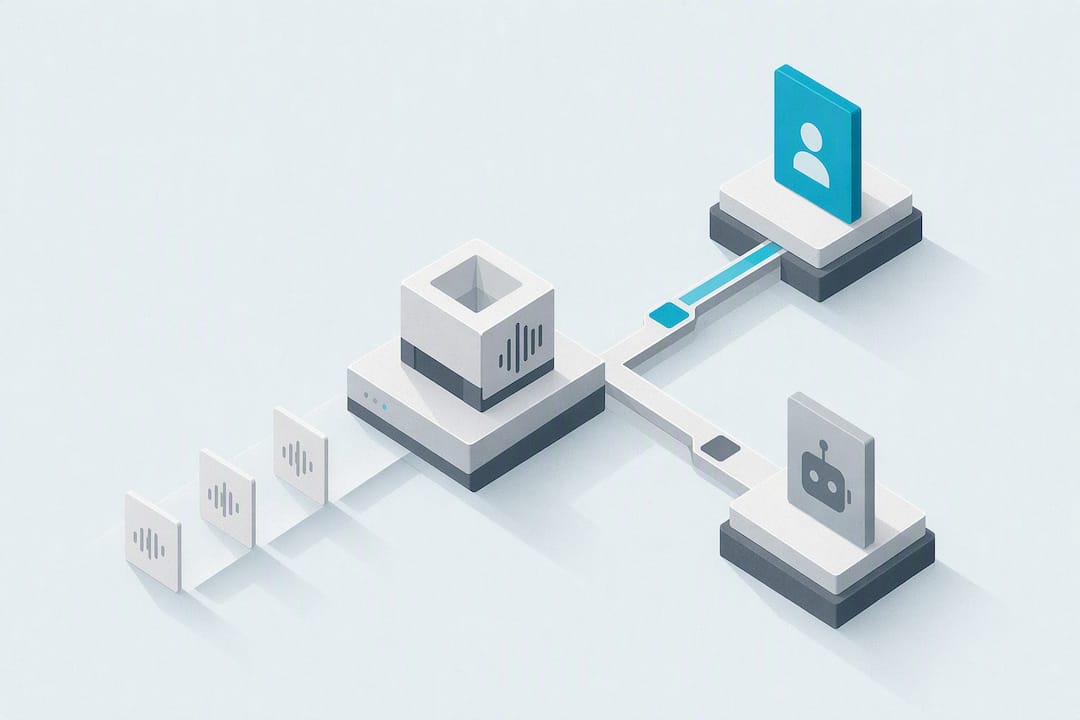
Answering machine detection (AMD) classifies each outbound call as a live human or a machine, then routes the call or triggers a message accordingly. For enterprise contact centers, AMD’s main value is efficiency: it keeps agents off voicemail and on live conversations, lowering cost per contact and raising campaign throughput. The trade-off is that AMD is probabilistic, not certain, and its speed, accuracy, and integration model (synchronous versus asynchronous) all shape how well it performs in production.
TL;DR:
- Most AMD models perform well in controlled tests but can struggle with complex IVR menus, call screening prompts, and short greetings, which are common in live traffic.
- Combining heuristics and machine learning, especially using layered detection with confidence thresholds, improves accuracy but is still affected by audio quality, codec, and network conditions.
- Synchronous detection simplifies logic for low-volume campaigns but introduces latency, while asynchronous models suit high-volume setups but require careful webhook handling and state management.
- Proper tuning of thresholds and timeouts, along with live A/B testing on actual call data, is essential for reliable deployment and reducing misclassification risks.
- Enterprise vendors typically offer validated accuracy SLAs, retraining options, and privacy controls, making buying a proven platform preferable over building a custom AMD model from scratch.
What Does Answering Machine Detection Do in Outbound Systems?
AMD sits at the front of every automated outbound call, listening to the first seconds of audio and deciding whether a person or a machine picked up. That single decision determines what happens next: connect the call to a live agent, play a pre-recorded message, hang up, or route to an automated voicemail response. It’s a small piece of logic with an outsized effect on operational cost.
Outbound dialers in collections, sales, and appointment reminders rely on AMD to avoid wasting agent time on voicemail. Predictive and progressive dialers use AMD results to decide whether to connect an agent at all, which directly affects average handle time and agent idle time. AI voice agents built for outbound campaigns use similar logic to decide whether to leave a voicemail drop or wait for a live response. Collections workflows depend on AMD to comply with contact-attempt rules while still maximizing live conversations per shift.
The operational KPIs affected by AMD performance include:
- Live-connect rate: the share of dialed calls that reach a real person and get routed correctly.
- Average handle time: reduced when agents stop wasting seconds on machine greetings before hanging up.
- Agent idle time: cut when the dialer only connects agents to calls AMD has already classified as human.
- Abandonment and compliance metrics: affected when AMD misclassifies a call and triggers an inappropriate message or silence.
AMD tends to struggle in a few predictable situations: complex IVR menus that mimic conversational pauses, iOS and Android call screening prompts that ask callers to state their purpose, and short business greetings that don’t leave enough audio for a confident decision. Those edge cases are where most production headaches start, and they matter more as call screening adoption grows across carriers.
How Does AMD Work: CPA, Machine Learning, and Hybrid Models
Two broad approaches drive answering machine detection, and most production systems now blend them.
Call Progress Analysis (CPA), the older DSP-based method, relies on signal heuristics rather than semantic understanding. It measures things like tone patterns, voice activity detection (VAD), and silence windows, then applies fixed timing assumptions to decide what it heard. Cisco’s CPA implementation on CUBE devices, for example, classifies audio into discrete event categories such as Asm (answering machine), LS (live speech), and SIT (special information tones), each governed by configurable timing knobs like maximum live-person duration. Dialogic’s telephony application notes describe a similar event model, where APIs expose media-detected events like GCEV_MEDIADETECTED that downstream logic interprets as machine or human answers, using Call Progress Analysis settings applied per call or per channel.
CPA heuristics work fast, but they’re brittle. A real-world example: Genesys Cloud’s documentation describes a heuristic where less than 2,200 milliseconds of speech followed by at least 700 milliseconds of silence signals a live person in some deployments. That kind of fixed rule works well for typical greetings but breaks down against long voicemail scripts with early pauses or clipped human greetings.
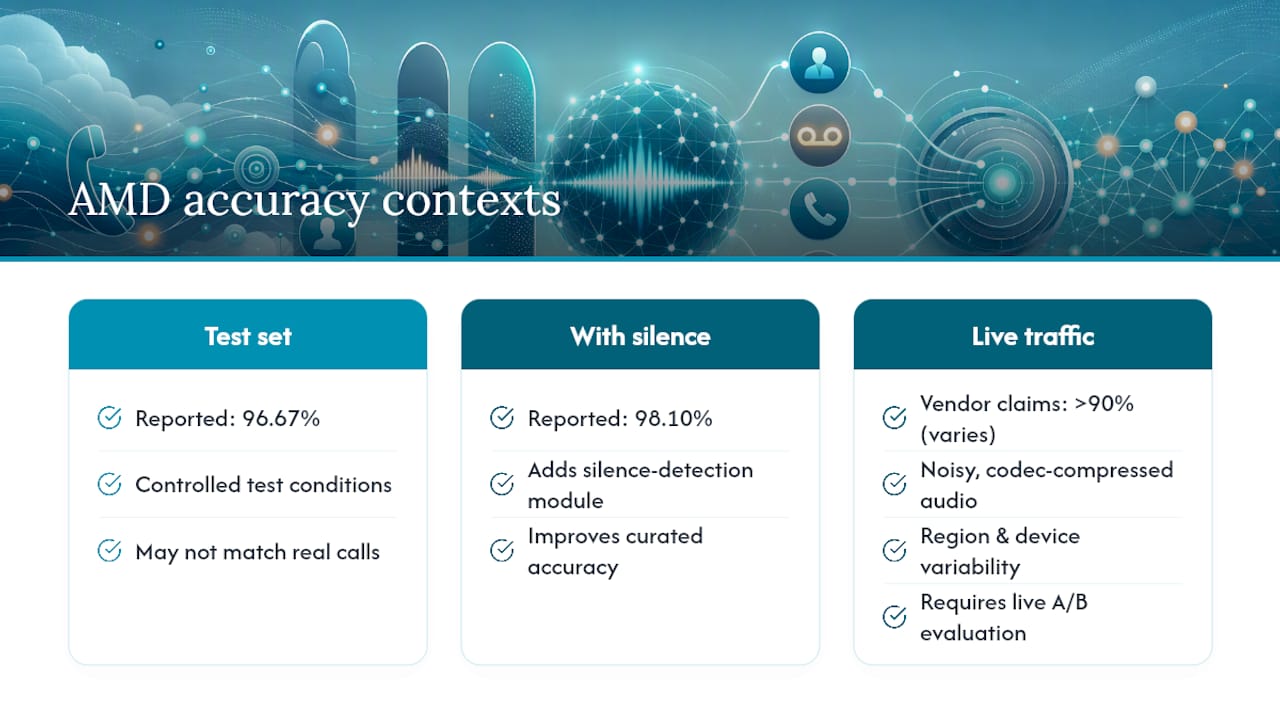
Machine learning approaches replace fixed rules with learned patterns. A 2024 paper describes a streaming architecture that extracts audio embeddings using YAMNet, a transfer-learning audio model, then feeds them into a GRU classifier with just 44,657 parameters. This model reached 96.67% accuracy on its test set, improving to 98.10% when combined with an added silence-detection module. The small model size matters: it’s light enough to run inference continuously on streaming audio without heavy compute.
Most mature production systems now use a layered design:
- A fast heuristic pass gives an early, low-confidence verdict within the first second or two.
- A heavier ML classifier confirms or overrides that verdict once enough audio has accumulated.
- Confidence thresholds decide when to commit to a decision versus wait for more signal.
Audio quality and codec choice change everything here. Compressed codecs, packet loss, and low-bandwidth mobile connections shrink the usable detection window and degrade the acoustic features both CPA and ML models depend on, which is one reason accuracy numbers reported in papers rarely translate one-to-one into live traffic results.
What API Parameters and Webhook Behaviors Matter for Integration?
Every AMD implementation exposes a set of tunable parameters, and understanding them before writing a single line of dialer code saves weeks of debugging later.
Synchronous vs. asynchronous AMD is the first architectural fork. Synchronous AMD holds the outbound call in a waiting state until a verdict is reached, then connects the agent, which adds latency but simplifies logic for lower-volume campaigns. Asynchronous AMD connects the agent immediately and sends the AMD result as a webhook event once detection finishes, which suits high-volume predictive dialers where every second of hold time compounds across thousands of calls. Twilio’s documentation distinguishes these directly through its MachineDetection modes, offering both Enable and DetectMessageEnd behaviors depending on whether you need to know when a voicemail greeting has actually finished.
Common tuning parameters, drawn from documented vendor implementations, include:
- Speech threshold: the minimum duration of continuous speech needed before the system starts leaning toward a “human” classification.
- Speech-end threshold: how long a pause has to last before the system decides the greeting or speech segment has ended.
- Total detection timeout: the hard ceiling on how long AMD will wait before returning an “unknown” or default result.
- AnsweredBy values: the webhook field reporting the final classification, typically including options like human, machine_start, machine_end_beep, or unknown.
Telnyx’s API exposes an even more granular set of modes, including detect_beep and greeting_end, and its premium tier emits specific events like call.machine.premium.detection.ended for greeting-end and beep-detection webhooks.
Webhook design deserves its own attention. Build idempotency into your event handlers, since retries and network jitter can deliver the same AMD result twice. Model the call as a state machine (dialing, detecting, detected, connected, ended) rather than a single flag, so a late or duplicate webhook can’t silently overwrite a call already routed to an agent. And plan explicitly for the “unknown” result: never assume every call resolves cleanly to human or machine, because timeouts and noisy lines guarantee a nontrivial “unknown” rate in live traffic.
Pro Tip: Treat the AnsweredBy webhook field as advisory, not authoritative, until your detection timeout has fully elapsed. Acting on an early partial result is one of the most common sources of misrouted calls in production dialers.
Operational constraints round out the picture. Forked audio streams, where the same RTP media feeds both AMD and a separate transcription or recording pipeline, consume additional per-call resources and need to be sequenced carefully so AMD gets first access to the raw stream before any other processing adds latency.
How Accurate Is AMD, and Where Does It Break Down?
Published benchmarks look strong, but the gap between a curated test set and live traffic is the single most important thing to understand before trusting any accuracy number.
The streaming YAMNet-plus-GRU model referenced earlier reports 96.67% accuracy on its test set, rising to 98.10% once a silence-detection module is added. That number reflects controlled test conditions, not the noisy, codec-compressed, regionally varied audio that hits a real dialer fleet.
Vendor marketing pages frequently advertise accuracy figures above 90%, but these claims vary widely by dataset and rarely disclose full testing methodology. Treat any unsourced accuracy claim as a starting point for due diligence, not a guarantee, and ask vendors for their evaluation methodology before signing a contract.
The predictable failure cases are worth memorizing. Short business greetings (“Thanks for calling, please hold”) can fool detection into a false “human” result because they lack the silence pattern typical of voicemail. Background noise on mobile networks degrades the acoustic signal both CPA and ML models rely on. Call screening features, increasingly common on both iOS and Android, insert an automated prompt before the real recipient speaks, which many AMD systems misread as a machine greeting.
Evaluate AMD not just on raw precision and recall but on time-to-decision, since a detector that’s 2% more accurate but takes three extra seconds to decide may cost more in agent idle time than it saves in avoided voicemail drops. The most reliable evaluation method is a live A/B test that measures downstream agent outcomes, live-connect rate and handle time, not just detection accuracy in isolation. Latency and timeout settings directly shift the false-positive/false-negative balance: shorter timeouts reduce hold time but increase the odds of guessing wrong on a slow-starting human greeting.
How Should You Architect AMD for Streaming and Scale?
Production AMD architecture comes down to a handful of concrete engineering decisions, most of which trade latency against accuracy.
Streaming inference works on small chunks of audio rather than waiting for the whole call to finish. The research behind the YAMNet/GRU model referenced above suggests an initial 480 millisecond stride with a 960 millisecond buffer, a sizing choice that aligns naturally with how voice codecs already packetize RTP audio, balancing responsiveness against model stability.
Serving considerations that matter at scale include:
- CPU vs. GPU serving: small GRU or CNN classifiers like the 44,657-parameter model cited earlier often run efficiently on CPU, avoiding the cost and complexity of GPU inference clusters for this specific task.
- Stateful model serving: recurrent architectures (GRU/RNN) carry hidden state across audio chunks, so your serving layer needs to track per-call state rather than treating each audio frame as independent.
- Non-speech signal handling: fax tones, modem carriers, and special information tones (SIT) need dedicated detection paths, since CPA systems already categorize these as distinct event types rather than lumping them in with human/machine classification.
- Apple call screening: detecting the automated screening prompt on iOS requires specific handling, and premium detection modes may need to restart after the screening prompt clears to correctly classify what follows.
Observability closes the loop. Track your unknown rate, average detection time, and timeout frequency as first-class metrics, not afterthoughts, and set retraining triggers when any of them drift outside historical baselines.
What’s the Right Way to Tune and Test AMD Before Going Live?
Tuning AMD without a plan turns into trial and error across live customer calls, which is expensive and reputationally risky. A structured approach avoids that.
- Start with timeout and silence thresholds, since these are the fastest levers to adjust without retraining any model, and they have the most direct effect on both latency and false-positive rate.
- Build a labeled holdout set from your own call traffic, not just a public dataset, because regional accents, codec quality, and greeting styles vary enough that generic benchmarks won’t predict your live performance.
- Run synthetic greeting tests covering short business greetings, long voicemail scripts, and call-screening prompts before touching live customer traffic.
- Launch a live A/B test that measures agent-side KPIs like live-connect rate and handle time, not just raw AMD accuracy, since the two don’t always move together.
- Define a retrain cadence tied to observed drift in unknown rate or false-positive complaints, rather than retraining on an arbitrary calendar schedule.
Graceful-failure design matters as much as tuning. AMD output is inherently probabilistic, so production systems should default to routing low-confidence calls to a human agent rather than risking a customer hearing dead air or an automated message meant for a machine.
Pro Tip: Capture raw audio snippets around every “unknown” or disputed classification. That small archive becomes the highest-value training data for your next retraining cycle, far more useful than randomly sampled call audio.
How Voiceracx Applies AMD in Production Outbound Workflows
Voiceracx’s AI outbound dialer integrates answering machine detection directly into predictive dialing and omnichannel routing, so calls classified as machine-answered can trigger a voicemail drop or reroute to SMS and WhatsApp follow-up instead of tying up an agent. The platform can support cloud, private cloud, and on-premise deployment models, accommodating enterprises needing to keep call audio and detection logic inside their own governance boundary when compliance requires it.
Operationally, some platforms expose webhook-driven AMD results, async detection modes for high-volume campaigns, and tuning controls for thresholds and timeouts, paired with monitoring and retraining support to maintain detection accuracy as call patterns shift. Quality assurance tooling like Vee Legion helps validate AMD decisions against actual call outcomes over time.
Buy Vs. Build: A Procurement Checklist for Enterprise Buyers
Building AMD in-house makes sense only if you have dedicated ML infrastructure and call volume large enough to justify continuous retraining. Most enterprises are better served buying a vendor implementation and focusing engineering effort on integration.
Before signing anything, verify: documented accuracy SLAs backed by methodology, not marketing claims; access to your own raw call audio for independent evaluation; retraining options tied to your actual traffic patterns; clearly stated streaming and latency limits; and privacy and consent controls that satisfy your jurisdiction’s requirements. For most enterprise dialer teams, a proven platform beats a custom model built from scratch.
— Voiceracx
Ready to Pilot AMD-Driven Outbound at Scale?
Building AMD from scratch means months of model training, threshold tuning, and webhook plumbing before the first live call ever gets classified correctly. Voiceracx skips that build cycle: its AI voice agents come with answering machine detection, async webhook support, and tunable thresholds already wired into the outbound dialer, so your team configures campaign logic instead of building detection infrastructure.
A pilot typically starts with three things: a sample of your own call recordings for baseline accuracy testing, clear success criteria (live-connect rate lift, handle time reduction), and a defined test window against a control group of calls. Certain platforms support cloud, private cloud, or on-premise deployment, enabling regulated teams to validate detection accuracy without moving sensitive call audio outside their existing security boundary. If you’re also fielding customer replies across text channels, the AI chat agents extend that same automation to WhatsApp, SMS, and web. Reach out to request a proof-of-concept scoped to your own call data and campaign goals.
Sources
- A Recurrent Neural Network Approach to the Answering Machine Detection Problem
- Answering Machine Detection
- Answering Machine Detection
- Call Progress Analysis Over IP-IP Media Session
FAQ
How Does Answering Machine Detection Work?
AMD listens to the first seconds of audio after a call connects and classifies it as human or machine using either signal heuristics like silence timing and tone detection, or machine learning models trained on audio embeddings, sometimes both in a layered pipeline.
Can I Check My Answering Machine Remotely?
That capability belongs to consumer answering-machine and voicemail products, not enterprise AMD systems, which classify inbound call audio automatically during outbound campaigns rather than letting anyone remotely browse recorded messages.
What Is the Answering Machine Message Called?
The recorded audio a caller hears is commonly called the greeting or outgoing message, and AMD systems specifically watch for the greeting’s end and beep, since modes like Telnyx’s greeting_end detection rely on identifying exactly when that greeting finishes.
Is There a Difference Between Voicemail and an Answering Machine?
Functionally, both play a greeting and record a message, but voicemail is typically network or carrier-hosted while an answering machine is a standalone device. For AMD purposes, detection logic treats them identically since it’s classifying acoustic patterns, not the underlying hardware.
Why Does AMD Sometimes Misclassify a Live Person as a Machine?
Short greetings, call-screening prompts, and brief pauses that mimic voicemail silence windows are the most common causes, which is why layered detection and confidence-based fallback routing matter for reducing false positives in production dialers.