Enterprise AI Outbound Dialer: Live in 6–12 Weeks, Protect Compliance
Enterprise guide for ops leaders: evaluate, pilot, and scale an AI outbound dialer with compliance controls, a 6–12 week pilot plan, and six key metrics.

An AI outbound dialer can reliably scale lead qualification and appointment booking while cutting agent idle time, provided the deployment enforces compliance and number-reputation controls from day one. It suits enterprise sales floors, collections operations, and high-volume SDR teams running thousands of weekly calls. It is a poor fit for organizations without clean lists, consent records, or a legal review process already in place.
TL;DR:
- High-volume sales and appointment booking operations see the greatest benefit from AI outbound dialers, especially when speed and compliance controls are strictly maintained.
- Successful deployment requires rigorous list hygiene, real-time compliance monitoring, and starting with small pilots to manage reputation and answer rates effectively.
- Critical features include sub-second latency, multi-mode dialing with pacing controls, natural language understanding, and seamless CRM integration to optimize conversation flow and compliance.
- Legal restrictions under the Telephone Consumer Protection Act demand careful consent tracking, calling window enforcement, and call logging, making compliance a key factor in scalability.
- Enterprise implementations often prefer private cloud or on-premise deployment with robust governance, to balance regulatory needs and data control during scaling.
What Is an AI Outbound Dialer and How Does It Differ From Traditional Dialers?
An AI outbound dialer is a calling engine that combines automated dial logic with real-time voice intelligence, deciding who to call, when to call them, and how to handle the conversation once someone picks up. That second layer is what separates it from a plain auto dialer, which simply works through a list and connects an answered call to a live agent with no understanding of what happens next.
The distinction matters at the moment of connection. A traditional predictive dialer measures agent availability and call abandonment statistically, then paces outbound volume to keep agents busy. An AI outbound dialer adds a layer on top: natural language understanding that detects intent within the first second or two of a live answer, distinguishes a person from voicemail, and either routes the call to a live agent, hands it to an autonomous AI voice agent, or disqualifies it instantly if the number is dead or hostile.

Sub-second latency is the detail that determines whether this feels like a real conversation or a stilted robocall. Anything slower than roughly 500 to 800 milliseconds of dead air after a greeting reads as unnatural to a human ear, and callers hang up. Vendors building AI dialers treat this response window as a core engineering constraint, not a nice-to-have feature.
Functionally, here is how the categories separate:
- Power dialer: dials one number per available agent, sequentially, with no predictive pacing.
- Predictive dialer: uses statistical models to dial multiple numbers ahead of agent availability, betting on answer rates.
- Parallel dialer: places several simultaneous calls per agent and routes only the first live connection through.
- AI outbound dialer: layers voice AI, intent detection, and often a full autonomous conversation flow on top of any of the above dialing modes.
The practical takeaway for a call center manager: an AI outbound dialer is not a replacement category for power or predictive dialing. It’s an intelligence layer that can run inside any of those dialing modes, deciding what happens once the phone stops ringing.
Where Does an AI Outbound Dialer Deliver the Most Value?
Not every outbound operation needs this technology, and the ones that benefit most tend to share a common trait: high call volume where speed and consistency beat individual agent judgment.
- High-volume sales and SDR outreach. Speed-to-lead is the single biggest lever in inbound-to-outbound sales motion. Teams calling web leads quickly convert at dramatically higher rates than teams calling much later, and parallel dialing lets an AI outbound dialer work a fresh lead list within seconds of it landing in the CRM. This use case rewards aggressive pacing because the cost of a missed connect is a lost deal, not a compliance exposure.
- Collections and other regulated outreach. Here the priority flips. Consent tracking, call-time restrictions, and a documented audit trail matter more than raw dial speed. An AI outbound dialer built for collections needs to log every call attempt, timestamp consent status, and produce a defensible record if a regulator or consumer disputes contact history. Runbooks for this use case typically slow the pacing deliberately to stay inside abandonment thresholds.
- Appointment booking and qualification. Real estate, insurance, healthcare scheduling, and B2B demo booking all benefit from an AI voice agent that can ask qualifying questions, check calendar availability through a live integration, and confirm a slot without ever routing to a human unless the prospect asks for one. Conversion here is measured in meetings booked per hundred dials, not just connects.
Where it struggles: low-volume, high-touch enterprise sales where every call is a relationship conversation with a named decision-maker, or any list with poor data hygiene and no verified consent basis. Feeding a stale, unscrubbed list into an AI outbound dialer just automates a bad outcome faster and increases your abandonment rate along with your regulatory exposure. If your outbound motion is fewer than a few hundred calls a week handled by a small, dedicated team, the operational overhead of standing up an AI dialer program probably exceeds the return.
Which Features Actually Determine Whether an AI Outbound Dialer Works?
Feature checklists from vendors tend to read the same. What separates a functional deployment from a frustrating one comes down to a shorter list of attributes that show up in every serious evaluation.
- Sub-second response latency. Anything that hesitates after a live answer sounds robotic and gets hung up on; this is the single most cited differentiator between AI dialers that convert and ones that don’t.
- Multiple dialing modes with pacing control. Predictive, power, parallel, and batch modes should all be configurable, with abandonment-rate caps you can adjust per campaign.
- Natural language understanding with multilingual support. The system needs to recognize intent, sentiment, and interruption in real time, ideally across whatever languages your customer base speaks.
- Hot transfer and human handoff. When a call needs a live agent, the transition should carry full context (transcript, intent signal, CRM record) so the human doesn’t restart the conversation cold.
- CRM and calendar integration. Real-time write-back of call outcomes, dispositions, and booked meetings into your existing CRM and calendar system, not a nightly batch sync.
- Number and carrier reputation management. Rotating local numbers, monitoring spam-likely flagging, and managing carrier relationships directly affects answer rates over time.
- Voicemail detection and retry cadence. The system should distinguish voicemail from a live answer instantly and apply a defined retry schedule rather than re-dialing randomly.
- DNC suppression and IVR traversal. Automatic checking against internal and national do-not-call lists before a number ever gets dialed, plus the ability to navigate a target’s own IVR tree when calling businesses.
Pro Tip: Ask any vendor for their median time-to-first-word after a live answer, measured in milliseconds, not a marketing range. If they can’t produce that number, treat it as a red flag on the core engineering claim.
Integration depth deserves special attention during evaluation. A dialer that connects to your CRM through a shallow webhook will lag on disposition updates, which throws off your speed-to-lead metrics and creates duplicate outreach. Look for native, bidirectional integrations with your specific CRM and calendar stack, not a generic Zapier-style bridge that someone configured once and never revisited.
What Legal and Compliance Guardrails Apply to AI Outbound Dialing?
The Telephone Consumer Protection Act sets the baseline federal framework governing automated and predictive dialing in the United States, and it predates AI voice technology by decades. That gap matters: the statute regulates dialing behavior and consent, not the specific software making the decisions, so an AI outbound dialer inherits every restriction that applied to older automated systems plus new questions about disclosure when a caller is speaking with an AI agent rather than a human.
Legal compliance, more than technical capability, tends to determine whether an outbound program can scale at all in a regulated market. A dialer that connects calls brilliantly but ignores calling-window restrictions or abandonment caps will generate complaints and regulatory exposure faster than it generates revenue.
Operational controls worth building into any deployment:
- Consent capture and documentation at the point of lead acquisition, stored with a timestamp and source.
- Calling-window enforcement matched to the recipient’s local time zone, not the campaign’s launch time zone.
- Abandonment-rate monitoring, typically kept under a strict internal threshold well below common regulatory ceilings.
- Do-not-call list synchronization checked before every dial attempt, not on a delayed batch schedule.
- Call recording consent handling that varies by jurisdiction, since one-party and two-party consent rules differ across states.
Statistic Callout: The Telephone Consumer Protection Act framework has shaped outbound-calling compliance requirements across the United States for decades, and its restrictions on automated dialing practices remain the primary federal reference point call centers use to structure consent and calling-window policy.
Technical safeguards should mirror these legal obligations directly: audit logs that timestamp every dial attempt and disposition, geo and time-zone restrictions enforced at the dialing layer rather than left to agent discretion, and carrier-compliance features that flag numbers at risk of spam labeling before they damage your connect rates. Platform-level data handling also matters once your dialer integrates with a CRM or messaging system. Review how each connected platform processes call data, the way Google’s privacy policy outlines data handling for integrated services, and how a provider like Brevo structures its privacy commitments around consent and retention. None of this replaces legal counsel. Calling rules vary by state and by country, and a compliance framework that works in one jurisdiction can create liability in another, so involve legal review before your first pilot campaign goes live, not after.
How Do You Pilot and Scale an AI Outbound Dialer Safely?
A rushed rollout is the most common way an AI outbound dialer program damages its own number reputation before it produces a single qualified lead. A structured pilot avoids that.
- Prepare before you dial. Clean and dedupe your list, verify consent basis for every contact, define what a “win” looks like for the campaign (booked meeting, qualified lead, payment commitment), and run your compliance prechecks against calling windows and DNC status.
- Run a small, controlled pilot. Start with a few hundred to a few thousand contacts split across pacing configurations, and A/B test scripts or AI conversation flows against each other rather than assuming one version is correct.
- Watch connect rate, abandonment rate, and call quality daily. Pilot-phase numbers move fast; a pacing setting that looked fine on day one can push abandonment over your threshold by day three as number reputation shifts.
- Scale number provisioning and carrier strategy deliberately. Add local numbers gradually and monitor spam-likely flagging as volume increases, since burning through numbers too fast is one of the fastest ways to tank answer rates.
- Build monitoring dashboards before you need them. Real-time visibility into pacing, abandonment, and agent handoff quality should exist before volume ramps, not after a problem shows up in a weekly report.
- Treat scripts as living documents. Use transcript analysis to find where prospects hesitate or object, feed that into coaching for live agents, and iterate the AI conversation flow on the same cadence.
Pro Tip: Run your pilot with a suppression list that’s reviewed weekly, not monthly. Numbers that should be excluded (recent contacts, opted-out leads, wrong numbers flagged by agents) accumulate faster than most teams expect once volume climbs.
Operationally, the teams that scale successfully treat the dialer program the way they’d treat a live product: something with a maintenance cycle, not a one-time setup. That means someone owns list hygiene weekly, someone owns script iteration based on transcript patterns, and someone owns carrier and number-reputation monitoring as a standing task, not an afterthought triggered by a sudden drop in connect rates.
What Metrics Prove an AI Outbound Dialer Is Working?
Six numbers tell you almost everything you need to know about program health: connect rate, conversion rate, speed-to-lead, abandonment rate, average handle time, and booked meetings per hundred dials.
- Connect rate measures the percentage of dials that reach a live person, and it’s the first signal that number reputation and timing are working.
- Conversion rate tracks how many connects turn into your defined win state, whether that’s a qualified lead, a scheduled meeting, or a payment arrangement.
- Speed-to-lead measures the time between a lead entering your system and the first outbound attempt; shrinking this window is one of the most reliable ROI levers available.
- Abandonment rate flags calls where a person answered but no agent or AI voice was ready, a metric regulators and reputation systems both watch closely.
- Average handle time (AHT) shows how efficiently calls resolve, and unusually long AHT on an AI-handled call often signals the conversation flow needs tightening.
Instrumentation matters as much as the metrics themselves. Tag every call with campaign, script version, and disposition, run transcript analysis to catch patterns human review would miss, and attribute every booked meeting or closed deal back to the specific call and lead source in your CRM.
Statistic Callout: Sales teams that cut speed-to-lead from hours to minutes see some of the largest conversion swings available in outbound sales operations, which is why parallel dialing and instant CRM-to-dialer handoff consistently rank as the highest-leverage technical investments in an AI outbound dialer deployment.
Pilot-phase expectations should stay modest. Expect a few weeks of tuning pacing and scripts before connect and conversion rates stabilize. Long-term gains show up once number reputation matures and script iteration catches most common objections, typically producing a meaningfully lower cost per qualified lead than a comparable manual dialing operation running the same volume.
What Does an AI Outbound Dialer Cost?
Pricing for AI outbound dialers generally follows one of three structures, and most enterprise vendors mix elements of all three depending on deployment scale.
Per-seat or per-agent licensing charges a monthly fee per active user, similar to traditional call center software, and suits teams where headcount is stable and predictable. Usage-based or per-minute pricing charges based on call volume or connected minutes, which fits organizations with seasonal or variable outbound volume better than a flat license. Platform or setup fees cover initial configuration, CRM integration work, number provisioning, and any custom AI voice agent scripting, and these are typically one-time costs separate from ongoing subscription charges.
Enterprise deployments requiring private cloud or on-premise hosting almost always move to custom contract pricing rather than published self-serve rates, since the security review, dedicated infrastructure, and integration scope vary too much for a standard tier. Expect setup costs to scale with the number of CRM connectors, custom compliance workflows, and voice agent personas your deployment needs.
The cheapest quoted rate rarely reflects total cost. Number provisioning, carrier fees for local presence dialing, and the ongoing labor cost of list hygiene and script iteration all add up outside the base subscription. When comparing vendors, ask for a fully loaded cost per qualified conversation at your expected volume, not just a per-seat or per-minute rate in isolation.
How Long Does It Take to Deploy an AI Outbound Dialer?
Most enterprise deployments move from vendor selection to live calling in six to twelve weeks, though the range depends heavily on integration complexity and compliance review scope.
The first two to three weeks typically cover contract finalization, security and data-flow review, and initial CRM integration mapping. Weeks three through six usually involve configuring dialing rules, connecting calendar and CRM systems, provisioning numbers, and building out initial AI voice agent scripts or conversation flows. A pilot phase of two to four weeks follows, testing pacing, script variants, and compliance controls against a limited contact list before full-volume rollout.
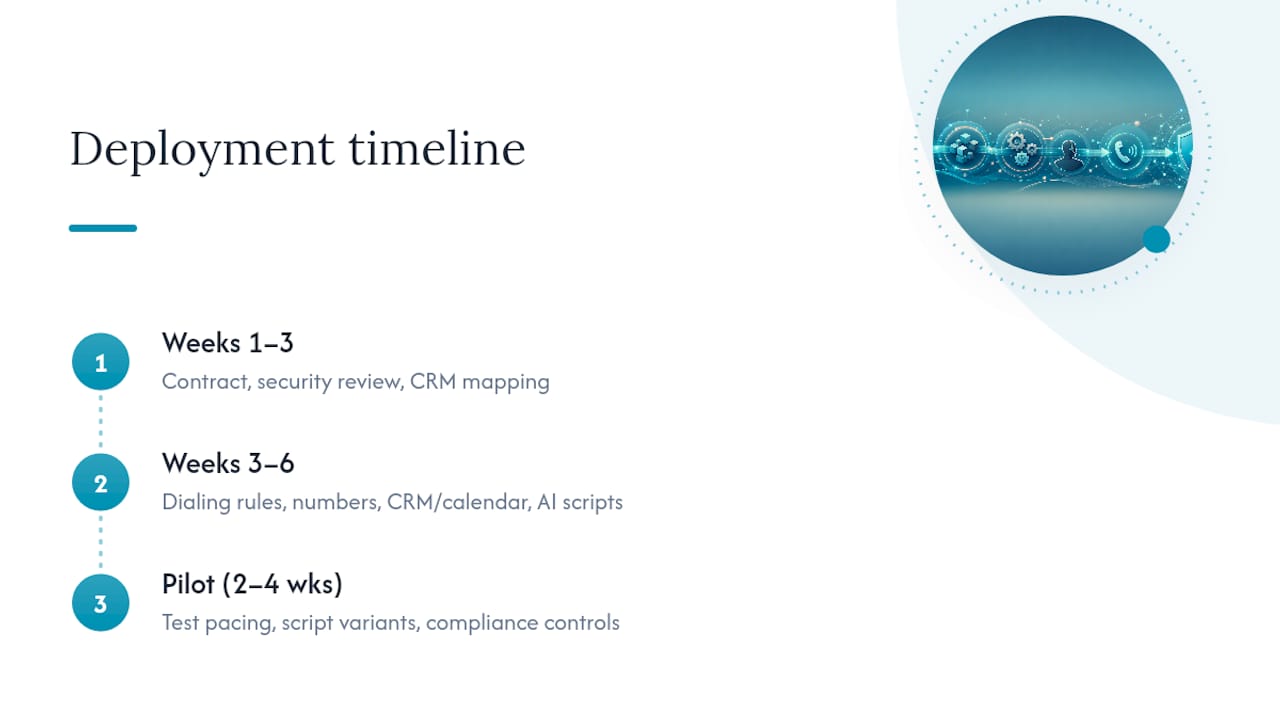
Deployment timeline can extend when infrastructure provisioning and security certification review are required compared to a standard cloud rollout. Organizations with complex legacy telephony or multiple regional compliance requirements also tend to run longer timelines, particularly when calling across jurisdictions with different consent and calling-window rules.
The fastest path to a working pilot comes from having list hygiene, consent documentation, and compliance sign-off ready before vendor selection even finishes, rather than treating those as parallel workstreams to sort out during implementation. Teams that start integration work with a messy CRM or undefined win-state criteria routinely add weeks to their own timeline through rework.
What Goes Wrong When Companies Adopt an AI Outbound Dialer?
The most common failure mode isn’t a technology problem. It’s a data problem that the technology exposes at scale.
Poor list hygiene is the single biggest risk. An AI outbound dialer will call a stale, unscrubbed list exactly as configured, which means every wrong number, opted-out contact, or duplicate record gets dialed at volume instead of caught by a human agent’s judgment. Fix this with mandatory list scrubbing and deduplication before any campaign launch, not as a periodic cleanup task.
Number reputation decay is the second major pitfall. Numbers that get flagged as spam-likely see answer rates collapse within days, and teams that scale dialing volume too fast without rotating and monitoring numbers often don’t notice until connect rates have already dropped significantly. Ongoing carrier and reputation monitoring, built into the operational routine rather than checked only when something breaks, prevents most of this damage.
Compliance blind spots cause the most expensive failures. Teams that treat consent and calling-window rules as a one-time setup task rather than an ongoing operational discipline often discover gaps only after a complaint or audit. Build compliance checks into the dialing workflow itself, not a separate policy document nobody references during daily operations.
Finally, over-automating the handoff frustrates customers. When an AI voice agent can’t recognize a request to speak with a human and keeps looping through scripted responses, it damages trust faster than a slower, more human-led process would. Clear, reliable hot-transfer triggers matter more than conversational polish.
How Do Leading AI Outbound Dialer Approaches Compare?
Rather than ranking specific vendors, it helps to understand the categories of approach available, since the right fit depends more on your use case than on any single feature list.
Entry-level cloud dialing platforms focus on ease of setup and self-serve pricing, typically offering predictive and power dialing with basic AI-assisted features like voicemail detection. These suit smaller sales teams testing outbound automation without a heavy integration lift.
Mid-market platforms with AI voice layers add natural language understanding and limited autonomous conversation handling on top of standard dialing modes, usually with solid CRM integrations for common platforms and moderate customization for script and compliance workflows.
Enterprise platforms with full deployment flexibility offer cloud, private cloud, and on-premise options, deeper governance and audit controls, custom AI voice agent development, and dedicated compliance tooling built for regulated industries like insurance, healthcare, and financial services. This tier typically involves custom contracts rather than published pricing and suits organizations where data governance requirements or call volume justify the added complexity.
The category distinction that matters most for evaluation is deployment flexibility paired with governance depth. A platform built primarily for small-team self-serve use rarely scales cleanly into the audit, security, and multi-region compliance requirements that enterprise collections or regulated sales operations need.
How Should Sales and Support Teams Train for an AI Outbound Dialer?
Rolling out new dialing technology fails more often on adoption than on engineering. Teams that skip structured training end up with agents who distrust the system’s handoffs or revert to old manual workflows the moment volume gets uncomfortable.
Start training before the pilot goes live, not after. Agents need to understand what triggers an AI-to-human handoff, what context they’ll see when a call transfers to them, and how to read the transcript and intent signals the system surfaces. Run practice sessions using recorded pilot calls rather than live customer interactions, so agents build comfort with the handoff flow before it affects a real prospect.
Change management works best when agents see the system as reducing tedious dialing work rather than replacing their judgment. Framing matters here: an AI outbound dialer handles volume and qualification so agents spend more time on conversations that are already warm, not fewer conversations overall. Supervisors should track early adoption friction closely, specifically where agents override or ignore handoff signals, since that pattern usually points to a trust gap in how the handoff context gets presented.
Ongoing coaching should draw directly from transcript-driven insights the dialer generates. Weekly review of where AI conversations succeeded or stalled, paired with script or handoff-rule adjustments, keeps both the technology and the team improving together rather than treating training as a one-time launch event.
Voiceracx Perspective: Enterprise Deployment Considerations and Proof Points
Enterprise procurement teams evaluating an AI outbound dialer rarely stop at feature comparisons. Data governance, auditability, and deployment flexibility usually decide the shortlist before conversation quality even enters the discussion, because regulated industries can’t accept a platform that locks their call data into a single public cloud environment with no visibility into processing. Private cloud and on-premise deployment options exist specifically to satisfy that requirement, letting security teams control data residency and audit trails to their own standard rather than a vendor’s default.
The Vee Lite insurance lead conversion case study illustrates what this looks like in a regulated vertical, where conversion lift mattered as much as the compliance controls that made the deployment approvable in the first place.
In practice, enterprise orchestration means the dialer, the CRM, and the agent desktop all share state in real time, so a disposition logged on a call updates the record everywhere at once. Procurement checklists should confirm data residency options, integration depth with existing CRM and telephony infrastructure, and role-based access controls before any pilot begins, since retrofitting governance after deployment costs far more than building it in from the start.
— Voiceracx
How VOICERAcx Can Help You Deploy an AI Outbound Dialer
Voiceracx built its AI outbound dialer, Vee Dialer, specifically for the enterprise procurement checklist above: cloud, private cloud, or on-premise deployment, native CRM and telephony integration, and governance controls that satisfy regulated-industry audit requirements rather than a generic feature list retrofitted for compliance later.
A pilot typically scopes a defined contact list, a target KPI set, and a two-to-four-week measurement window against your existing baseline. That mirrors the pilot structure any serious AI outbound dialer program should run, but with enterprise governance built into the deployment from the first call rather than bolted on after volume ramps.
To schedule a demo, bring your current connect and conversion baselines, a sample of your CRM’s contact schema, and a clear picture of your compliance requirements by jurisdiction. Voiceracx’s AI voice agent platform and contact center automation tools integrate directly with the dialer, so procurement teams evaluating a broader omnichannel rollout can scope both in a single conversation. Visit the Vee Dialer product page to request a pilot scope tailored to your call volume and compliance profile.
Sources
Review the TCPA regulatory text and platform policies like Google’s terms of service directly with legal counsel before finalizing any compliance framework for your deployment.
This article is general information, not a substitute for advice from a qualified lawyer. Consult a qualified legal professional about your own circumstances before acting on anything here.
- Telephone Consumer Protection Act of 1991 (Federal Register)
- Google Privacy Policy
- Brevo privacy policy