Pilot in 90 Days: AI Lead Qualification for Regulated RevOps
RevOps playbook: pilot AI lead qualification in 90 days for regulated teams. Prioritize chat agents, CRM writebacks, and compliant handoffs.

AI lead qualification uses conversational agents, real-time enrichment, and multi-signal scoring to qualify and route leads within seconds of first contact. The technology’s payoff is speed and consistency: reps get CRM-ready context instead of a raw name and email, and every lead gets the same evaluation logic regardless of when it arrives. It fits best for organizations with high inbound volume or multichannel intake, where manual triage creates bottlenecks and inconsistent prioritization.
TL;DR:
- AI lead qualification updates scores in real time using multiple signals, improving accuracy and providing reason codes for better transparency to sales reps.
- Building a successful program requires starting with conversational qualification, real-time enrichment, and attachable reason codes before progressing to CRM integration and SLA monitoring.
- A typical qualification chatbot can classify leads into hot, warm, or cold within 30 to 60 seconds based on intent, fit, timeline, and contact preferences.
- Proper data quality, regular model retraining, and clear SLAs are essential to prevent scoring inaccuracies, drift, and misrouted high-value leads.
- Deploying across multiple channels guarantees consistent qualification logic and reason codes, especially in regulated industries requiring strict governance.
What Is AI Lead Qualification, and How Does It Differ From Rule-Based Scoring?
AI lead qualification combines four components: a conversational agent that asks qualifying questions, enrichment that fills in missing firmographic or contact data, a scoring model that ranks fit and intent, and routing logic that sends the lead to the right rep or queue. Traditional MQL scoring assigns static points to form fields, updated in batches, often overnight. AI-driven scoring works differently:
- It updates in real time as new signals arrive, rather than waiting for a nightly batch job.
- It weighs multiple signal types together, including behavioral, firmographic, and intent data, instead of a single point-per-field formula.
- It can attach reason codes to a score, so a rep sees why a lead is hot, not just a number.
Salesforce’s Einstein lead scoring illustrates this shift well: scores update promptly as new interactions occur and integrate directly into existing sales workflows, rather than sitting in a separate report a rep has to check manually.
Which Capabilities Should You Prioritize First?
Not every capability delivers equal return in the first 90 days. Build in this order:
- Conversational qualification that adapts its next question based on the previous answer, rather than firing a static form.
- Real-time enrichment to complete missing company size, industry, or role data the moment a lead engages.
- Fit and intent scoring with reason codes attached, so a rep understands the score without digging into a model.
- CRM write-backs and routing rules, including calendar or auto-booking for hot leads.
- SLA monitoring and alerting, flagging any hot lead that goes uncontacted past its threshold.
HubSpot’s documentation on building AI lead scores notes that initial evaluation can take up to an hour once a scoring model is created, a detail worth planning around if you’re demoing capability to stakeholders on a tight timeline.
Pro Tip: Build the reason-code layer before you build the scoring model. Reps trust a score they can explain to a prospect far more than a number handed down from a black box.
What Does a Fast Lead Qualification Workflow Look Like?
A well-built qualification chatbot or voice agent can qualify a lead in 30 to 60 seconds using a four-turn question stack:
- Intent — What brought you here today? (Branches to product interest or support routing.)
- Fit — Company size, industry, or role, pulled from enrichment where possible to skip redundant questions.
- Timeline — When are you looking to solve this? (Immediate, this quarter, exploratory.)
- Contact — Best way and time to reach you.
Implementation guides for lead qualification chatbots recommend this exact four-field minimum because it maps cleanly onto banding logic without over-questioning a prospect who might abandon a long form.
The resulting bands and next steps typically look like this:
- Hot: confirmed budget or urgent timeline, immediate rep alert and calendar booking offered.
- Warm: fit confirmed but timeline vague, added to a nurture sequence with a scheduled follow-up call.
- Cold: no fit or no budget signal, routed to a low-touch newsletter or resource track.
Voice and chat behave differently here. Voice agents need shorter question phrasing and tolerance for interruptions; chat can display multiple-choice options that speed up the fit and timeline turns considerably.
How Do You Implement AI Lead Qualification Step by Step?
A pilot rollout succeeds or fails based on groundwork, not the model itself. Work through this checklist before go-live:
- Map every CRM field the qualification flow needs to write back to, and define a fallback for missing enrichment data.
- Start with rule-based scoring for low lead volume; migrate to a machine learning model only once you have enough closed-won and closed-lost examples to train against, then retrain on a regular cadence, monthly is a reasonable starting point.
- Connect the agent to your calendar or booking API and CRM webhooks so hot leads route in real time, not on a delay.
- Set explicit SLA commitments, for example, contact hot leads within one hour, and build alerting for anything that breaches it.
- Define your KPIs up front: time-to-contact, conversion rate by score band, and closed-won rate. Run a cohort or A/B test comparing AI-qualified leads against your existing process.
ZoomInfo’s research on automated lead qualification found that manual qualification typically takes a rep 15 to 30 minutes of research per lead, a task automated enrichment and scoring compress to under 60 seconds. That gap is where most of the ROI case gets made, and it’s worth quantifying against your own team’s current per-lead time before you pitch the pilot internally.
Which Signals Actually Predict a Good Lead?
Not all data carries equal predictive weight. Four categories matter most:
- Firmographic: company size, industry, and revenue band, useful for confirming ICP fit before intent even enters the picture.
- Behavioral: page visits, email opens, content downloads, showing engagement depth over time.
- Intent: search behavior, competitor research, or explicit statements made during a conversational flow.
- Relational: product usage, billing history, and support ticket patterns, most useful for expansion or renewal scoring rather than net-new leads.
Most CRM-native predictive models work from a single flattened table and perform well for straightforward fit scoring. Relational models that join CRM, product usage, billing, and support data across multiple tables can surface subtler signals, such as a colleague at a target account already engaging with your product, something a flat model typically misses entirely. The trade-off is complexity: relational models need more data infrastructure to maintain. Combining hard rules (industry, deal size floor) with a machine learning score for ranking within that qualified pool tends to give you both explainability and lift.
What Goes Wrong, and How Do You Prevent It?
Four failure modes account for most stalled AI qualification programs:
- Data quality gaps silently degrade scoring accuracy; build enrichment fallbacks and monitor fill rates weekly.
- Model drift happens as your ideal customer profile shifts; schedule retraining and periodic drift checks rather than treating the model as “set and forget.”
- SLA mismatch occurs when a hot lead sits unrouted because a human review gate wasn’t built for high-value accounts; keep that gate, but pair it with a strict response-time commitment.
- Compliance gaps arise when qualification data isn’t tied to consent management, particularly for outbound follow-up.
Pro Tip: Keep a replayable audit log of every scoring decision. When a deal review asks “why was this lead marked cold,” you want an answer in seconds, not a shrug.
How Do Enterprise Teams Deploy This Across Channels?
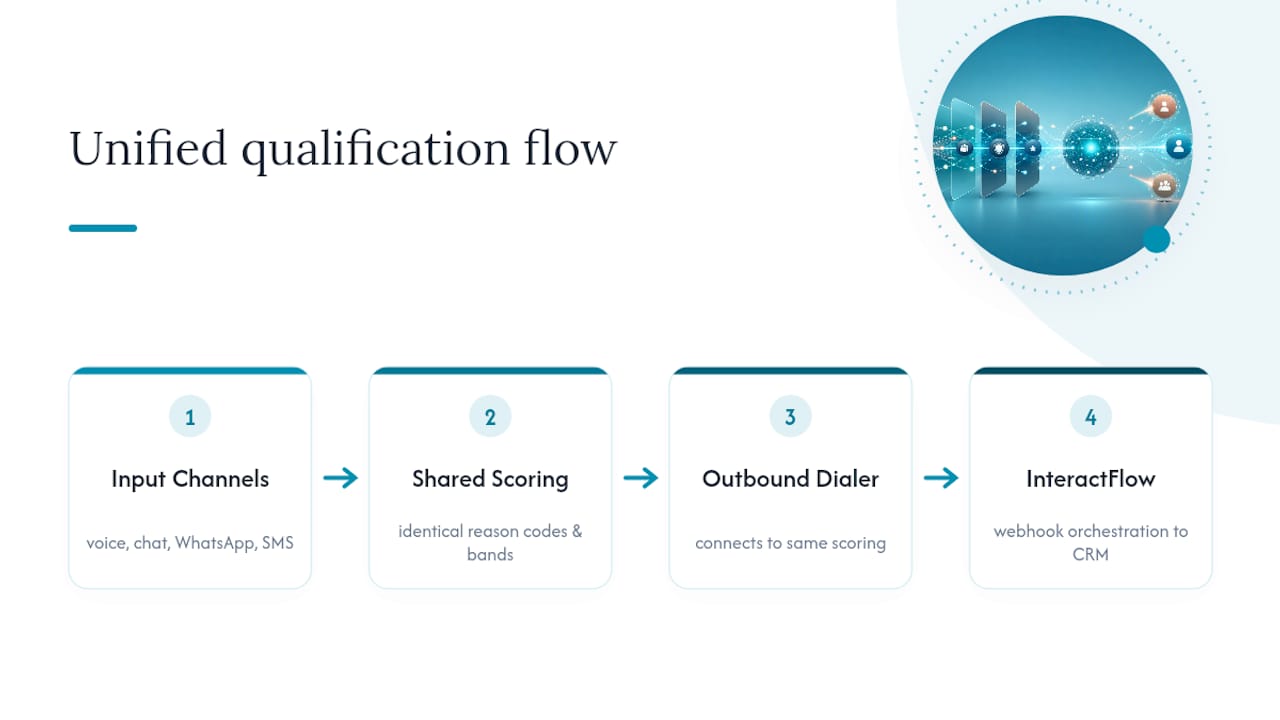
Omnichannel qualification means the same scoring logic and reason codes apply whether a lead arrives by voice, WhatsApp, SMS, web chat, or email, so a rep sees one consistent history rather than fragmented threads across systems.
- Voice and chat agents can share the same underlying qualification logic, keeping banding consistent regardless of channel.
- Regulated industries, financial services, healthcare, insurance, often require private cloud or on-premise deployment for governance over where qualification data routes and logs.
- An AI maturity assessment is a practical starting point for teams unsure which capabilities to pilot first, particularly where data control requirements shape the deployment model from day one.
When Should You Pilot vs. Scale?
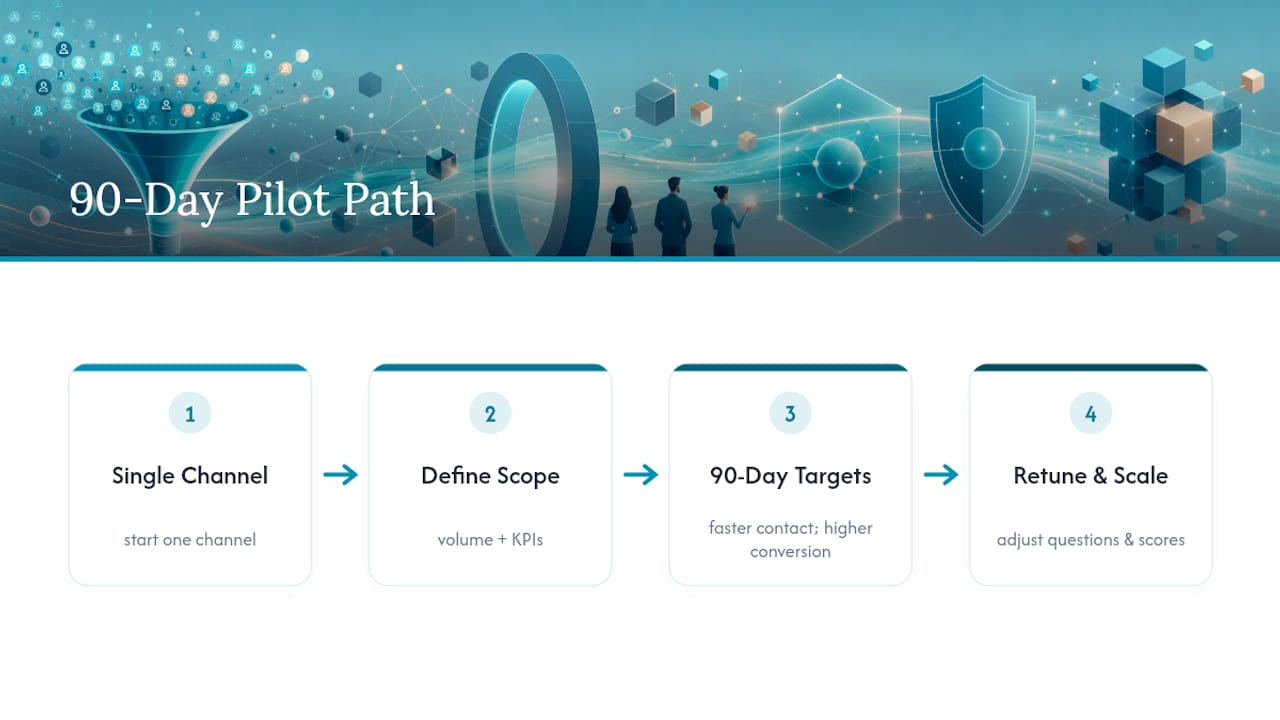
Start with one channel, a defined lead volume, and a fixed KPI set, not a company-wide rollout. Target measurable gains in 90 days: shorter time-to-contact and higher conversion in the hot band. Use pilot feedback to retune your questions and score thresholds before expanding.
Ready to Pilot AI Lead Qualification?
This AI platform is built for teams that need conversational qualification to work consistently across voice, chat, WhatsApp, and SMS, without sacrificing the governance regulated industries require. Where a standalone chatbot tool only covers one channel, Voiceracx’s AI voice agents and chat agents share the same scoring and routing logic, so a lead qualified over the phone and one qualified in web chat land in your CRM with identical reason codes and priority bands. For teams that also need outbound follow-up on warm and cold bands, the AI outbound dialer connects directly to that same scoring output, and InteractFlow handles the webhook orchestration between your qualification flow and downstream CRM actions. Deployment options can include cloud, private cloud, and on-premise setups to address data residency or compliance requirements. Start with a scoped pilot to map current qualification questions onto a working conversational flow.
Sources
For technical teams building or extending a qualification flow, HubSpot’s AI lead scoring documentation covers setup steps and evaluation timing, while the lead-intelligence-bot project on GitHub demonstrates adaptive question logic and webhook-based CRM routing in working code. For conversion tracking once scoring is live, see this guide to conversion rate optimization.
- Salesforce Einstein lead scoring datasheet
- Build lead scores with AI — HubSpot Knowledge
- What Is Automated Lead Qualification? — ZoomInfo Pipeline
FAQ
What Is AI Lead Qualification?
It’s the use of conversational agents, enrichment, and scoring models to evaluate a lead’s fit and intent automatically, then route it to the right rep or queue in real time instead of through manual review.
How Do You Use AI for Lead Qualification?
Deploy a conversational agent to ask a short adaptive question stack, feed the answers plus enrichment data into a scoring model, then connect that score to CRM routing rules and calendar booking so hot leads get contacted immediately.
What Is the 30% Rule in AI Lead Scoring?
There’s no established “30% rule” specific to AI lead qualification; if you’ve seen this referenced, it likely refers to a general data completeness or model confidence threshold used internally by a specific vendor rather than an industry standard.
Are AI-Qualified Leads Worth It?
Automated enrichment, scoring, and routing can compress the 15 to 30 minutes of manual research a rep typically spends per lead into under a minute, which usually translates into faster contact times and more consistent prioritization, provided the underlying data quality and scoring rules are maintained.